



Thailand and Cambodia will resume formal discussions this week to try to halt their latest border conflict, following crisis talks in Malaysia, as fighting displaces hundreds of thousands and raises fresh concerns for regional stability in mainland Southeast Asia.
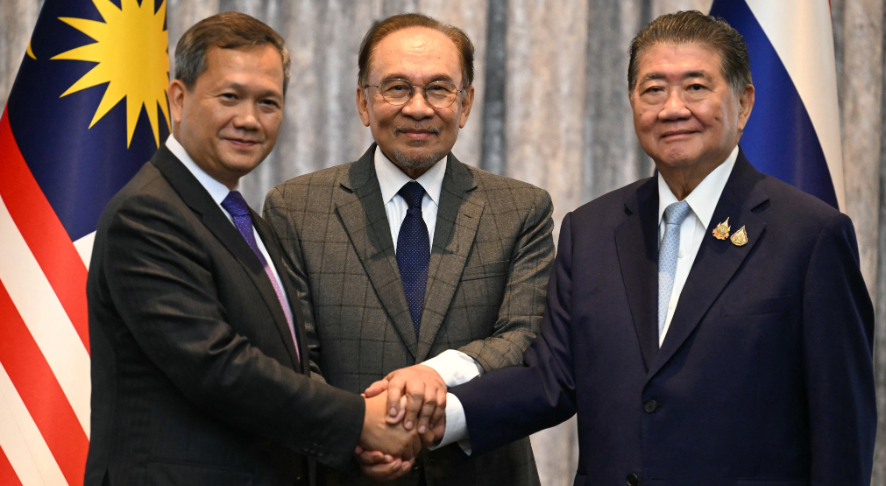
Thailand and Cambodia have agreed to hold further discussions on Christmas Eve this week aimed at ending their escalating border conflict, according to Thai Foreign Minister Sihasak Phuangketkeow, following crisis talks hosted in Kuala Lumpur. The discussions will take place under the framework of the Joint Boundary Committee, a long-established bilateral mechanism intended to address disputes along the two countries’ shared frontier.
Speaking to reporters in the Malaysian capital, Sihasak said the meeting had been proposed by the Cambodian side and was scheduled for December 24. While welcoming renewed dialogue, he struck a cautious tone on the prospects for an immediate ceasefire, stressing that any halt to fighting must be demonstrated on the ground rather than declared rhetorically.
“Our position is a ceasefire does not come with an announcement but must come from actions,” he said.
The agreement to resume talks comes amid one of the most serious flare-ups between the two neighbours in more than a decade. Fighting along contested stretches of the roughly 800-kilometre border has intensified since early December, with artillery exchanges, rocket fire, and air operations reported on both sides. The violence has killed dozens, injured many more, and triggered a humanitarian crisis affecting communities in northeastern Thailand and northwestern Cambodia.
According to Cambodian authorities, more than 500,000 people have been displaced from their homes as clashes spread across border provinces, forcing families to flee to temporary shelters, schools, and religious buildings. Thai officials have also confirmed large-scale evacuations on their side of the border, with tens of thousands moved away from frontline areas as a precaution against further attacks.

THE BACKGROUND
The current conflict is the latest chapter in a long-running territorial dispute rooted in colonial-era mapping and unresolved boundary demarcation. Tensions between Thailand and Cambodia have periodically erupted since the mid-20th century, most notably around the area surrounding the Preah Vihear temple complex. Although the International Court of Justice ruled in 1962 that the temple itself belonged to Cambodia, disagreement over the surrounding land has continued to fuel nationalist sentiment and military stand-offs.
More recently, the dispute appeared to ease following a ceasefire agreement reached in mid-2025, brokered with Malaysia’s involvement and welcomed by regional partners. That truce, however, proved fragile. Both sides accuse the other of violating its terms, and it ultimately collapsed earlier this month after a series of incidents along the frontier, including injuries to soldiers and renewed troop movements.
Since then, the conflict has escalated rapidly. Reports from the border describe the use of heavy weapons and military aircraft, raising alarm among neighbouring countries and within the Association of Southeast Asian Nations. Landmine incidents, particularly sensitive given Cambodia’s history with unexploded ordnance, have further inflamed tensions and heightened civilian fears.
MALAYSIAN MEDIATION
Malaysia, which currently plays a leading diplomatic role within ASEAN, has stepped forward as a mediator. Prime Minister Anwar Ibrahim has held direct conversations with leaders in Bangkok and Phnom Penh, urging restraint and a return to dialogue. Kuala Lumpur has also supported calls for an ASEAN-led monitoring mechanism to help verify any ceasefire and reduce the risk of miscalculation.
Regional and international actors have echoed these concerns. The United Nations, the United States, and the European Union have all called for an immediate end to hostilities, warning that continued fighting risks destabilising a region that has largely avoided interstate conflict in recent decades. For ASEAN, the crisis presents a significant test of its ability to manage disputes among member states through consensus and quiet diplomacy.
Despite the diplomatic push, deep mistrust remains. Thailand has insisted that negotiations must address security guarantees and verification mechanisms before any ceasefire can be considered durable. Cambodia, meanwhile, has publicly stated its readiness for an unconditional ceasefire, while also accusing Thai forces of violating Cambodian territory. These competing narratives underline the difficulty of translating talks into tangible de-escalation.
EXPECTATIONS VS OUTCOME?
Analysts say the Joint Boundary Committee meeting will be an important signal of intent but caution that progress is likely to be incremental. The JBC has existed for years and has produced technical discussions on mapping and demarcation, yet it has often struggled to resolve politically charged issues during periods of heightened tension. Success this time, observers note, will depend on whether both sides are prepared to pair diplomacy with meaningful restraint on the ground.
Beyond the immediate security concerns, the conflict has placed significant strain on border communities whose livelihoods depend on cross-border trade, agriculture, and tourism. Markets have closed, transport routes have been disrupted, and schools remain shut in several affected districts. Humanitarian groups warn that prolonged displacement could worsen health and education outcomes, particularly for children.
As talks resume on December 24, expectations remain cautious. While both governments have publicly committed to dialogue, the gap between diplomatic language and battlefield realities remains wide. For many civilians caught in the middle, the priority is less about formal statements and more about a sustained reduction in violence that allows them to return home safely.
Whether the renewed discussions can deliver that outcome will be closely watched across Southeast Asia. The stakes extend beyond the immediate border areas, touching on regional stability, ASEAN credibility, and the enduring challenge of resolving historical disputes in a rapidly changing geopolitical environment.
Sources: AFP, regional media reports, ASEAN statements