


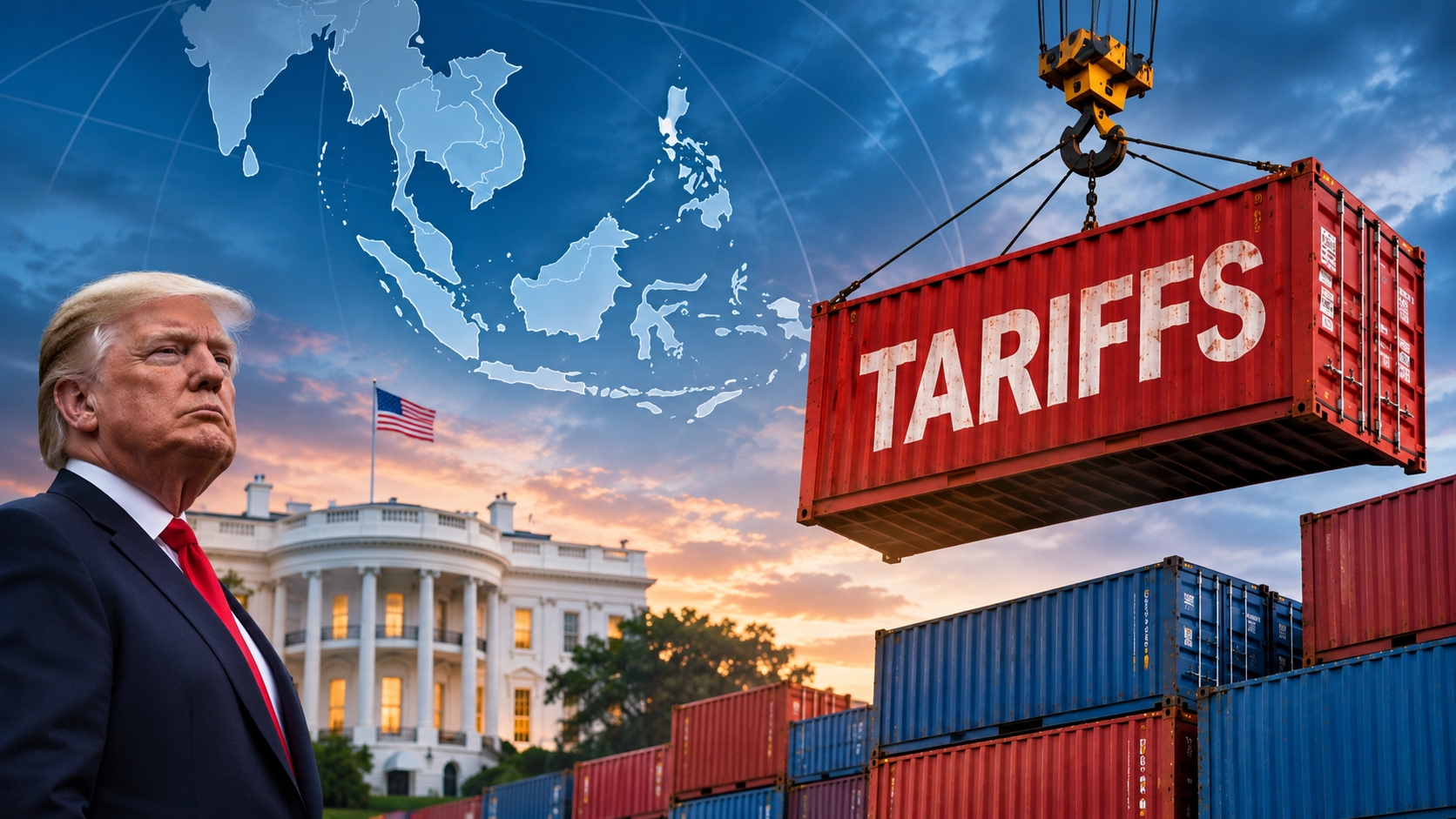
Washington is proposing fresh duties on 14 major trading partners over alleged excess manufacturing capacity. Malaysia is among those targeted, but with the November midterm elections delivering a decisive rebuke to Donald Trump, the US president may find his increasingly unpredictable trade policy facing rather more scrutiny.
If there is one thing businesses around the world have learned during Donald Trump’s chaotic second presidency, it is that planning ahead has become considerably more difficult. One week brings the promise of a trade agreement; the next, a fresh tariff threat. Countries that have negotiated concessions with Washington can find themselves back in the firing line, while manufacturers and exporters are left wondering what the rules will be by the time their next shipment reaches its destination.
The latest example arrived on November 25, when the US Trade Representative (USTR) announced proposed tariffs on 14 major trading partners, including Malaysia, Singapore, Thailand, Indonesia, Vietnam, Japan, South Korea, China, India, and the European Union. The administration says these economies have policies that contribute to structural excess manufacturing capacity, allowing goods to be produced in quantities that distort international markets and disadvantage American manufacturers.
Proposed rates vary considerably, from 15 per cent for Japan and South Korea to as much as 35% for Vietnam. China’s proposed rate is 20%, while Singapore also faces up to 20%. Meanwhile, Malaysia, Indonesia, and Thailand are among the Southeast Asian economies facing proposed rates of up to 18%.
These are not tariffs that take effect immediately. The USTR’s determinations follow investigations initiated in March, and the proposed measures must go through further consultation. Written comments are due by January 5, 2027, with public hearings scheduled for January 25. Final decisions are expected in the first quarter of next year.
MALAYSIA’S POSITION: AVOIDING ANOTHER TRADE SETBACK
For Malaysia, the announcement is an unwelcome development, particularly after considerable effort was put into negotiating an Agreement on Reciprocal Trade (ART) with Washington. Malaysia was among the first countries to sign such an agreement, and the government is understandably keen to preserve the terms it negotiated.
The Ministry of Investment, Trade and Industry (MITI) has stressed that the proposed tariff figures are indicative rather than final. While the USTR has proposed duties of up to 18% under its excess-capacity investigation, the ministry says Washington has communicated a broader indicative range of 18 to 25%. MITI will continue negotiations with the US to ensure Malaysia’s overall tariff rate under Section 301 does not exceed 19%.
There is an important distinction here. MITI says the only tariff currently in effect against Malaysia under the relevant Section 301 investigations is the 10% duty imposed on July 24, 2026, in connection with forced-labour concerns. The proposed excess-capacity measures have not yet been finalized.
Malaysia has also rejected Washington’s assessment that its manufacturing sectors contribute to global excess capacity in a way that distorts international markets. Nevertheless, MITI says it will review goods imported from third countries to ensure that Malaysia is not inadvertently contributing to the problem.
The stakes are considerable. The United States remains one of Malaysia’s most important export markets, with bilateral goods trade totalling an estimated US$88.2 billion in 2025. Malaysian exports to the US reached US$59.5 billion, led by electrical and electronic products, machinery, medical equipment, and other manufactured goods.
Any additional duties could affect manufacturers’ competitiveness, investment decisions, and supply-chain arrangements. Even the uncertainty surrounding the proposed rates can be damaging, as businesses hesitate to commit to new orders or long-term investment while waiting to see what Washington eventually decides.
ASIA PUSHES BACK
Malaysia is far from alone in questioning the US findings. Singapore has expressed disappointment, arguing that its outward-oriented economy does not protect domestic markets or subsidize manufacturing for export. Japan has described the proposed measures as regrettable, while China has accused Washington of using excess-capacity concerns as a pretext for protectionism and warned that it reserves the right to take necessary measures.
Elsewhere in the region, governments are taking a more conciliatory approach. Vietnam is seeking to finalize a trade agreement with Washington, potentially reducing its proposed tariff rate from 35 to 20%. Thailand is hoping to secure a rate below its proposed 18 per cent ceiling, while Indonesia is reviewing the implications with affected industries.
The underlying dispute is not entirely without merit. Governments around the world do use subsidies, incentives, and industrial policies to encourage domestic production, sometimes creating overcapacity and putting pressure on international competitors. However, applying broad tariffs across entire economies is a blunt response to what are often highly specific industrial issues.
It is also worth remembering who actually pays these duties. Despite Trump’s repeated assertions that foreign countries pay his tariffs, the tax is collected from the US importer when goods enter the country. Importers may absorb some of the cost, negotiate lower prices with overseas suppliers, or pass the additional expense on to American businesses and consumers. In practice, tariffs can therefore increase domestic prices, disrupt supply chains, and make manufacturers reliant on imported components less competitive.
It is unfortunate that Trump still seems not quite to understand this basic economic reality. Tariffs can serve a legitimate purpose in addressing unfair trade practices, but using them as a negotiating tactic – or, worse, an economic weapon – creates uncertainty and can ultimately hurt the very businesses and consumers they are supposedly intended to protect.
A NEW CONGRESS, AND HOPEFULLY SOME RESTRAINT
There may, however, be a political development that offers some reason for optimism. The November 3 midterm elections delivered a sweeping, unmistakable rebuke to Trump and the Republican Party, with Democrats winning solid control of both the House of Representatives and the US Senate. The results reflected widespread frustration over living costs, inflation, the administration’s erratic policies, and serious concerns about its conduct.
The new Congress takes office on January 3, 2027, and its Democratic majorities should provide considerably greater oversight of the administration. Congressional committees will have more scope to investigate policy decisions, scrutinize government spending, and challenge executive actions. While this does not mean Trump will suddenly lose the ability to pursue his agenda, it does introduce a more substantial set of political checks than he has faced during the current Congress.
There is also a significant legal backdrop to the latest tariff proposals. In February, the US Supreme Court ruled that the International Emergency Economic Powers Act did not give the president authority to impose tariffs, striking down the legal basis for much of Trump’s earlier sweeping tariff programme. The administration has since turned to other legislation, including Section 301 of the Trade Act of 1974, which allows action against foreign practices deemed unfair to US commerce. The latest proposals are part of that effort.
For Malaysia, the immediate priority is to keep negotiations moving and secure the most favourable terms possible. The government will need to protect exporters while maintaining the country’s attractiveness as a manufacturing and investment destination. That is no easy task when the goalposts in Washington seem to move with such regularity.
International trade depends on predictability, mutual confidence, and rules that businesses can understand and plan around. Tariffs may make for dramatic political announcements, but they are a poor substitute for sound economic policy. With a new Congress preparing to take office, one can only hope that a little more scrutiny, restraint, and common sense will return to America’s approach to international trade.
Sources: Channel NewsAsia; Reuters; Associated Press; US Trade Representative; Malaysia Ministry of Investment, Trade and Industry; The Star; US Supreme Court; Council on Foreign Relations.