


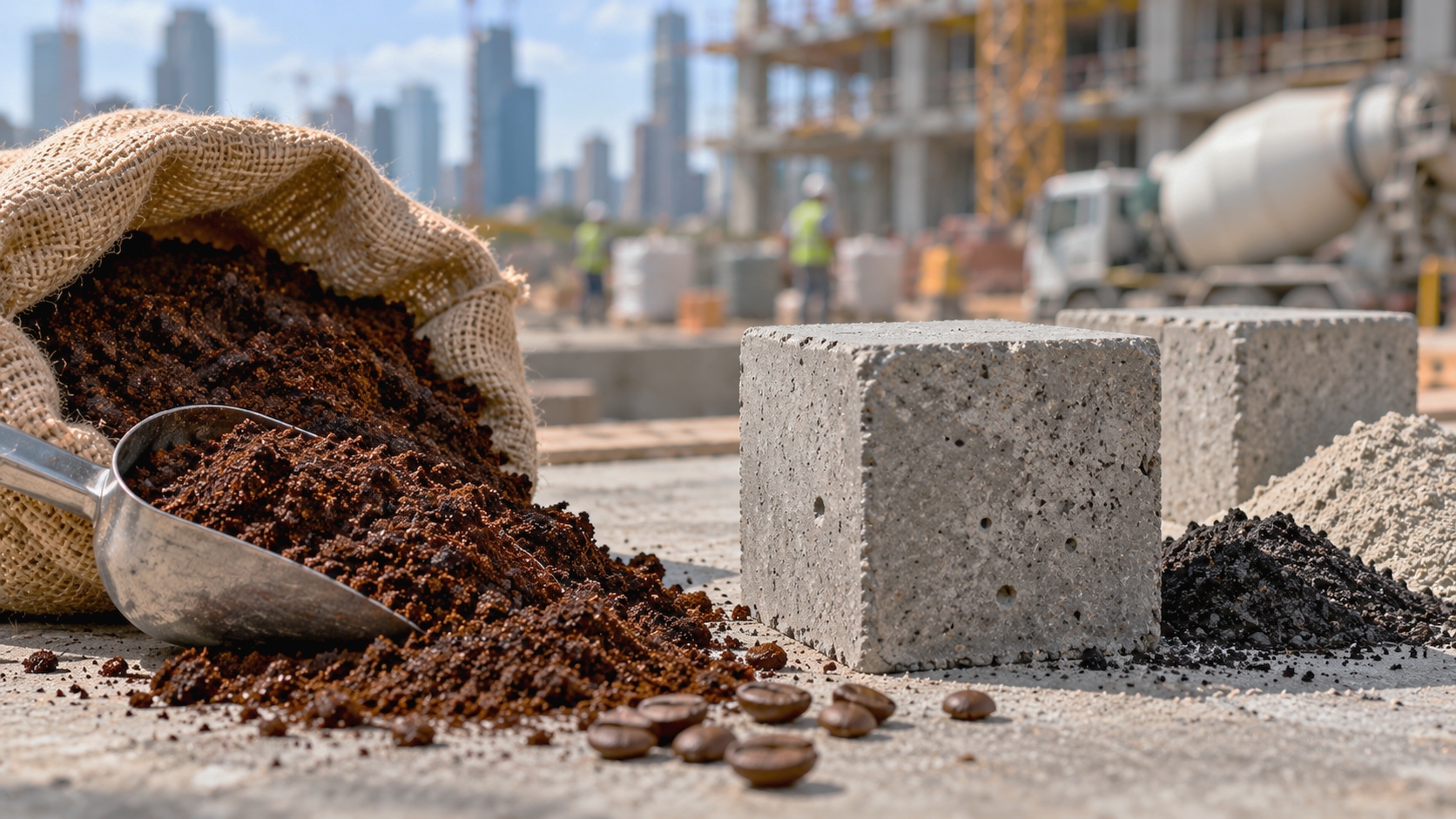
Researchers at RMIT University have found that spent coffee grounds can be transformed into biochar that makes concrete significantly stronger while reducing demand for natural sand. The idea has now moved beyond the laboratory, although some important questions remain.
There are plenty of things you can do with used coffee grounds. Compost them. Put them in the garden. Attempt to make some dubious homemade beauty treatment. Or, apparently, turn them into stronger concrete.
That last option sounds rather like the setup for a joke, but researchers at Melbourne’s RMIT University have demonstrated that waste coffee grounds can be processed into a charcoal-like material that can improve the strength of concrete by almost 30 percent.
The finding comes with an appealing environmental double act. It offers a potential use for enormous quantities of spent coffee grounds that would otherwise become waste, while also reducing the amount of natural sand required to produce concrete.
The original research, published in the Journal of Cleaner Production in 2023, found that replacing 15 percent of the sand in a concrete mix with coffee-ground biochar produced at 350°C increased compressive strength by 29.3 percent compared with conventional concrete.
That is not just a meaningful increase, but an unusually specific result – one that’s worth a closer look.
FROM COFFEE GROUNDS TO BIOCHAR
The researchers could not simply shovel wet coffee grounds into a concrete mixer. Spent coffee grounds contain organic compounds that can interfere with cement hydration, weakening the resulting concrete. The solution was to subject the grounds to pyrolysis – heating them in the absence of oxygen – at 350°C.
Without oxygen, the coffee grounds do not simply burn away. Instead, they are transformed into a porous, carbon-rich material known as biochar. The resulting material can then be used as a partial replacement for the fine aggregate, or sand, in concrete.
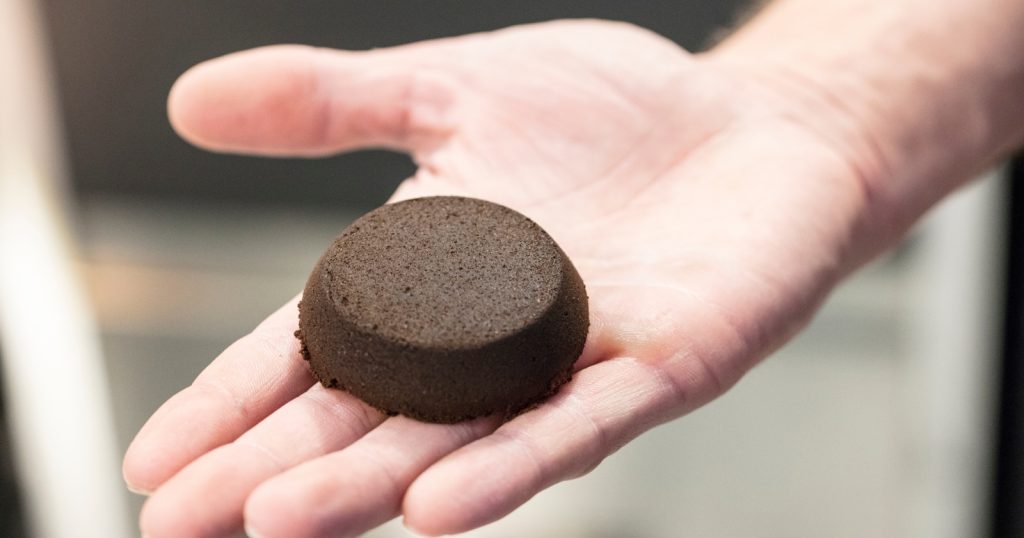
The researchers tested biochar produced at both 350°C and 500°C and experimented with replacing different proportions of sand. The standout result came from the 350°C material replacing 15 percent of the sand by volume, which produced the 29.3 percent improvement in compressive strength after 28 days. Interestingly, hotter was not better: the researchers found that biochar produced at 500°C performed less well, with microscopic analysis suggesting that the higher temperature produced a more porous, micro-cracked structure.
The scale of the waste problem is considerable. RMIT estimates that Australia produces around 75 million kilograms of spent coffee grounds annually, while the global figure is roughly 10 billion kilograms. Much of that material currently ends up in landfill.
There is another resource problem hiding in the concrete mixer, too.
WHY SAND REPLACEMENT IS KEY
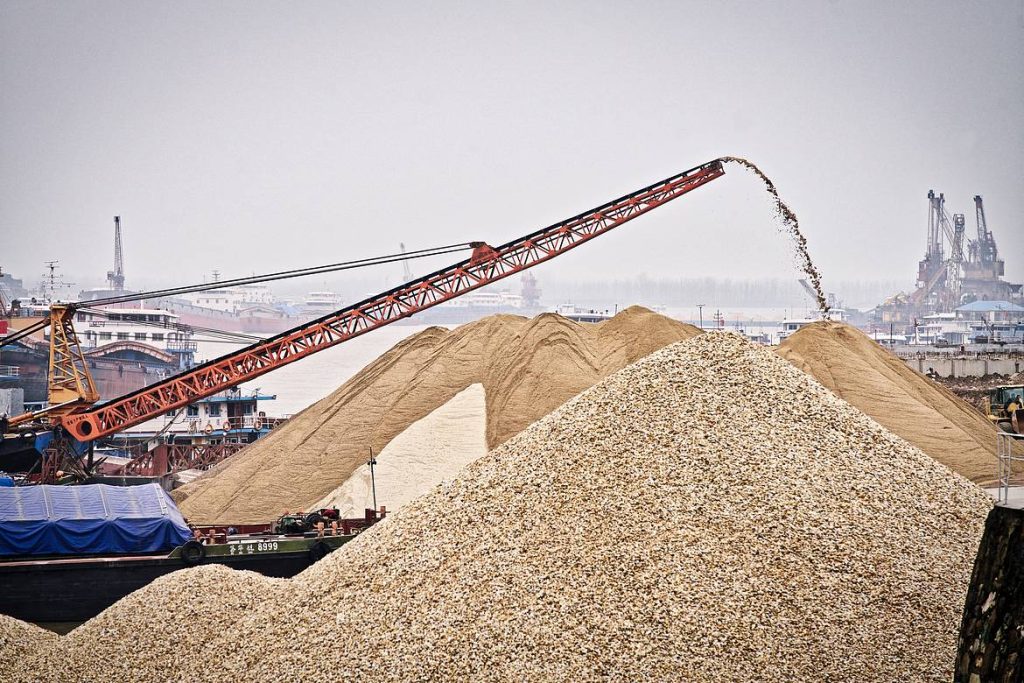
Sand seems like one of those resources that should be effectively limitless, but construction requires particular types of sand, and the industry’s enormous appetite has created growing environmental and supply concerns. RMIT says around 50 billion tonnes of natural sand are used in construction globally each year, with much of the material extracted from riverbeds and riverbanks.
Desert sand, despite being plentiful, generally does not make a straightforward substitute because its grains tend to be too smooth and rounded for many construction applications. That leaves pressure on more suitable natural sources.
Coffee biochar therefore offers an intriguing two-for-one proposition: divert a troublesome organic waste stream from landfill while replacing some of a finite construction resource.
And this is where the story gets more interesting than the original laboratory headline. RMIT has since moved the research into real-world applications. In 2024, the university worked with Macedon Ranges Shire Council on what it described as the world’s first coffee-concrete footpath trial in Gisborne, Victoria. The researchers have also subsequently examined the material in a major infrastructure project in Pakenham.
There is, however, an important wrinkle. The biochar used in the field work could not be produced at the laboratory’s optimal 350°C because of limitations with the commercial-scale production equipment. As a result, the concrete used in that particular trial achieved strength comparable to conventional concrete rather than reproducing the approximately 30 percent improvement seen in the laboratory. A 2025 field study nevertheless described the work as an important step toward translating the laboratory research into actual construction, while identifying the biochar supply chain as one of the obstacles that still needs to be overcome.
Meanwhile, a 2025 life-cycle assessment provided another encouraging piece of the puzzle. RMIT researchers reported reductions in life-cycle carbon dioxide emissions of 15 percent, 23 percent, and 26 percent when biochar replaced 5 percent, 10 percent, and 15 percent of the sand, respectively, along with reductions in fossil-fuel use.
A GOOD FIRST STEP, BUT MORE TO DO
None of this means coffee concrete is ready to replace conventional concrete in skyscrapers tomorrow morning. The original strength results were laboratory findings, and long-term durability is a different question. Engineers need to know how the material behaves over years of wetting and drying, changing temperatures, repeated loads, shrinkage, and other real-world stresses.
There are also practical questions around collecting, drying, processing, transporting, and consistently producing enormous quantities of coffee biochar at the required temperature.
But that is what makes the research so fascinating. The proposition is no longer simply that someone has discovered a clever use for coffee waste. Researchers have demonstrated a measurable performance benefit, identified a second resource problem that the technology could help address, conducted field trials, and begun assessing its full environmental footprint.
So the next time someone says they have had way too much coffee, there may eventually be a perfectly reasonable response: Keep the grounds. We have a sidewalk to build.
Sources: RMIT University; Journal of Cleaner Production; ScienceBlog.com