




A large UK study suggests that when it comes to the potential longevity benefits of walking, there may be more than one way to get there. Taking more steps helps, but picking up the pace could also make a meaningful difference.
If your fitness tracker has ever cheerfully informed you that you are 2,347 steps short of some arbitrary daily target, there is potentially good news: you may not need to spend the evening marching around the living room to make up the difference.
A new study published in the British Journal of Sports Medicine suggests that both the number of steps you take and how briskly you take them are associated with a lower risk of death from all causes and cardiovascular disease.
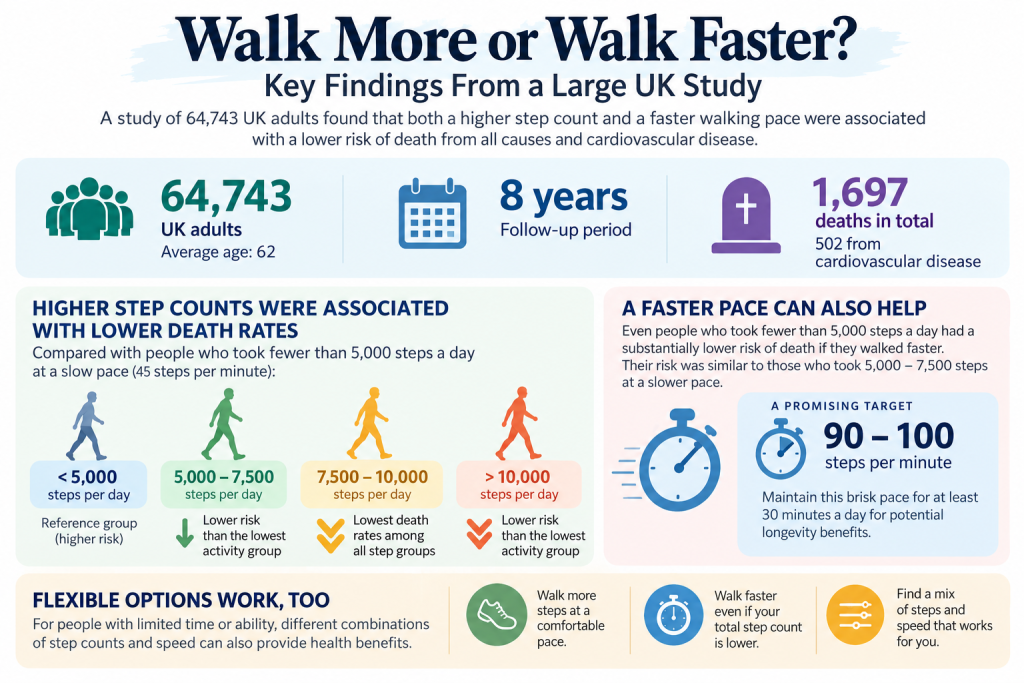
Researchers analyzed data from 64,743 UK adults with an average age of about 62 who had worn wrist-based activity trackers for seven days. The participants were subsequently followed for around eight years, during which 1,697 deaths were recorded, including 502 from cardiovascular disease.
Rather than simply counting steps, the researchers also looked at something they called “peak 30-minute cadence” – essentially the average number of steps per minute during each person’s 30 most active minutes of the day. Those 30 minutes did not have to be consecutive.
The participants were divided into four daily step-count groups: fewer than 5,000 steps, 5,000–7,500, 7,500–10,000, and more than 10,000.
SPEED CAN MAKE A DIFFERENCE
The results suggest that increasing the pace can be useful, particularly for people who struggle to accumulate large numbers of steps.
Among those taking fewer than 5,000 steps a day, a faster walking cadence was associated with a lower risk of death. At around 80 steps per minute, for example, the study found a hazard ratio of 0.72 compared with the lowest-activity reference group. The researchers also found beneficial associations among people taking 5,000–7,500 steps at relatively modest walking intensities.
The lowest overall mortality risk was observed among people taking 7,500–10,000 steps a day, with the most favourable association occurring at a cadence of approximately 100 steps per minute. Similar patterns were seen when the researchers looked specifically at cardiovascular mortality.
The findings therefore offer a little flexibility for people whose circumstances make a particular step target difficult. If you have limited time, increasing the intensity of the walking you already do may be one option; if walking quickly is difficult, accumulating more steps at a comfortable pace may be another.
That does not mean 80, 90, or 100 steps per minute is a magic prescription, nor does the study prove that walking faster directly causes people to live longer. This was an observational study, meaning it identified associations rather than establishing direct cause and effect. The researchers themselves note that different combinations of step count and intensity may offer useful approaches to physical activity.
For the rest of us, however, the message is quite simple and perfectly easy to understand: Keep walking. If you can, walk a little more. And when you have the opportunity, pick up the pace.
The study was published online September 8, 2026, in the British Journal of Sports Medicine.
Sources: British Journal of Sports Medicine, Harvard Health Publishing