


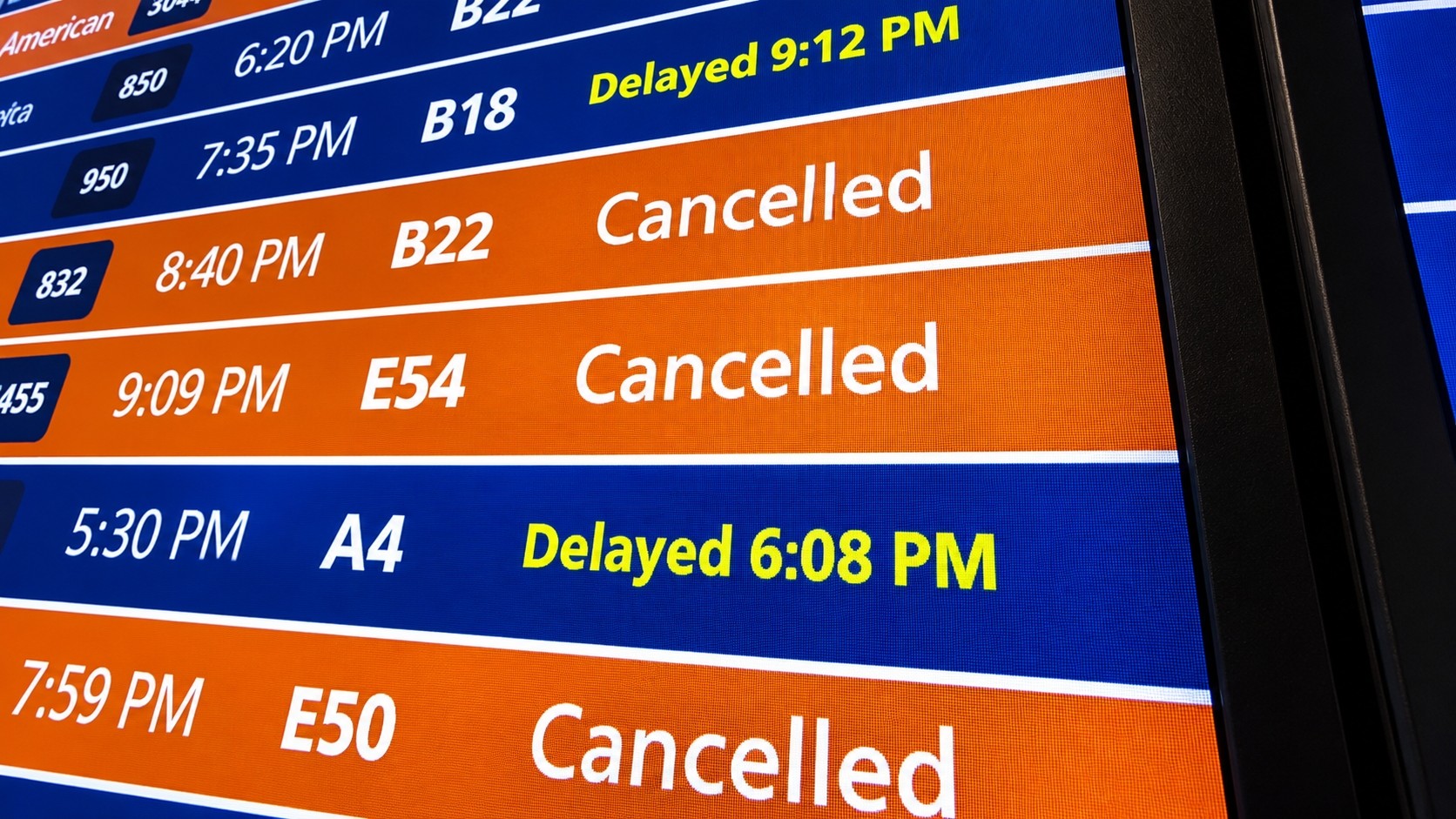
In the United States, a stunning nationwide FAA ground stop has disrupted thousands of flights after communications problems hit the country’s air traffic control network. The agency says its newly expanded AI traffic-management system is not responsible, but the timing has inevitably raised eyebrows.
UPDATE: The nationwide ground stop order was lifted at 8:15 p.m. Eastern Time (9:15 a.m. Saturday in Malaysia), according to CNN. Officials noted it would take time to clear the significant backlog of delayed flights, and airlines are currently scrambling to get flight operations back to normal.
Another day, another tech-related blockbuster news story.
Hot on the heels of the Nvidia Chinese spy scandal two days ago and the worldwide Microsoft outage yesterday, the United States experienced one of its most extraordinary aviation disruptions in decades early this morning (Saturday in Malaysia, and Friday, November 13 in the US), after the Federal Aviation Administration (FAA) ordered a nationwide ground stop, preventing departing aircraft from taking off at airports across the country.
The order followed a telecommunications failure affecting all 22 of the FAA’s Air Route Traffic Control Centers, the facilities responsible for managing aircraft travelling between airports. Issued at approximately 3:54 p.m. Eastern Time (that’s 4:54 a.m., Saturday, November 14, Malaysia Time), the directive cited “extraordinary circumstances and for reasons of safety,” with the agency instructing airlines to keep departing traffic on the ground until further notice.
Aircraft already airborne were allowed to continue to their destinations and land safely. The FAA said all flights had been accounted for, while inbound international services and certain departures were assessed individually.
The scale of the disruption was massive, with chaos spreading quickly across the country’s aviation system. By Friday evening, FlightAware was reporting more than 1,000 cancellations and nearly 10,000 delays, with the figures continuing to rise. At least 600 aircraft had been diverted, according to aviation analytics company Cirium. Many thousands of passengers were left stranded at major airports, while airlines struggled to determine when normal operations might resume.
The nationwide scale of the stop order is both shocking and significant; the last such event like this occurred on September 11, 2001 amid coordinated terrorist attacks on the United States. Unlike that instance, this event is not related to an attack, but apparently rather some sort of tech malfunction. However, nothing has been confirmed, and some aviation experts – as well as US officials – have said that for a nationwide stop order to be issued like this, grinding the entire country’s air traffic to a halt, the event would inherently have to be quite serious.
WHAT CAUSED THE GROUND STOP?
The precise cause of the communications failure which supposedly prompted the shutdown order had not been established as of Saturday morning, November 14. Transportation Secretary Sean Duffy confirmed that the problem affected the network of regional control centers, while Homeland Security Secretary Markwayne Mullin described it as a telecommunications outage.
Mullin said there was no indication that the incident was a deliberate attack or act of sabotage, although investigators were examining possible causes. He also cautioned against drawing premature conclusions about a connection to other recent technology disruptions.
One particularly significant detail emerged in reporting by CBS News: sources told the broadcaster that an update to the private communications network connecting the country’s air traffic control system had caused the system to reboot, resulting in a crash and loss of communications. The network is operated by telecommunications and defense technology company L3Harris, which had not publicly commented on the report at the time of writing.
If confirmed, this would point to a technical failure within critical communications infrastructure rather than a problem with the aircraft themselves or the FAA’s central flight-management software.
Congressional lawmakers in the United States are already demanding answers from the White House and the revelant federal agencies, such as the Department of Transportation and the Department of Homeland Security.
THE AI COINCIDENCE
There is, however, another development that has already attracted considerable attention – at least among online observers.
On November 10, just three days before the ground stop, the FAA announced the nationwide expansion of its new Strategic Management of Airspace, Routes, and Trajectories (SMART) system. The AI-assisted platform had initially been deployed in the Washington, D.C., region in September and was now being extended across the airspace managed by all 22 regional centers.
SMART is designed to analyze flight schedules, weather conditions, airport capacity, airspace restrictions, and other data to identify potential congestion and recommend more efficient routes and scheduling adjustments. The FAA says it is intended to improve operational efficiency, reduce delays, and lower fuel consumption.
Importantly, SMART is a planning and advisory tool, not an autonomous air traffic control system. Recommendations are reviewed by FAA personnel, and human controllers retain responsibility for aircraft separation and safety.
Nevertheless, the timing has been difficult for observers to ignore. Online commentators and critics have questioned whether the new system could have contributed to the disruption, particularly given its recent expansion across the national network.
The FAA and the system’s developer, Air Space Intelligence (ASI), have firmly rejected that suggestion, and given the scope of the tool’s abilities, it doesn’t seem likely that there is a strong correlation. In line with that, ASI stated that the ground stop was not based on, or a result of, SMART, any of its products, or its integration with FAA and air traffic control systems. The company has maintained that its platform was not responsible for the communications failure.
There is currently no verified evidence connecting the two events. The coincidence is certainly noteworthy, but it should not be mistaken for proof of causation.
WHAT DOES THIS MEAN FOR INTERNATIONAL FLIGHTS?
The ground stop primarily affected departures from US airports, rather than imposing a blanket ban on international aviation. The FAA allowed exceptions on a case-by-case basis, and some international services were cleared to depart.
Noteworthy for travellers between the United States and Asia, San Francisco International Airport confirmed that transpacific flights were cleared to leave from around 5 p.m. Eastern Time on Friday, including services to Asia and Hawaii. Flights from the West Coast to Hawaii and international departures from Honolulu were also permitted.
This does not mean every US–Asia service was unaffected. Aircraft, crews, connecting passengers, and airport operations were still subject to knock-on disruption because of the interconnectedness of the aviation system. A cascading ripple effect is likely unavoidable, and airlines warned that even after restrictions were lifted, restoring normal schedules could take considerable time.
The wider consequences, unsurprisingly, extended beyond passenger flights and traffic. Cargo operators, including FedEx, were affected, while European authorities temporarily suspended US-bound departures at the FAA’s request and Mexico halted scheduled flights heading north.
There is currently no firm timeline for recovery, though some reports suggest it could happen within several hours. However, this is not an official estimate.
Sources: Reuters, Associated Press, CBS News, Business Insider, FAA, Air Space Intelligence, FlightAware, Cirium.
Editor’s Note: This article reflects information available on Saturday morning, November 14, 2026, Malaysian time. The precise cause, restoration timetable, and full operational impact remain subject to official updates.