


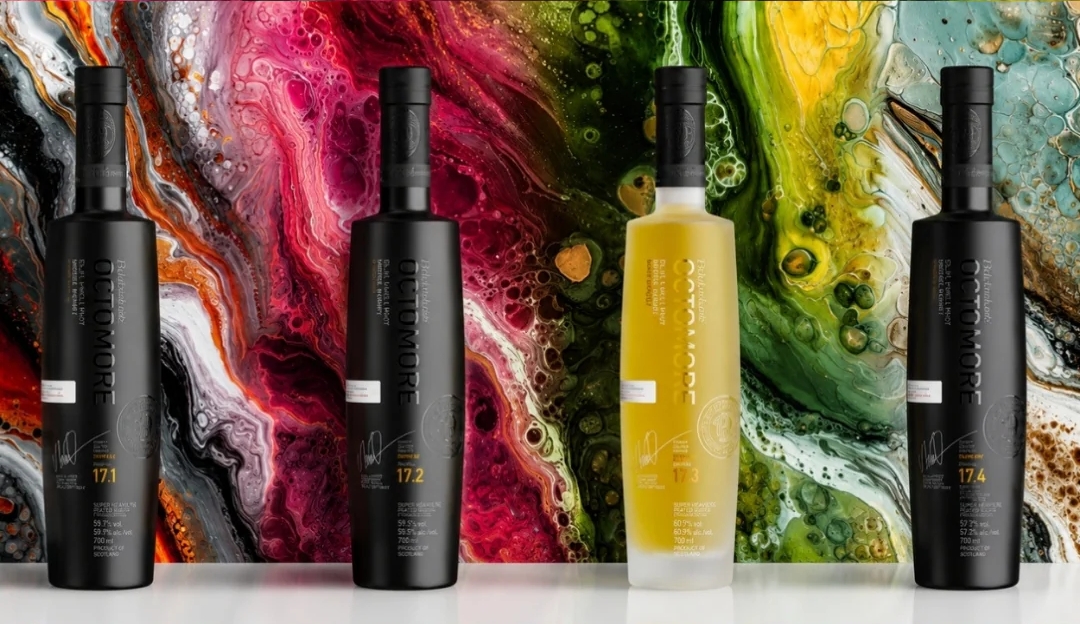
There are peated whiskies, heavily peated whiskies… and then there is Octomore. Bruichladdich’s annual exercise in pushing the boundaries of Scotch whisky returns with one of its most compelling series in years.
Bruichladdich has long occupied a special place in my whisky cabinet, and not simply because I happen to enjoy Islay malts in general. The old Bruichladdich 15, long discontinued, is the single malt that got me into whisky. Beyond that, though, Bruichladdich is a distillery with a restless curiosity, a willingness to question convention, and an approach to whisky-making that puts flavour, provenance, and experimentation ahead of doing things because they have always been done that way. Although there are quite a few distilleries which I genuinely like, if I had to choose a favourite among them, it would be Bruichladdich.
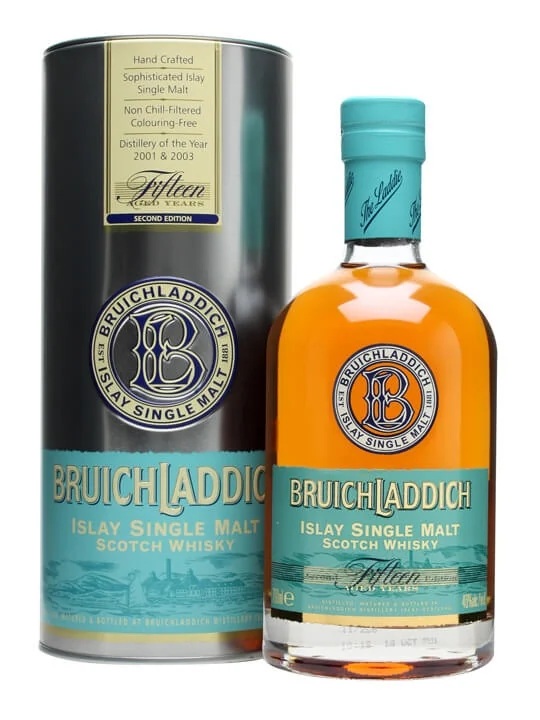
Of all its expressions, however, Octomore is the one I look forward to most each year. The annual release has become something of an occasion for whisky enthusiasts, and the arrival of Series 17 was no exception. Following an intimate private launch hosted by Bruichladdich’s Global Brand Ambassador and Islay native, Abigail Clephane, I came away thinking that this might be my favourite Octomore series overall since Adam Hannett took over from the legendary Jim McEwan in 2015. That year saw the 7 series released, the last under McEwan, and the Octomore 7.1 remains my favourite of the label (although there is plenty of close competition).
Octomore has never been a whisky for those who simply want another bottle of peated Islay single malt. It is an ongoing experiment, a challenge to accepted ideas about age, peat, cask influence, and what makes a whisky great. It’s so special that whisky lovers eagerly anticipate each year’s release, with sellouts quite common, as the total number of bottles in each series is quite limited.
THE IMPOSSIBLE EQUATION
The story of Octomore begins in 2002, when Bruichladdich commissioned malted barley with exceptionally high peat levels. The first spirit was distilled that September, although it would be another six years before the inaugural bottling reached whisky drinkers in 2008.
At the time, the idea was wildly unconventional. What if peating levels were taken to extremes… just to see what happened? What if the spirit was bottled after just five years in casks? What if the whisky wasn’t diluted but offered at what was effectively cask strength? The resulting whisky would be young, powerful, and bottled at a strength – usually around 57 to 63% alcohol by volume – that left little doubt about its intentions. Yet the early releases revealed something unexpected: beneath all that smoke, contrary to the whisky’s youth, and beyond the eye-watering strength was a remarkably elegant spirit.
This is the paradox that has made Octomore so admired. Its peat figures can be astonishing, but the whisky rarely behaves as those numbers might suggest. The distillery’s tall, narrow-necked stills, slow distillation, and careful spirit management and cask selection all help produce a character that balances smoke with fruit, sweetness, and coastal freshness. The result is not simply a peat bomb designed to overwhelm the palate.
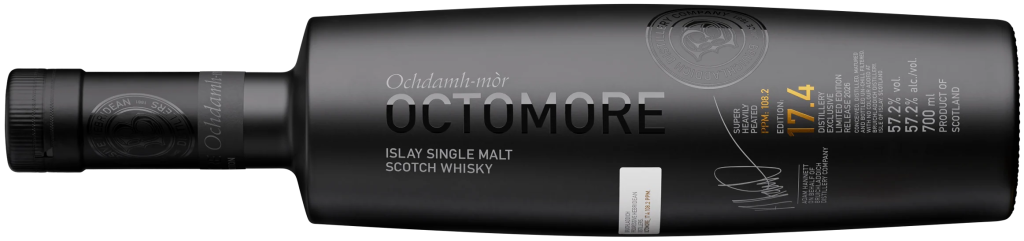
It is worth remembering that PPM – phenol parts per million – refers to the phenol content measured in the malted barley, not a direct measurement of smoke in the finished whisky. Nor does a higher figure automatically mean a more intensely smoky dram. Peat is only one part of the equation, and Octomore has now gone through 17 series, year after year, demonstrating just how much else matters.
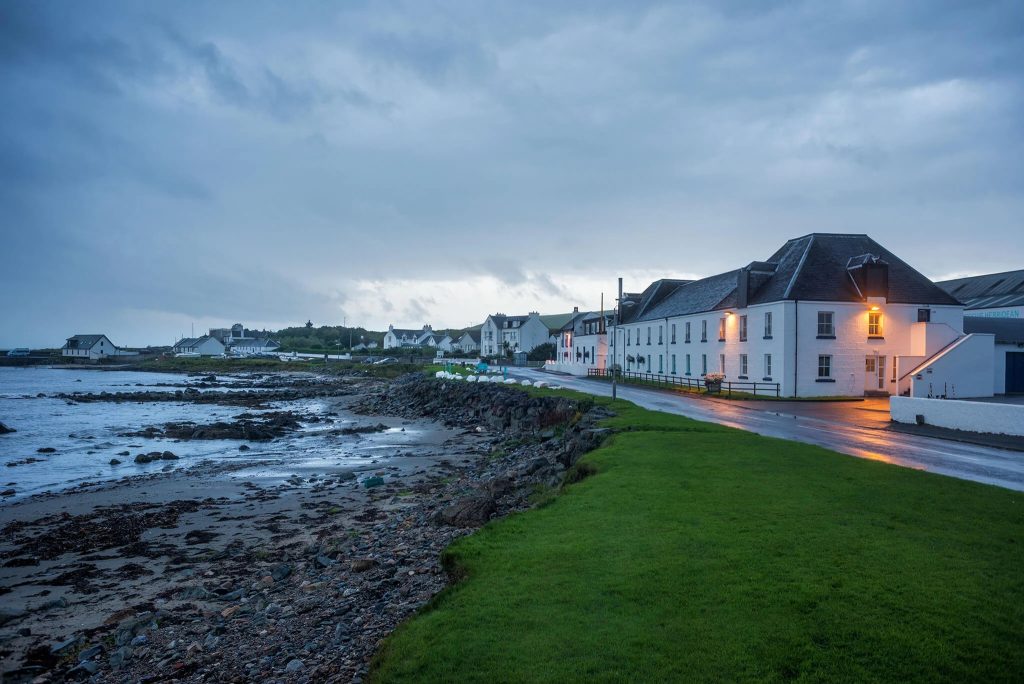
The project also reflects Bruichladdich’s broader interest in barley provenance and terroir, which is one of my favourite things about this distillery. Where the grain is grown, how it is malted, the casks used for maturation, and the time spent in the warehouse all contribute to the final character. Octomore is never intended to be a uniform product, and no shortcuts are taken. Each annual series is a snapshot of a particular harvest, distillation, and selection of casks.
When Jim McEwan retired in 2015, Adam Hannett stepped into the role of Head Distiller, having worked alongside his mentor for several years. Hannett has continued that spirit of experimentation, and in 2025 was appointed Bruichladdich’s Master Blender. His approach has helped preserve the character of the distillery while taking its experimental ambitions in new directions.
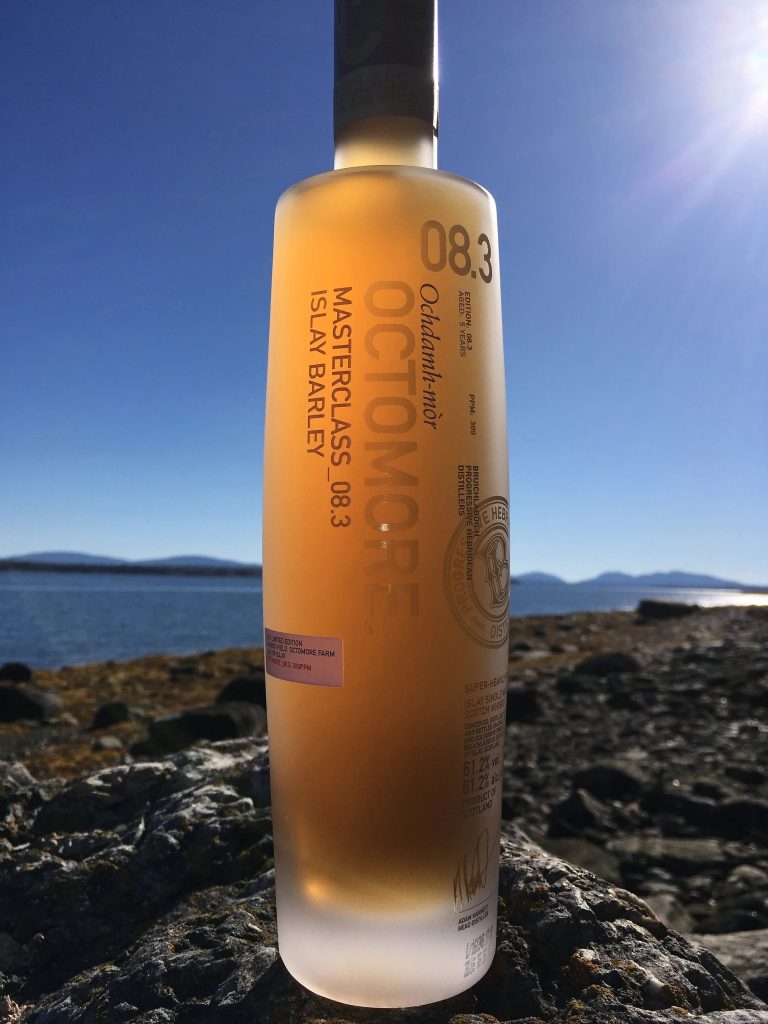
As if to underscore the point, Hannett’s first Octomore series included the now-almost-mythical Octomore 8.3, with a jaw-dropping 309.1 PPM, still the most heavily peated whisky to have ever been produced. (However, Hannett’s Octomore 15.3, released two years ago, came very close – slipping in at 307.2 PPM.)
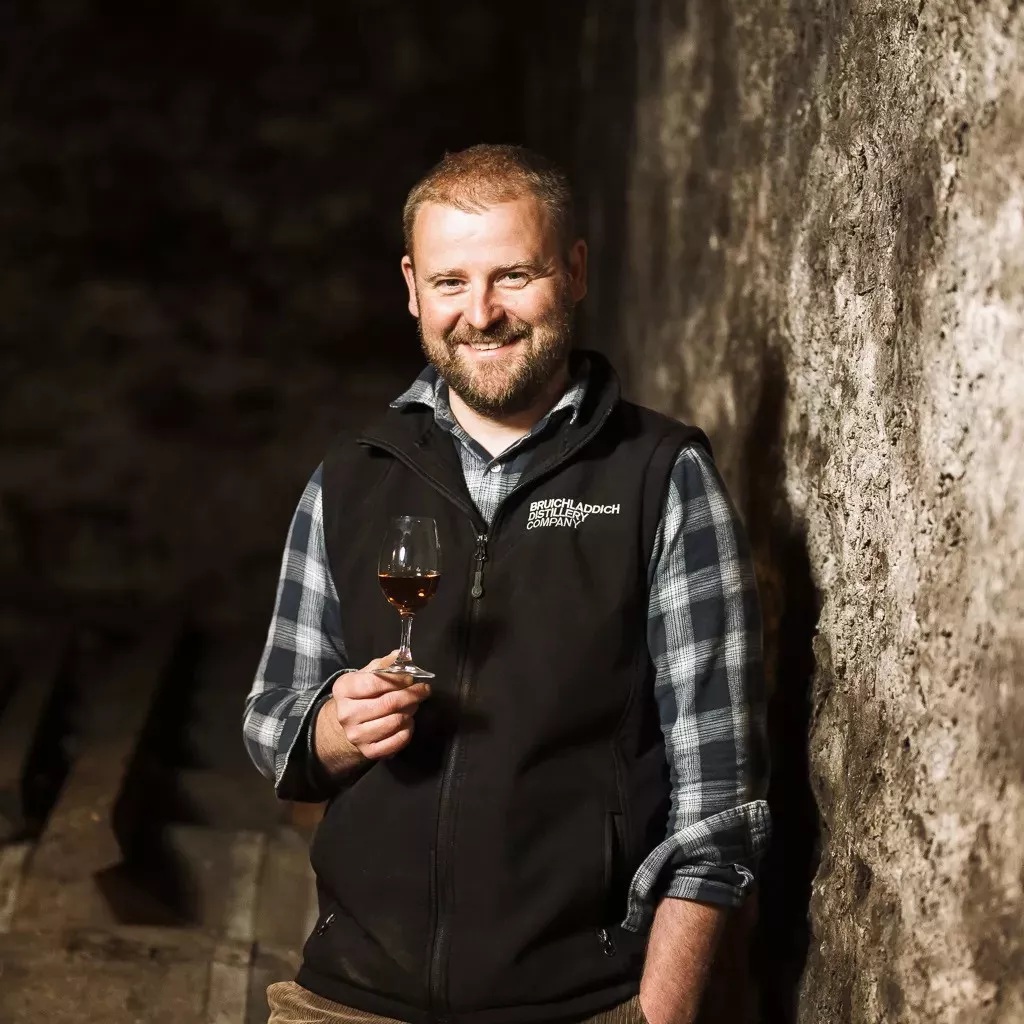
As Hannett puts it: “Octomore embodies Bruichladdich’s Distillery’s raison d’etre – to create whiskies that are thought provoking, challenge industry norms and offer consumers something that they could not get anywhere else.”
That is a pretty good description of why I keep coming back. There is nothing quite like Octomore in all of Scotch whisky.
As a bit of a primer for next year, there are rumours in the whisky world that 2027’s Octomore 18.3 will match the legendary 8.3, with a 309.1 PPM level and, different to the usual five years of ageing, will be a 15-year-old expression. We’ll see if the tales are true by this time next year!
THREE EXPRESSIONS, THREE DIFFERENT STORIES
The 17 Series comprises three core expressions, each offering a different interpretation of the Octomore character. While there have been some real standout individual expressions for me in the last three or four series (particularly the 14.2, 14.3, 15.3, and 16.3), I found that this year’s series to be a contender for the best overall Octomore series in years.
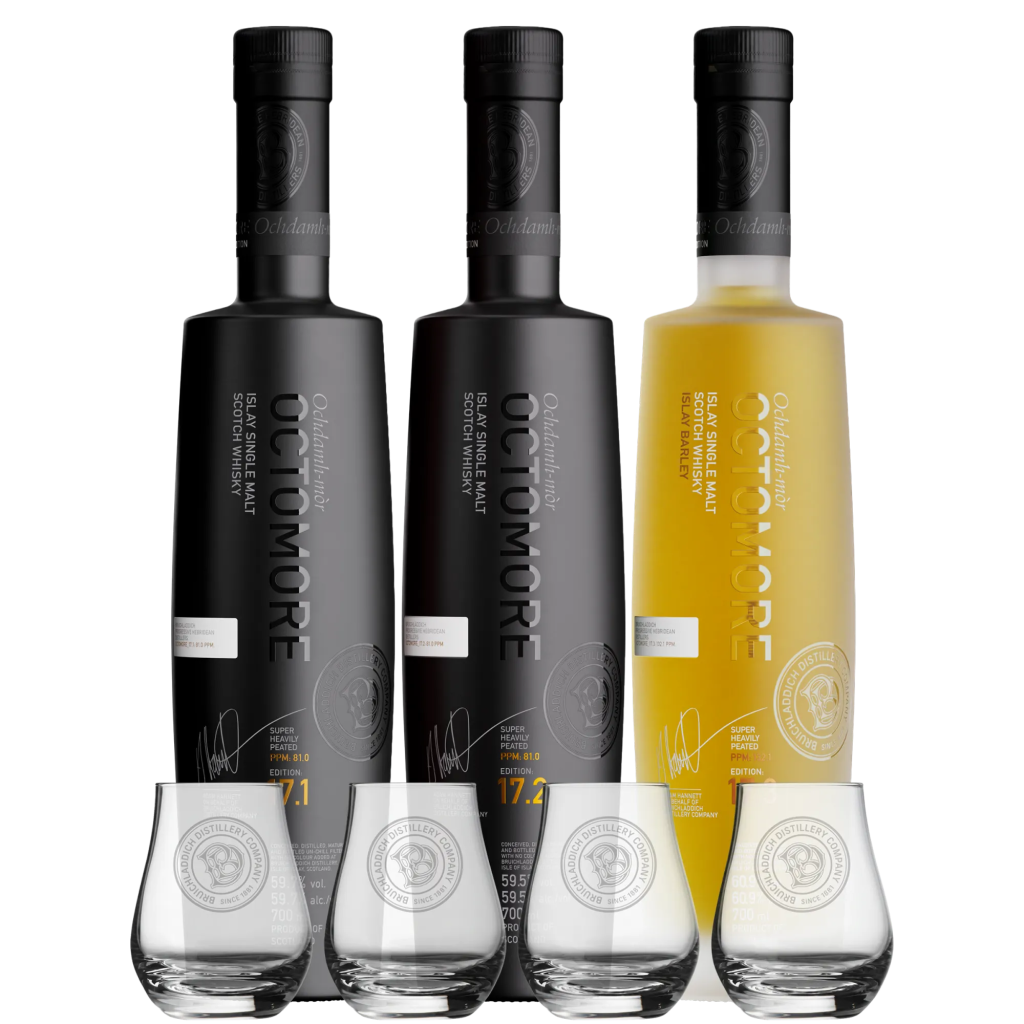
Octomore 17.1 is the reference point, distilled from 100% Scottish mainland Concerto barley malted to 81.0 PPM. Matured for five years in first-fill bourbon barrels, it is bottled at 59.7% ABV. The combination of smoke, salt, and sweetness provides the foundation against which the other expressions can be judged. It is a reminder that even at 81 PPM, Octomore can be remarkably composed. Typically, the .1 in any recent series is, at least for me, the most basic of the range. Of course it’s not bad (it’s an Octomore, come on!), but in my experience, the .1 is sometimes just kind of upstaged by the notably more impressive .2 and .3 expressions. In the 17 series, however, that’s just not the case. There is no weak link in this chain. Having thoroughly enjoyed the 17.1, we moved on.
The 17.2 uses the same barley and peating level, but takes a different route through maturation. It spends four years in second-fill French oak that previously held bourbon, before finishing in first-fill Port barriques. Bottled at 59.5% ABV, it introduces a different set of influences, with pepper, citrus, and berry notes adding complexity to the familiar smoky foundation. It is an intriguing exercise in how dramatically cask selection can alter the character of a spirit. This one really impressed everyone at the tasting, and I loved the depth the Port finish provided.
Then there is 17.3, which is arguably the most compelling expression from a provenance standpoint. The barley comes exclusively from Irene’s Field on Octomore Farm, just two miles from the distillery. This is single-farm, single-field, single-vintage whisky-making, with a traceability that takes the idea of terroir beyond marketing terminology.
Matured for five years in a combination of first-fill bourbon barrels and second-fill Ribera del Duero, Sauternes, Eiswein, and Syrah casks, it reaches an impressive 132.1 PPM and is bottled at 60.9% ABV. Yet the intention is not simply to produce the biggest smoke statement possible. Hannett describes it as “an elemental and expressive dram – powerful yet composed – weather-beaten, coastal and deeply satisfying.”
He also makes a persuasive point about its origins: “You don’t get a higher provenance whisky than this. We know the farmer, we know the field the barley was grown in, and we know this is going to be a dram that intrigues people with its peating level of 132.1 PPM.”
It’s not uncommon for the .3 expression in a given series to be a favourite – not just for me, but for many others as well. However, this year’s range made the pick much more challenging, because all three that we tasted were genuinely just that good.
For me, that is what makes the whole Octomore project so compelling. The numbers are attention-grabbing, certainly, but they are not the point. The real pleasure is in the liquid itself – and in discovering how each expression translates a different combination of barley, peat, distillation, and maturation into something distinctive. The fact that the bottles are released just once each year in limited numbers with plenty of pomp and circumstance on the global whisky stage doesn’t hurt, either.
All Octomore whiskies are conceived, distilled, matured, and bottled on Islay, un-chill filtered, and presented without added colour. They are limited releases, and once a particular series is gone, it is gone. Remember that 8.3 edition I mentioned earlier? When it was released back in 2016 (I was at that launch event), it retailed for “just” £137, or about RM750. These days? Well, good luck finding it at all, but if you do, be prepared to pay many times that figure.
I have followed Octomore for quite a number of years now, and Series 17 is an especially satisfying reminder of why. It honours the experimental spirit established by McEwan and his colleagues, while showing how confidently Hannett has made the project his own. For anyone who appreciates what can happen when a distillery is prepared to take a few risks and push a few boundaries, this is absolutely a series that’s worth seeking out.
Octomore 17.1, 17.2, and 17.3 are available through specialist whisky retailer Zeyeable KL. For enquiries and purchases, contact JY on +60 16-564 9235.