



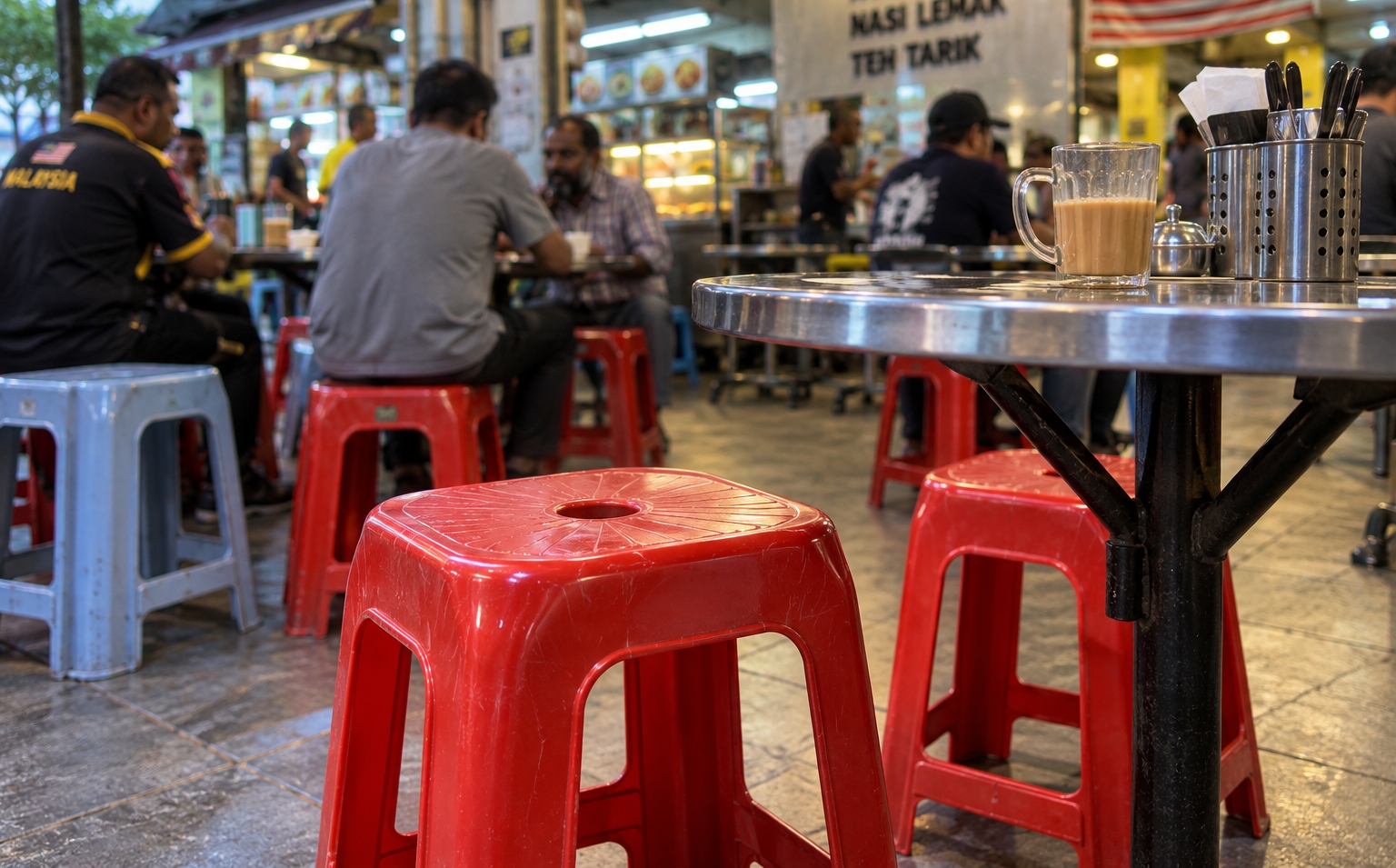
That little circular opening in the middle of a plastic stool looks almost too ordinary to notice. But it is a surprisingly clever bit of everyday design, helping with stacking and unstacking, carrying, drainage, material efficiency, and even the manufacturing process.
If there’s one piece of “furniture” that feels almost synonymous with Southeast Asia, it has to be the humble plastic stool. They’re everywhere in Malaysia, of course, but travel pretty much anywhere in the region and you’ll find them in all manner of shapes, sizes, and colours – lined up outside roadside eateries, tucked under tables at kopitiams, scattered around wet markets, or brought out by the dozen when there’s a family gathering. Cheap, practical, and churned out by the millions, they’ve become as much a part of the Southeast Asian landscape as coconut palms and the aromas of garlic, chilli, and spices wafting from the nearest kitchen.
But have you ever stopped to wonder about that little hole in the middle of the seat? It’s such a familiar feature that most of us probably never give it a second thought. And if you had to guess why it’s there, your answer would probably be right – at least partly. Because that seemingly insignificant hole actually serves several useful purposes, some of which are rather more ingenious than you might expect.
It is one of those bits of everyday design that has become so familiar we barely see it anymore. You’ll never have to look very hard to find a stack of lightweight plastic stools, each sporting the same little circular opening.
At first glance, it looks decorative. It isn’t.
That hole is there because a simple piece of plastic furniture has to solve a surprising number of practical problems. And while the exact reason can vary depending on the stool’s design, the opening commonly helps with everything from storage and handling to drainage and material use. We’ve found seven practical reasons for the hole.
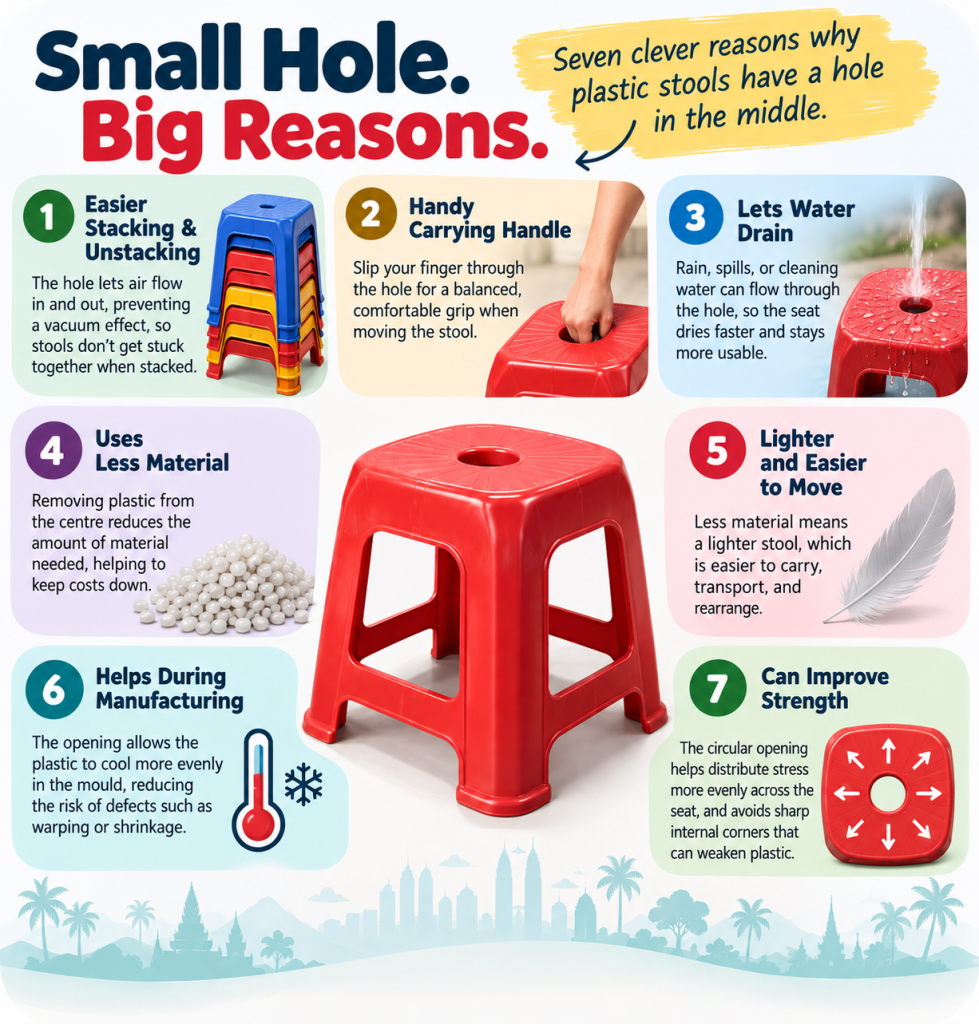
THE LITTLE HOLE THAT DOES A LOT
The most obvious benefit is probably the one anyone who has ever had to move a pile of plastic stools will appreciate: stacking and unstacking.
Most plastic stools are designed to nest neatly inside one another, allowing dozens of them to occupy a small footprint. There is, however, a small problem with putting smooth plastic surfaces tightly together. Air can become trapped between them, making the stools awkwardly resistant to being separated.
The hole provides a simple route for air to move in and out, reducing that suction effect and making the stools easier to stack and, more importantly, unstack. Anyone who has wrestled with a stubborn tower of plastic furniture will appreciate the difference.
The same opening also doubles as a rather ingenious carrying “handle.”
Instead of grabbing the stool around its edge, you can simply slip your fingers through the hole and lift. Because the opening is positioned near the centre, it gives you a relatively balanced grip, which makes moving a stool from one side of the room to the other much easier. This is particularly useful in places where furniture is constantly being rearranged – restaurants, classrooms, homes, event venues, and outdoor gatherings, for example.
Then there is water drainage.
Plastic stools are frequently used outdoors, in bathrooms, on balconies, at food stalls, and anywhere else where rain, splashes, or cleaning water are part of the equation. On a completely solid seat, water can simply sit there in a shallow puddle. The central opening gives it an easy escape route, helping the surface drain and dry more quickly. To be fair, this is hardly revolutionary engineering, but it is exactly the sort of tiny practical detail that makes an object more convenient to live with. (And you’ll often see holes in the seats of plastic chairs for this reason, too.)
There is also a less visible reason: plastic costs money.
Most mass-produced plastic stools are made using injection moulding, and removing material from an area where a completely solid surface is unnecessary can reduce the amount of plastic resin used in each product. The saving on a single stool may be quite modest, but manufacturers producing furniture by the thousands or millions can turn even small reductions in material into meaningful savings.
The opening can also contribute to a marginally lighter stool, which makes transportation and handling easier. Exactly how much material is saved, of course, depends on the particular design.
And this is where things get a little more interesting.
MANUFACTURING AND PHYSICS
A large, completely solid section of plastic can be more difficult to mould consistently because thicker areas cool at different rates. Uneven cooling can contribute to problems such as shrinkage, warping, or other defects. Injection-moulded plastic products are therefore generally designed around controlled wall thicknesses, openings, and reinforcing structures to help the material cool more predictably.
So that hole may also be part of a broader strategy to make the stool easier to manufacture reliably, rather than simply being an afterthought punched into the finished seat.
One commonly repeated explanation goes a step further, suggesting that the circular opening helps distribute stress and makes the stool stronger. There is some engineering logic behind using rounded rather than sharply cornered openings, since sharp internal corners can create stress concentrations. But it would be misleading to suggest that the hole itself automatically makes every plastic stool stronger. Overall strength depends on the material, wall thickness, reinforcing ribs, geometry, and how the entire stool is designed. The hole, therefore, is just part of the overall design to strengthen the stool.
As with many pieces of everyday design, there probably isn’t one grand master explanation that applies to every stool ever made. Some manufacturers may prioritize easy stacking. Others may be thinking more about material efficiency, drainage, ergonomics, or the requirements of their moulding process. Often, several of those considerations can be addressed by the same small opening.
We tend to think of clever engineering as something involving impressive bridges, aircraft, smartphones, or spacecraft. Yet here it is, sitting quietly beneath us in a RM10-or-so plastic stool at the neighbourhood mamak.
A little circle of empty space that helps the stool stack, separates it from its neighbours, gives us somewhere to grab it, lets the rain run through, saves a little plastic, and can even simplify and improve the manufacturing process.
Not bad for a hole.