



The latest TikTok sensation involves going for a walk without headphones, music, podcasts, or a phone. Older generations may remember it as, well, walking.
There’s a revolutionary new wellness trend sweeping TikTok, and it involves something humanity has been doing for several thousand years: going for a walk without listening to anything.
Dubbed “silent walking” or, somewhat less elegantly, “rawdogging a walk,” the idea is to leave your phone, headphones, music, podcasts, and other distractions behind and simply enjoy a stroll with your own thoughts for company. No playlist. No podcast. No checking messages. Just you, the pavement, and whatever happens to be rattling around inside your head.
Content creator Hawea Washburn is among those championing the practice, saying she turns to silent walks when feeling overwhelmed or mentally distracted. She admits she is usually listening to music or chatting on FaceTime, leaving little opportunity to sit with her own thoughts. A quiet walk, she says, helps her regain mental clarity and return home feeling recharged.

There is actually some science behind the idea. Neuroscientists point to the brain’s default mode network, which becomes active when we are not focused on a specific task. It plays a role in reflection, processing emotions, recalling experiences, and making connections between ideas. In other words, giving the brain a little breathing room can be useful. Who knew?
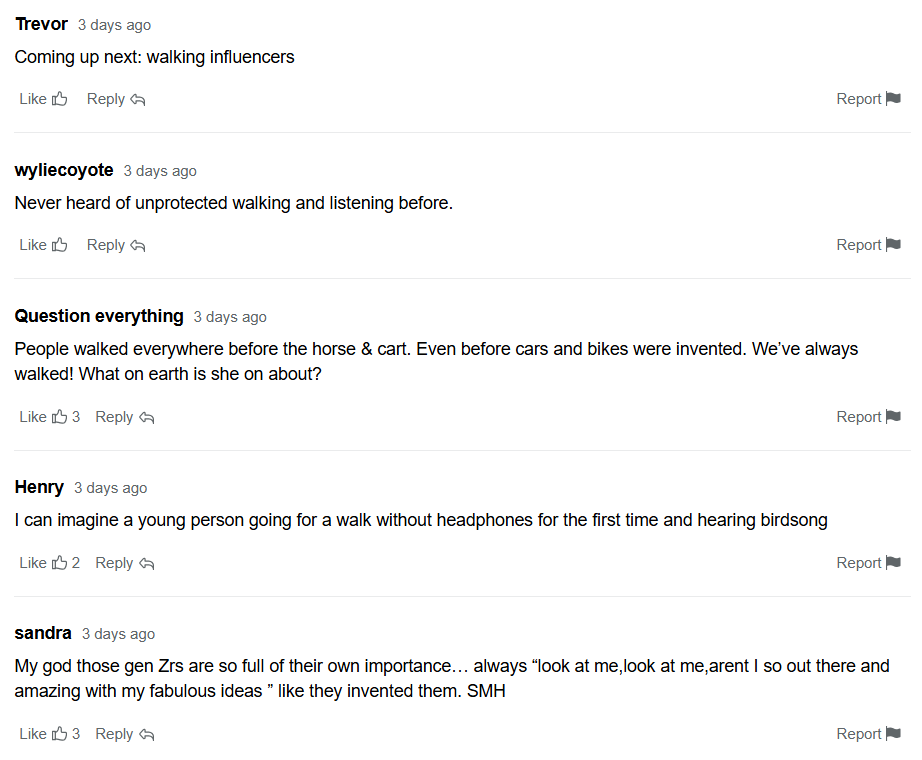
The backlash, however, has been predictably entertaining. Older users have been quick to point out that walking without headphones is hardly a groundbreaking invention. Those of us who remember leaving the house without a smartphone may struggle to understand why this requires a TikTok tutorial, a catchy name, and a wellness endorsement.
According to recent news articles, critics have piled on, branding Gen Z as “insufferable” and “annoying” for attempting to rebrand a basic human function as some sort of groundbreaking wellness hack.
“This generation is the worst,” one commenter wrote, while another bluntly added: “Why are they so irritating? You’re just walking.”
“Gen Z think they invented everything,” a third user posted sarcastically. Plenty of people also pointed out the irony of these content creators advocating for an unplugged walk to get away from their digital devices… while taking their smartphone along to record and post themselves doing it.


And silent walking is hardly the first everyday activity to receive a Gen Z makeover, usually followed by a round of mockery from older generations. “Girl dinner” turned a plate of odds and ends, leftovers, and assorted snacks into a culinary trend. “Bed rotting” gave spending an entire day under the duvet a more marketable label, while “quiet quitting” repackaged doing the job you are actually paid to do without volunteering for three additional jobs. Then there’s “girl math,” which offers some creative accounting for purchases (oftentimes unnecessary ones, bought on a whim) that somehow became free once the cash had already left your wallet.
The Guardian even noted the absurdity of rebranding familiar activities, observing that a ploughman’s lunch could apparently be reinvented as “girl dinner.” More recently, younger consumers have been rediscovering vinyl records, knitting, journaling, scrapbooking, and other decidedly analogue pursuits – sometimes referred to as “grandma hobbies.”
To be fair, there is a serious point beneath the social media silliness and intergenerational teasing. Constant notifications, endless scrolling, and the urge to fill every quiet moment with digital noise are hardly conducive to a calm mind. Encouraging younger people to put their phones down and spend time outdoors is surely a good thing.

But perhaps we can spare ourselves the grand unveiling and social media rebranding. Your grandparents were doing silent walks long before TikTok existed, and they managed without calling it a movement (or worse, a ‘life hack’). They probably just called it going out for a walk.
Sources: news.au.com, The Guardian UK