


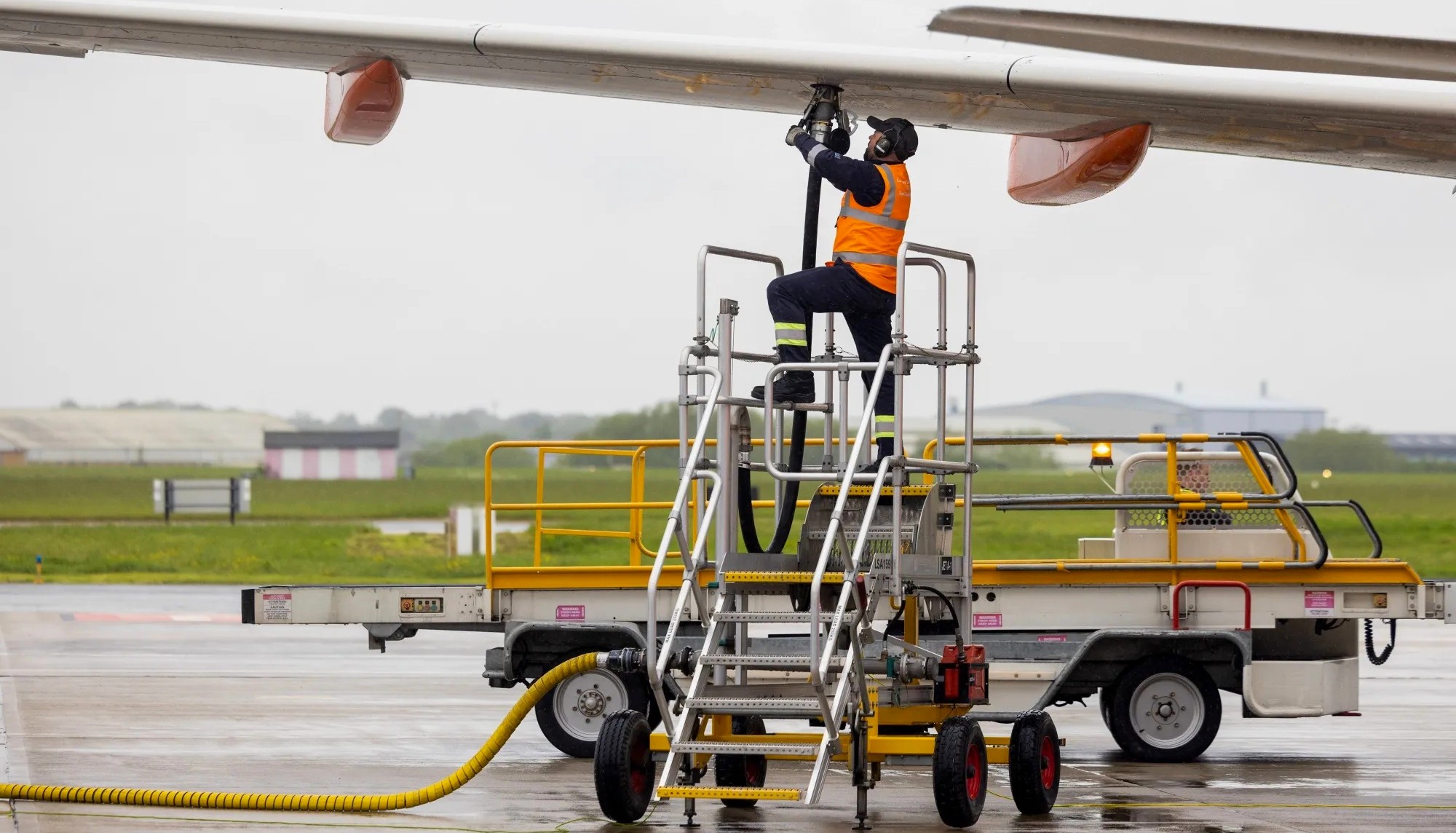
Every year, the world produces hundreds of millions of tonnes of plastic waste while the aviation industry searches for cleaner, more sustainable fuels. New research from China suggests one innovative technology could help address both problems at once.
Plastic waste has become one of the defining environmental challenges of the modern era. More than 460 million tonnes of plastic are produced globally each year, yet only a small fraction is successfully recycled. Much of the rest ends up in landfills, is incinerated, or finds its way into rivers and oceans, where it can persist for centuries.
At the same time, the aviation industry faces mounting pressure to reduce its carbon footprint. Unlike passenger cars, aircraft cannot simply switch to batteries, making sustainable aviation fuel (SAF) one of the sector’s most promising routes toward lower emissions.
Researchers in China now believe they may have found a way to tackle both challenges simultaneously.
A joint team from the Shanghai Advanced Research Institute of the Chinese Academy of Sciences and Fudan University has developed a catalytic process that converts waste plastics into hydrocarbons suitable for use as aviation fuel. The research, recently published in Applied Catalysis B: Environment and Energy, represents another step forward in the growing field of chemical recycling.
FROM PLASTIC WASTE TO AVIATION FUEL
The new process focuses on polyolefins – primarily polyethylene and polypropylene – which account for more than 60% of global plastic waste. These materials are found in everything from shopping bags and food packaging to detergent bottles and household containers.
Their chemical structure makes them exceptionally durable, which is excellent for consumer products but problematic once they become waste. Traditional recycling methods often struggle to deal with contaminated or mixed plastics, while landfill and incineration create their own environmental concerns.
The Chinese researchers instead use a process known as hydrogenolysis, in which hydrogen and specially engineered catalysts break the long polymer chains into shorter hydrocarbon molecules.
The challenge has always been controlling exactly where those long chains break. Conventional catalysts often produce an unpredictable mixture of gases, liquids, and waxes, reducing both efficiency and commercial viability.
The research team says it has overcome much of that obstacle by developing a cobalt-modified nickel catalyst that selectively converts the plastic into C8 to C16 hydrocarbons – the same molecular range that forms the basis of conventional jet fuel. Laboratory testing achieved liquid fuel yields exceeding 80%, with a large proportion falling within the desired aviation fuel range.
PROMISING, BUT NOT YET READY FOR TAKE-OFF
The announcement has attracted considerable attention because it addresses two pressing global issues with a single technology. Rather than treating plastic purely as waste, it views discarded packaging as a valuable feedstock for producing higher-value fuels.
The timing is also significant. Airlines worldwide are under increasing pressure to reduce greenhouse gas emissions, while governments are encouraging greater production of sustainable aviation fuels. Most SAF today is produced from used cooking oil, agricultural residues, or other biological feedstocks, but supplies of those materials are limited. Waste plastics could eventually provide an additional source of carbon without requiring new fossil fuel extraction.
Another recently published study by Chinese researchers, appearing in Nature Energy, demonstrated a different plastic-to-jet-fuel process operating under atmospheric pressure, producing jet-fuel-range hydrocarbons with an estimated production cost of between US$1.00 and US$1.80 per kilogram. Life-cycle analysis suggested the process could reduce well-to-pump carbon emissions by approximately 73% compared with conventional petroleum-derived jet fuel.
Nevertheless, significant hurdles remain before either technology reaches commercial scale.
The current research has been demonstrated primarily under laboratory conditions. Scaling the process to industrial production will require larger reactors, durable catalysts capable of operating continuously for extended periods, and efficient systems for sorting and preparing waste plastics. Contaminants commonly found in real-world plastic waste can quickly deactivate catalysts, presenting another engineering challenge.
It is also important to recognise that converting plastic into fuel is not the same as eliminating plastic pollution. Once burned in an aircraft engine, the carbon contained within the plastic is released as carbon dioxide. For that reason, many scientists view plastic-to-fuel technologies as a complement to recycling rather than a replacement for reducing plastic consumption and improving conventional recycling systems.
Even so, the research represents an encouraging development. If scientists can successfully scale the technology while maintaining competitive costs, tomorrow’s aircraft may one day be powered, at least in part, by yesterday’s discarded plastic packaging. It would not solve the world’s plastic problem overnight, but it could transform one of society’s most persistent waste streams into a valuable resource.
Sources: Applied Catalysis B: Environment and Energy; Nature Energy; South China Morning Post; Chinese Academy of Sciences; Fudan University.