



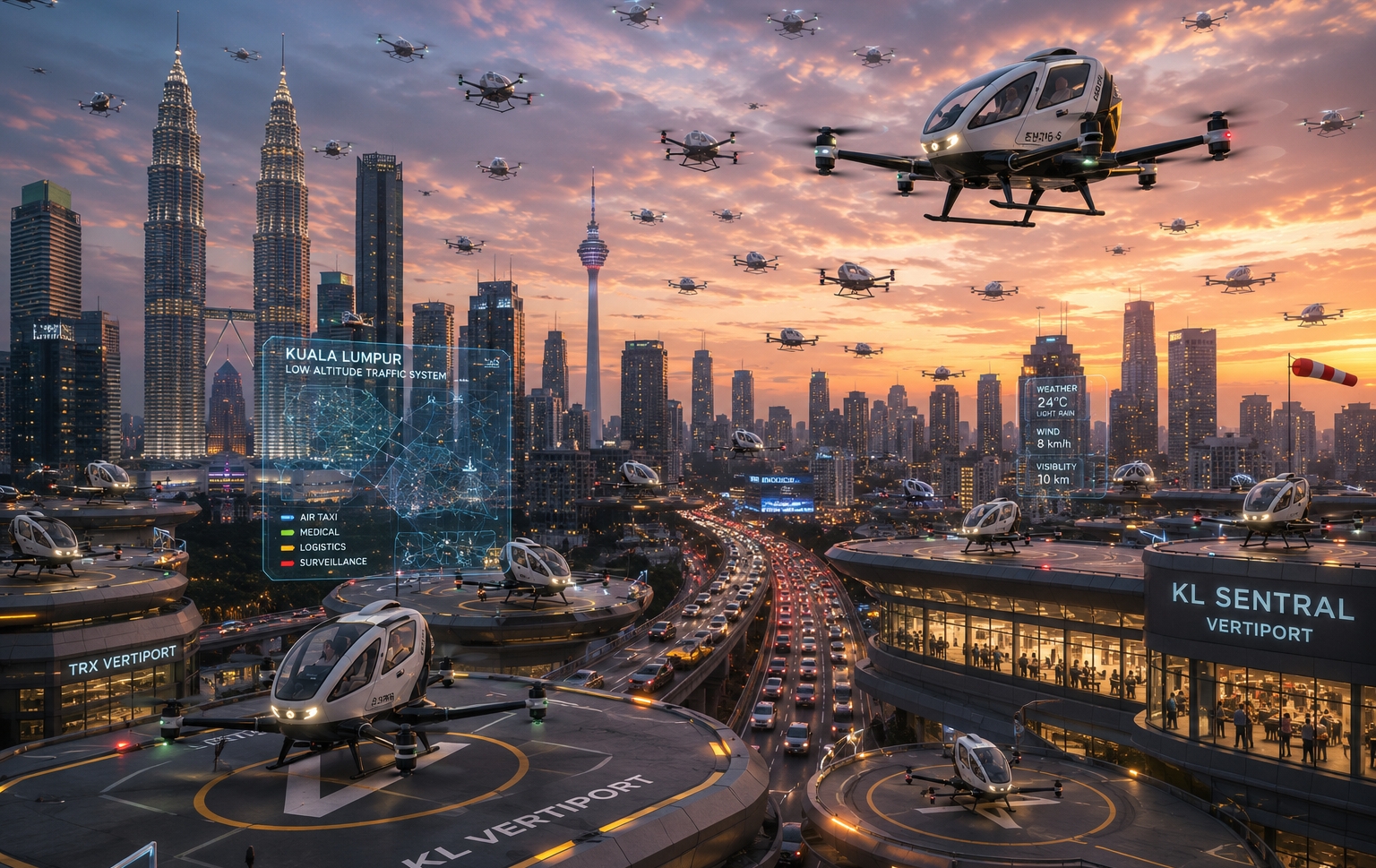
Berjaya founder Vincent Tan has taken a ride in a pilotless electric air taxi in China, just as Malaysia begins laying the regulatory groundwork for its own low-altitude economy. The obvious question is: how exactly is all this going to work?
Malaysian cities, well-known for their often hideous land-based traffic jams, may eventually have traffic jams in the sky, too. And, if recent developments are anything to go by, some of those vehicles may not even have anyone sitting in the cockpit.
Berjaya Group founder Tan Sri Vincent Tan has become the first Malaysian reported to fly aboard a pilotless electric air taxi, taking a ride in EHang’s two-seat EH216-S during a visit to the company’s headquarters in Guangzhou, China.
Tan documented the experience himself, and his verdict was surprisingly enthusiastic. As the aircraft prepared for take-off, he could be heard saying, “OK, we’re gonna take off now,” before offering a suitably spontaneous “Wow.”
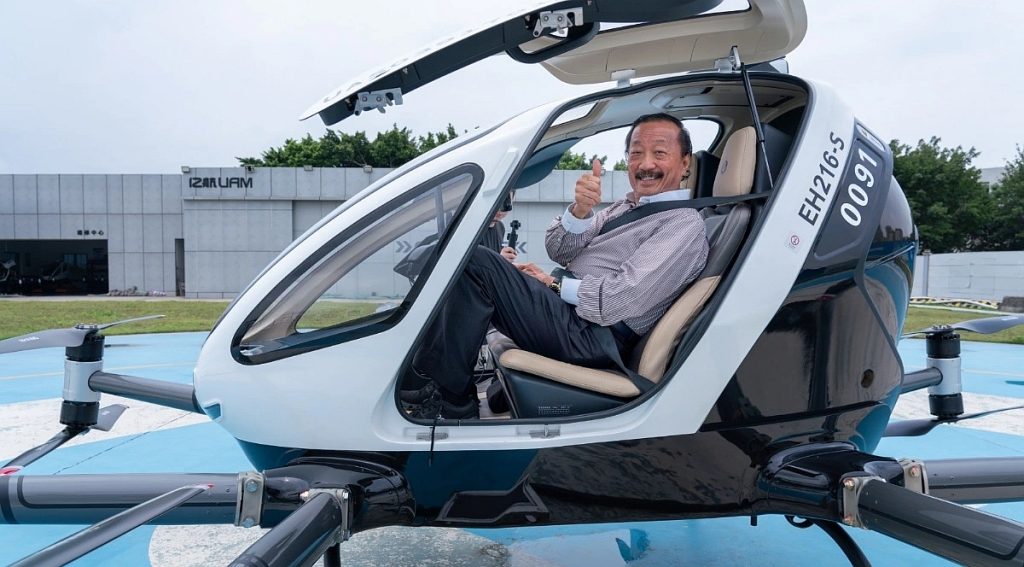
Afterwards, he declared the experience better than travelling by helicopter, adding that the noise was surprisingly manageable. He apparently did not even need headphones.
That may sound like a little more than fairly entertaining billionaire tries-the-future story, but the timing is interesting, and it’s pretty easy to see this as a harbinger of things to come. Malaysia is now actively preparing for something called the low-altitude economy, and the phrase covers considerably more than wealthy businessmen taking futuristic joyrides.
WELCOME TO THE LOW-ALTITUDE ECONOMY
On August 3, the Civil Aviation Authority of Malaysia (CAAM) published its proposed Malaysia Low Altitude Economy Framework, opening a public consultation that runs until September 2. The framework is intended to establish the strategic direction for developing the sector safely, securely, and sustainably, while coordinating government, industry, and other stakeholders.
And the sector potentially encompasses quite a lot: unmanned aircraft systems, drones, advanced air mobility, electric vertical take-off and landing aircraft (eVTOLs), autonomous systems, logistics, surveillance, emergency response, agriculture, inspection, and eventually passenger transport.
In other words, the sky just above the land, but well below the traditional airline world could become a rather busy place.
The EHang EH216-S provides a useful glimpse of what that might look like. The aircraft is an autonomous, battery-powered eVTOL designed for short-range, low-altitude flights carrying two people, with no pilot aboard. Some say it looks like an oversized drone, but in actual fact, EHang’s aircraft received a type certificate from China’s Civil Aviation Administration in 2023 and became the first passenger-carrying unmanned eVTOL to achieve that milestone. In March 2025, EHang operators received China’s first air operator certificates for civil human-carrying pilotless aerial vehicles, allowing commercial flights for activities including sightseeing and tourism in Guangzhou and Hefei.
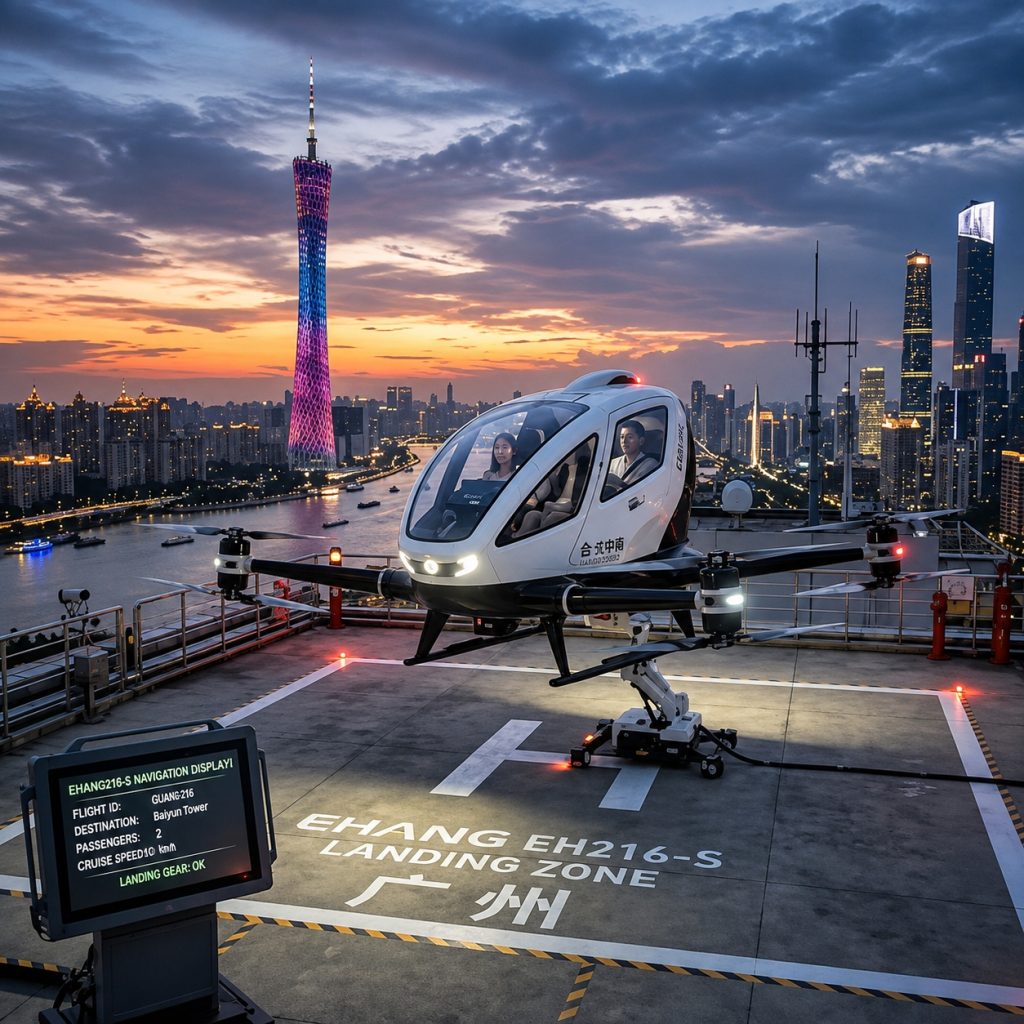
So this isn’t quite a case of someone wandering into a Chinese showroom, climbing into a flying toaster, and hoping for the best. The EH216-S certification programme involved more than 40,000 test flights and hundreds of formal verification and assessment items.
That said, Malaysia’s proposed framework is still a framework. It does not mean that autonomous air taxis are about to start buzzing between KLCC and Bangsar next Tuesday.
But it definitely leads to a number of questions… and that is where things get interesting.
WHO GETS TO USE THE SKY?
The appeal is obvious. Small electric aircraft could potentially move people over congested roads, connect airports with nearby destinations, provide tourism experiences, deliver goods, and eventually become another layer of urban transport. No traffic lights, no motorcycles filtering between lanes, and no need to explain to your passenger why the journey from KLIA to the city is taking 90 minutes.
But none of this will happen in isolation, and once hundreds of autonomous aircraft are operating above our heads, some fairly substantial questions arise.
Who controls the airspace? Where can these aircraft take off and land? How are routes managed when drones, delivery aircraft, helicopters, air taxis, and conventional aircraft are all sharing increasingly crowded skies? What happens when communications fail, weather turns nasty, or an autonomous system encounters something it was not expecting? Do we react to an eVTOL crash much as we do to a car crash now – that it’s something we try to mitigate, but ultimately accept as a “cost of doing business”?
And, perhaps most importantly, what happens when the low-altitude economy becomes genuinely popular?

CAAM’s consultation is therefore considerably more important than the futuristic language might suggest. The agency is effectively trying to work out the rules of the road before the roads become airborne.
For now, Vincent Tan’s Guangzhou flight is a fascinating preview rather than a sign that Malaysian commuters will soon be ordering an air taxi on their phones.
Still, if Tan’s reaction is anything to go by, the experience is already winning converts. The bigger challenge will be ensuring that Malaysia’s low-altitude future remains orderly, safe, and – ideally – doesn’t simply turn into a three-dimensional version of Jalan Tun Razak at rush hour.
Sources: Civil Aviation Authority of Malaysia; EHang; The Sun.