



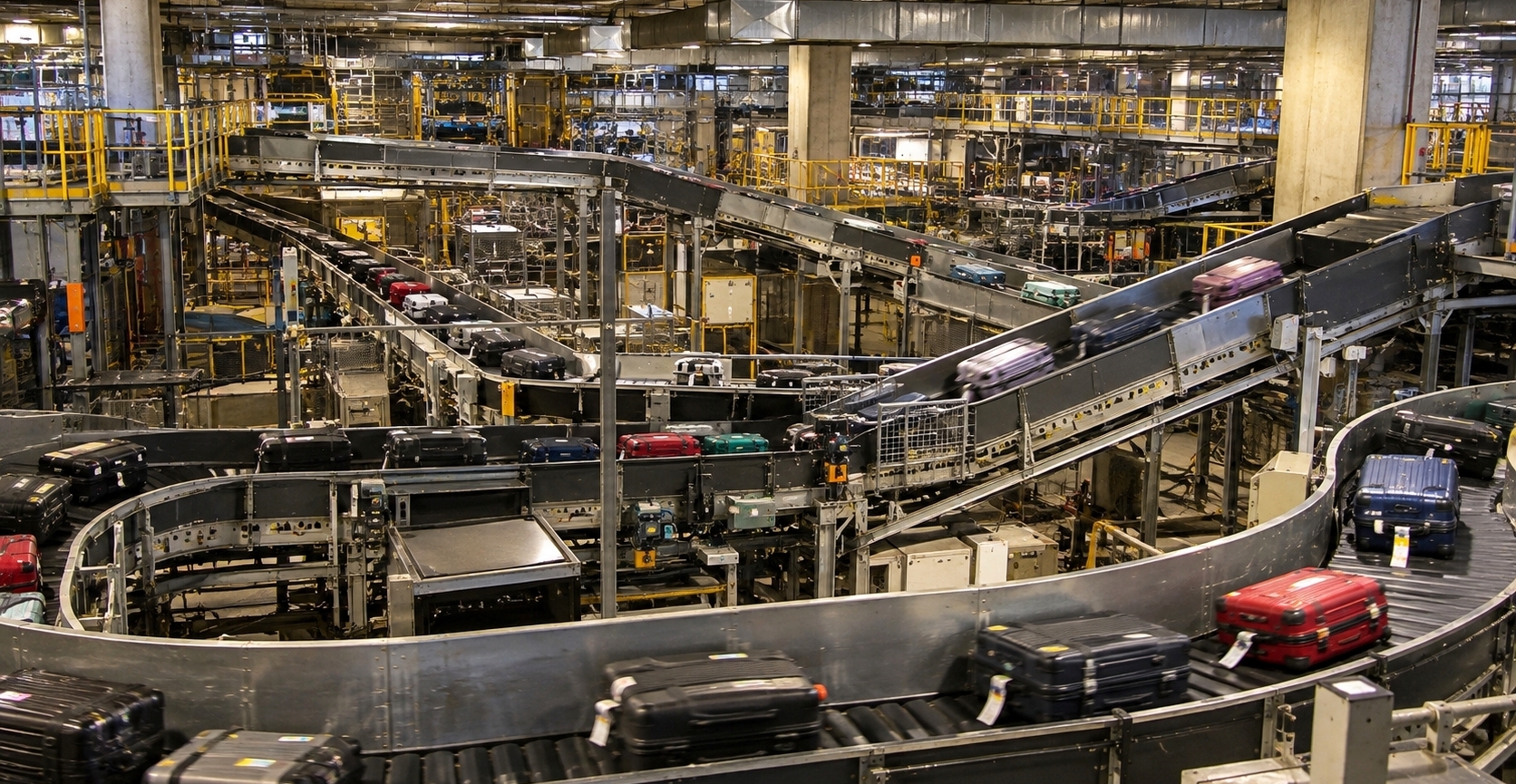
If KLIA’s baggage claim hall has seemed unusually cramped lately, there is a good reason. Behind the temporary walls, one of the airport’s biggest infrastructure projects is underway, replacing its ageing baggage handling system while keeping one of Southeast Asia’s busiest international gateways fully operational.
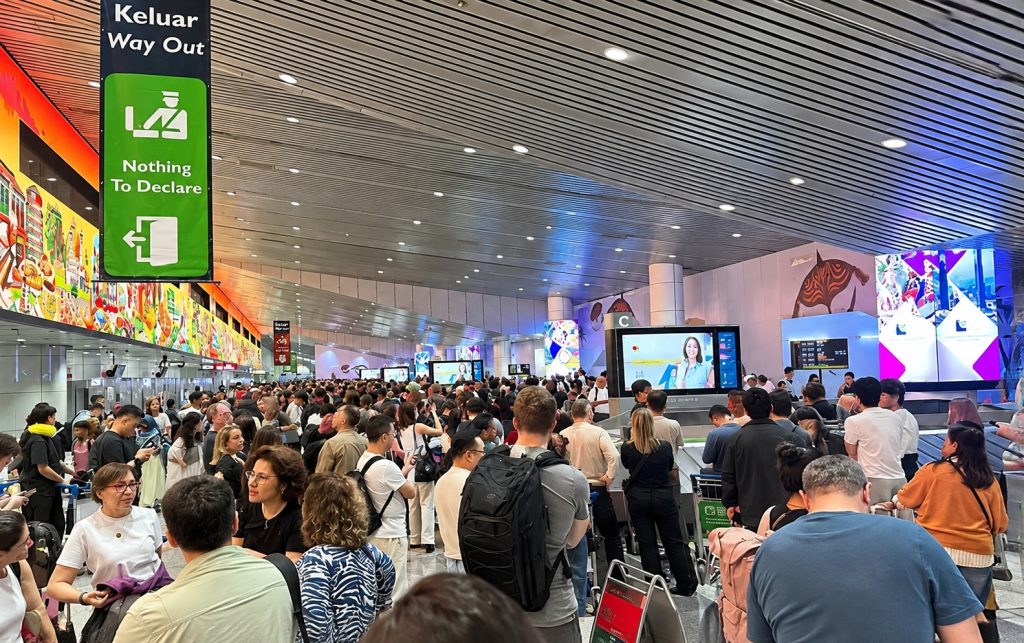
If you’ve collected your bags from KLIA following a flight anytime in the last year or so, you may have noticed that the baggage collection area has been undergoing a transformation, one requiring it to – for the time being, anyway – look rather claustrophobic and undersized as major changes take place behind temporary walls and coverings.
It is not exactly the most glamorous side of airport redevelopment. Travellers generally want their bags to arrive, a reasonably comfortable place to wait for them, and a clear route toward immigration and the exit. What happens behind the walls is largely somebody else’s problem.
Except that, at KLIA, what is happening behind those walls is a remarkably substantial undertaking.
When Kuala Lumpur International Airport opened in 1998, its baggage handling system was regarded as one of the most sophisticated in Asia. Designed for the scale and ambitions of a new international hub, it was built to move huge numbers of bags efficiently between check-in counters, aircraft, transfer points, storage areas, and reclaim carousels.
For more than two decades, that system did its job (some days better than others, it must be said). But baggage handling infrastructure, like almost everything else in a major airport, has a finite working life. Technology advances, passenger volumes change, airlines develop different operating requirements, and expectations around speed, reliability, and connectivity continue to evolve.
KLIA is therefore undertaking a major replacement and modernization of its Terminal 1 baggage handling system. The new system is intended to provide greater capacity, improved reliability, faster baggage movement, and substantially more flexibility, including high-speed individual carrier technology and expanded early baggage storage.
The challenge, of course, is that an airport cannot simply close the baggage system for a few years while it installs a new one. It has to keep handling passengers and bags every day. That makes the project at KLIA considerably more complicated than building a new baggage system in an empty terminal – and ensures a project time measured in months rather than weeks.
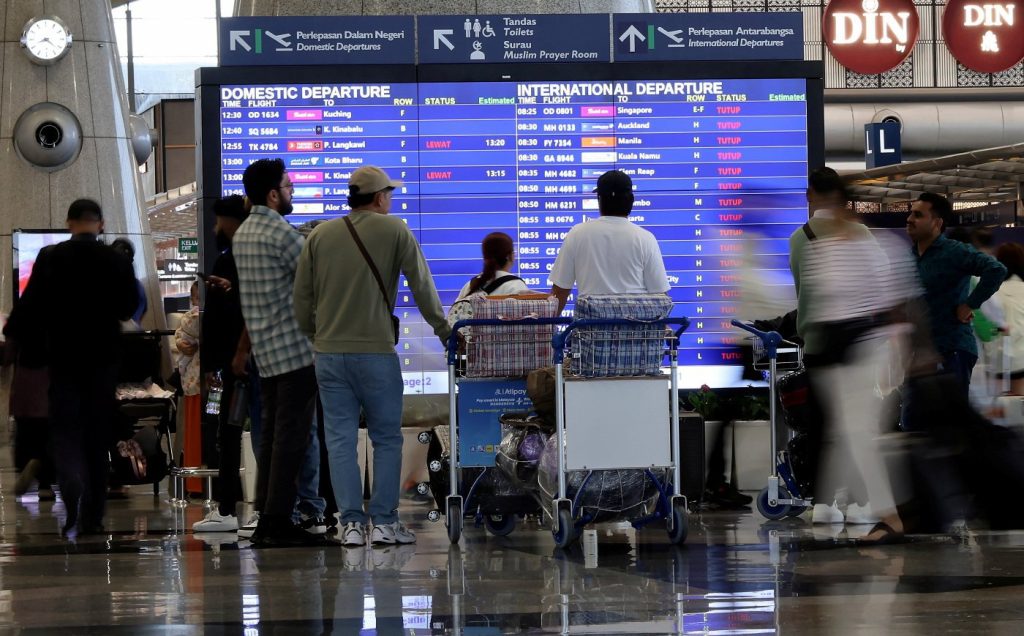
BUILDING TOMORROW… WHILE KEEPING TODAY RUNNING
The scale of the challenge became particularly apparent in 2026, when KLIA’s baggage system experienced a major disruption in April that delayed baggage delivery for many arriving passengers. CAAM subsequently confirmed that operations had stabilized, while the Transport Ministry ordered a review of baggage-handling protocols and infrastructure. The investigation found that a power-system incident caused a voltage dip that led to a controller failure in the baggage system.
That incident was not, in itself, the reason for the long-term replacement programme – the improvement efforts had already been set in motion by then – but it provided an uncomfortable reminder of just how dependent a major international airport is on infrastructure that most passengers never see.
And that brings us to the thinking behind Fallback 360, a resilience framework that was described by Malaysia Airports project director Gaurang Harit earlier this year in International Airport Review.
Rather than treating contingency planning as something reactive – that is to say, somethingto be activated after a failure – the approach was to ask a more useful question: how can the conditions that lead to disruption be reduced before they become a problem? Think of it as proactive problem-solving.
That meant bringing airlines, ground handlers, airport operations teams, and project partners together early to identify vulnerabilities and work out how the airport could continue operating through successive stages of construction and implementation.
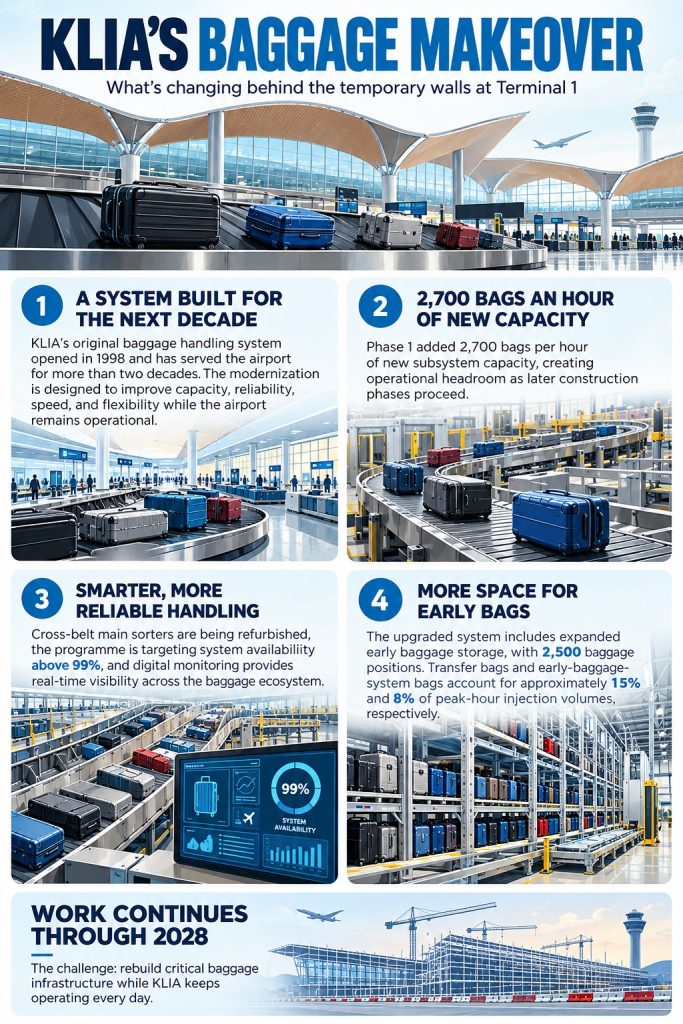
A COORDINATED AND INTERCONNECTED SOLUTION
The Fallback 360 framework, according to Harit, is built around four interconnected pillars, supported by a digitalization layer.
The first pillar is straightforward in principle: have enough fallback capacity before you need it.
Phase 1 of the asset replacement programme added 2,700 bags per hour of new subsystem capacity, providing additional headroom before subsequent stages of construction began. Rather than simply following the original construction sequence, the programme was reviewed as baggage volumes and construction requirements became clearer. The phasing was then adjusted to bring capacity and system availability forward, strengthening the baggage network before the most demanding stages arrived.
That sequencing is particularly important in an airport environment. A new conveyor or sorter is not particularly useful if taking the old equipment offline at the wrong moment creates a bottleneck elsewhere.
The second pillar is reliability.
Some of KLIA’s core baggage infrastructure has been operating for more than 20 years, including its cross-belt main sorters. Their refurbishment therefore forms an important part of the programme. At the same time, the project has been examining condition monitoring and predictive maintenance, with the aim of moving beyond fixed maintenance schedules toward systems that can provide earlier warning of developing problems.
The target is ambitious: system availability above 99%. For an airport, that is not simply a number on a performance dashboard. Every percentage point of availability represents a significant amount of baggage moving through a system that has very little tolerance for failure.
The third pillar is perhaps less obvious but just as important: people and procedures.
A highly sophisticated baggage system is of limited use if, when something goes wrong, nobody is quite sure who is responsible for what.
Fallback standard operating procedures have therefore been revised, with responsibility matrices defining the roles of airlines, ground handlers, and airport operations teams during disruption scenarios. Make-up unit opening times have also been reviewed, while co-ordination mechanisms have been strengthened to reduce the time required to respond when manual and automated operations have to work side by side.
This is an important point. Airports are often described as machines, but they are really enormous collections of organizations, systems, contractors, technologies, regulations, and people that have to operate in close synchronization. The baggage system is merely the part of that ecosystem that happens to have a lot of conveyor belts.
The fourth pillar looks at capacity optimization – improving the efficiency and use of the capacity equation, rather than simply adding more of it.
Analysis found that transfer baggage and early baggage storage collectively accounted for significant portions of peak-hour baggage injections, approximately 15% and 8%, respectively. By managing these flows more intelligently, the airport can reduce pressure on the system during its busiest periods without necessarily having to build more physical infrastructure.
The programme has also examined off-airport and remote check-in possibilities for selected flight categories, potentially allowing baggage acceptance at partner locations and distributing demand more evenly before passengers even reach the terminal.
THE DIGITAL SYSTEM BEHIND THE PHYSICAL ONE
Possibly the most interesting element of the project is the digital layer running across all four pillars. This one is a bit esoteric, though, so it requires a more detailed explanation.
Rather than waiting for the new baggage infrastructure to arrive before improving visibility, the programme has worked with its technology partner to “digitize the existing asset base.” What does that mean? Well, the objective is to create a well-connected baggage environment in which operations teams, airlines, and ground handlers can all see what is happening across the system in real time.
That becomes especially valuable when the airport is operating in an unusual combination of automated and manual modes.
During construction, there will inevitably be sections of the baggage system that are being modified, temporarily unavailable, or operating differently from normal. If a disruption occurs at the same time, the potential for bags to be misrouted (or to miss their intended flight altogether) increases. Real-time information can help reduce that uncertainty.
Instead of relying on assumptions about where a bag should be or whether a particular piece of equipment is functioning, operations teams can make decisions based on what the system is actually reporting.
It comes across as a relatively simple (and obvious) concept, but it’s an important one that gets overlooked or sidelined all too often. Putting it plainly, the idea here is to use the infrastructure that’s already in place to generate more information and intelligence while the new infrastructure is being built.
And there is plenty of new infrastructure coming. The new system is designed around high-speed individual carrier technology, expanded early baggage storage, and improved baggage processing. Earlier information from the project indicated that the new Early Bag Store would provide 2,500 baggage positions, allowing more scope for passengers to check in earlier and for transfer baggage to be managed more efficiently. klia2.info
The physical work, however, is by no means happening overnight.
Malaysia Airports began the latest phase of the programme in July 2026, with work on the baggage reclaim carousels serving international arrivals. Hoarding was installed around Carousel E ahead of replacement of its baggage reclaim belt, with similar work on Carousel F scheduled to begin in August. Both phases are expected to be completed by January 2027 before work progresses through further baggage reclaim areas.
Passengers may therefore continue to encounter temporary arrangements and some congestion in the baggage reclaim hall as the project progresses. Malaysia Airports has said temporary baggage collection areas can be activated when required to manage volumes and prevent congestion, with signage and operational teams assisting passengers during the transition.
And there is a fair bit more work ahead. The overall replacement programme’s completion timeline was revised in 2026 to the fourth quarter of 2028, reflecting the complexity of carrying out the work within a live airport environment.
So, if KLIA’s baggage hall feels a little more cramped than usual these days, there is at least a good explanation. The airport is essentially rebuilding one of its most critical pieces of infrastructure while still continuing to use it every day.
For passengers, the eventual payoff will hopefully be quite a lot less visible than the construction work. Faster baggage movement, more reliable processing, greater early-bag storage capacity, better handling of transfer baggage, and a system capable of supporting KLIA’s next few decades are not particularly exciting things to photograph… or write about… or experience as an arriving passenger.
But they are exactly the sort of improvements that make an international airport work better.
Sources: International Airport Review, Business Today, Malaysia Airports, New Straits Times, CAAM, Free Malaysia Today