



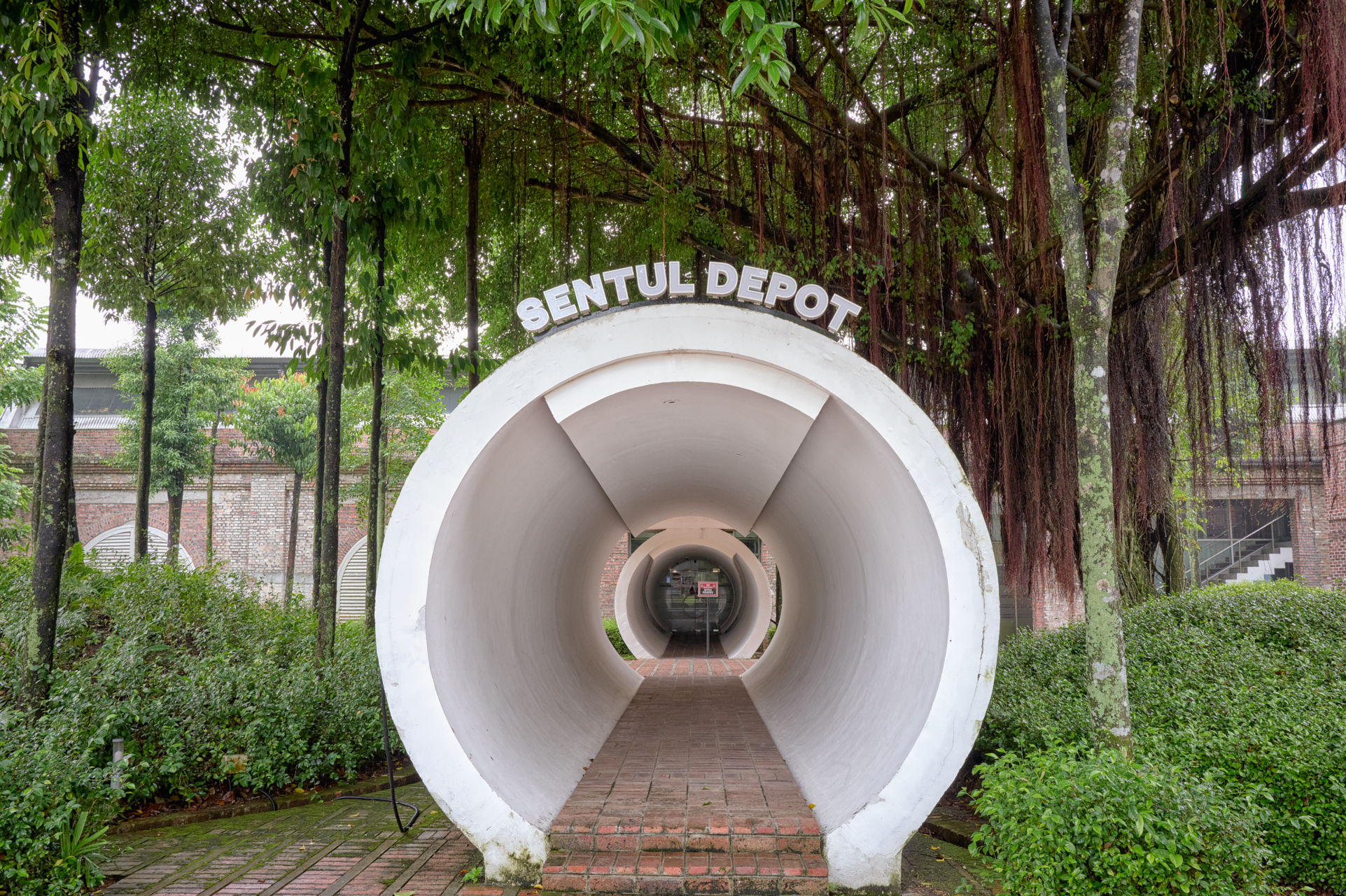
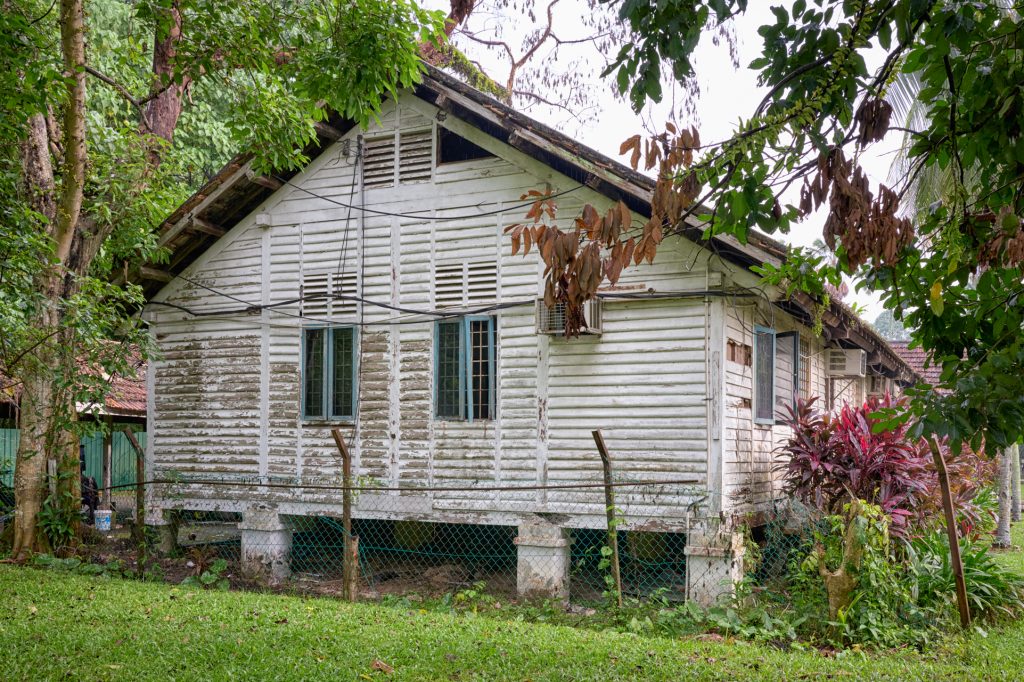
Jalan Strachan, which leads to Sentul Depot, runs straight between tall palms. Trees spread across the lawns on either side, and Sentul Park’s banners hang from the lamp posts. Then, behind a hedge of red cordyline, a long, low timber building comes into view. It’s the kind people here loosely call kampung-style.
The building has white timber weatherboard walls and a clay-tiled roof. Concrete steps lead up to each door, while strips of peeling paint hint at its age.
These were the local housing quarters, a small share of Sentul’s railway housing, and the closest to the workshops. When writer Katherine Sim, author and illustrator of A Career with the Malayan Railway visited in the late 1950s, about half of the works’ 2,500 staff lived in these railway quarters. It was part of a railway village of some 10,000 people in Sentul.
John Strachan, a chartered engineer, became General Manager of the Federated Malay States Railways in 1927, and the road honours his name. Further along it, we pass the former office of the man who ran the workshops under him, the Chief Mechanical Engineer, built more than a century ago. It is two storeys of red brick banded with plaster, the striped style KL knows from its older colonial buildings. Today it is Sentul Works, restored in 2021. It’s now an office building, which YTL Land describes as Kuala Lumpur’s first contemporary heritage office set in a park.
BEST EAST OF SUEZ
Malaya’s railway network began in 1885 with a short line from Taiping to Port Weld. As new lines reached Selangor, Negeri Sembilan and Johor, each state ran its own railway. Small depots were built along the way for repairs. By the early 1900s, the railway lines had connected, traffic had increased, and the need for a central facility had become clear. The Federated Malay States Railways built its State Central Workshops in Sentul between 1904 and 1906, on about 56 acres. At their height they employed up to 5,000 people.
The Japanese occupation during the Second World War disrupted the works, and allied bombing in January 1945 destroyed the electrical, carriage and boiler shops. Much of the machinery had already been moved out to rubber estates in what is now Petaling Jaya Old Town. Even so, after the occupation, the workshops were rebuilt and put back to work.
When writer Sim visited a decade or so later, the Chief Mechanical Engineer showed her around. She began her tour in the engineers’ drawing office, where Sikh, Indian, Chinese and Malay draughtsmen bent over their boards. In the quiet of the air-conditioned gauge room hung a framed letter from 1941, sent by the Chief Inspector of Armaments in Calcutta, rating the railway’s gauges the best he had received from any maker east of Suez.
She continued, crossing the yard into the workshops proper. By then, Sentul was building the railway’s coaches itself. They made about twenty a year, framed in chengal wood, and making almost everything for them on site. Every locomotive came back after 70,000 miles for a rebuild lasting nearly a month, beginning in a bath of steaming caustic soda. Sim called it a “beauty parlour for engines.” The loudest stop was the steam hammer, where a young Malay worker guided it as it forged a block of steel. Each blow shook the ground under her feet.
THOSE WERE THE DAYS
I wanted to learn more about the families though who lived around them. So, I met Guna Ramachandran, author of Sentul Gems, over coffee. I told him what I had read in the historian Amarjit Kaur’s work: the quarters ran from two-bedroom bungalows down to one-bedroom units, some with a bucket toilet, assigned by position and marital status. He knew them well. His grandfather worked in the machine shop from the early 1900s, and the family lived in railway quarters where The Fennel condominium now stands. His father later worked in the CME’s office. Sentul Boulevard, Guna says, was once a large field, and right where the action was. In 1935 a Railway Recreation Club opened there for the workshop’s workers.
I left with a copy of his book and spent the rest of the evening reading it. By the end, I could picture Sentul as it was, down to the hour the siren went. The first sounded at 6.15am, waking the workers and most of Sentul with them. At 6.45, a second sent the men out of their homes to clock in at the Time Taker’s office by the workshop entrance. The third, at 7am, started the working day, and sent the railway children off to the schools around the quarters. At 11.30 the siren went for lunch, and workers streamed out on their bicycles to eat at home. At 12.15 it called them back and the last siren sounded at 4pm, as the workshop staff went home.
SENTUL GEMS
On pay day, a market sprang up along the lanes near the station, close to where YTL’s Saffron condominium stands today. A crossing track cut through the spot, busy with men heading home. Most of them cycled to the workshops, so there were several bicycle repair shops, alongside tailors, barbers, provision stores and coffee shops, each with its own regulars.
The people in the workshop could make almost anything. In Sentul Gems, Guna records a story from Ir. Dalip Singh, who was the railway’s Chief Mechanical Engineer by 1962. When the late Tunku Abdul Rahman needed a spare part for one of the first King’s limousines, a replacement from Britain would have taken too long to arrive. The Machine Shop, where Guna’s grandfather had worked, made one identical to the drawings.
THE SODHI EXPRESS
I drift back to my conversation with Guna. He shared that a whole commercial street grew along what is now Jalan Haji Salleh. Shanghai Laundry did wash-and-press, and Sinwa Shoes sold rubber shoes. A bakery sent loaves out to the railway quarters, and the Asiatic News-stand sold newspapers and magazines. Further along stood Yuen Hup Seng Kopitiam, an Indian restaurant and Yong Hup Seng Bar. Menon Brothers, the tailors, shared the row with Jacob’s dental clinic. Maniram’s cheroot factory sold cigarettes, tobacco leaf, cheroots, betel leaves and nuts. You could find the Indian dhoby’s shop by its washing lines, which needed no pegs. The cloth was twisted into the rope itself, pulled tight enough to hold through sun, wind and the occasional downpour.
Jaswant Singh grew up in the railway quarters facing the railway gate. He recalled in a 2025 post to a Facebook heritage group that the road in front of their houses was called Railway View, or Langgak Keretapi. On weekdays the clerks’ train stopped just past the gate, picking up staff who worked at Kuala Lumpur Station and bringing them home again in the evening. So many of those clerks were Jaffna Tamils that the service earned a nickname: the Sodhi Express, after sothi, the coconut-milk curry that is a staple of Jaffna cooking. Behind the houses ran Institute Road, now Jalan Latihan, where the Railway Club once stood, and beyond it, the workshops.
FROM STEAM TO DIESEL
In the 60s, writer Sim was sure the works would run at full speed “for years to come.” She had in fact arrived at a turning point, when the railway was moving from steam to diesel. Part of the workshops had already been converted for diesel engines. New oil tanks were being installed for the mainline diesel locomotives, and eight railway employees were in Britain training to operate diesel-electric trains.
Rebuilt after the war, Sentul remained the country’s main railway engineering centre well into the diesel era. The railway around it changed its name from the Malayan Railway to Keretapi Tanah Melayu in 1962. The training school Sim heard being planned in 1958 did open at Sentul Depot, in 1973, as the Pusat Latihan KTM, with the Minister of Communications, Tan Sri Haji Sardon bin Jubir, at the opening.
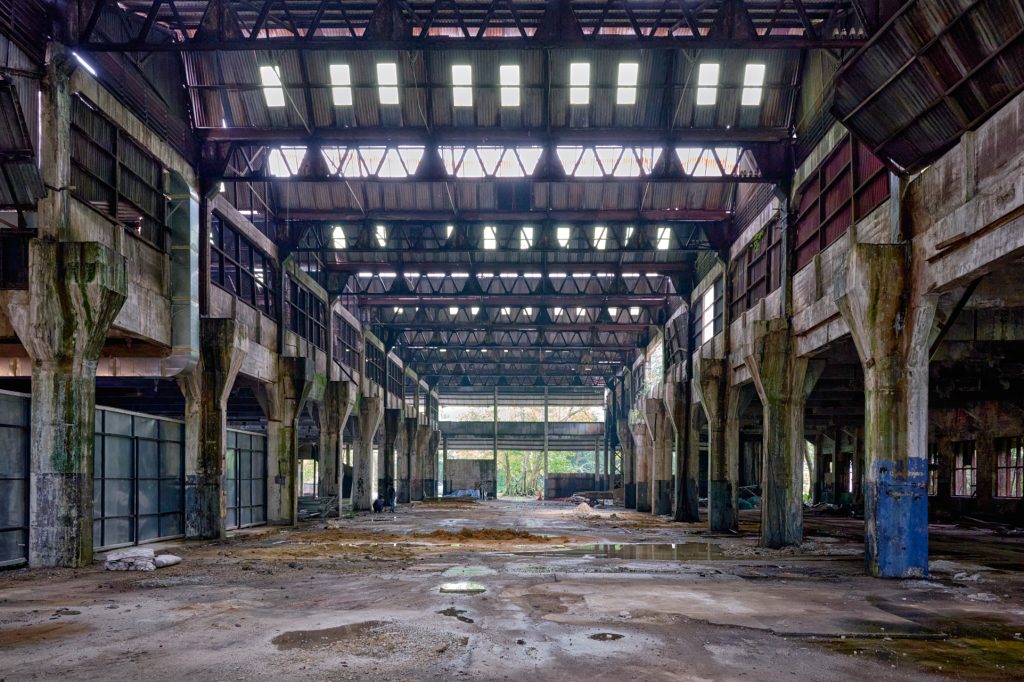
But rail had been losing ground since the 1960s, and the railway industry needed less of Sentul Depot. As the need for large engineering facilities shrank, the workshops and warehouses lost their purpose. They fell into disrepair, and the railway community that had defined Sentul for generations began to scatter. The training centre left for Batu Gajah in 2008, leaving traces along JalanLatihan. The buildings, however, survived.
TREES AND SPICES
YTL’s masterplan covers 294 acres of freehold land, split almost in half by the KTM tracks. Each side has got its own character. Sentul West, at 186 acres, is green and quiet. Sentul East, at 108, is the denser, busier half. The names follow suit, with developments in the west named after trees, starting with The Maple. In the east they are named after spices: The Tamarind, The Saffron, The Capers, and The Fennel.
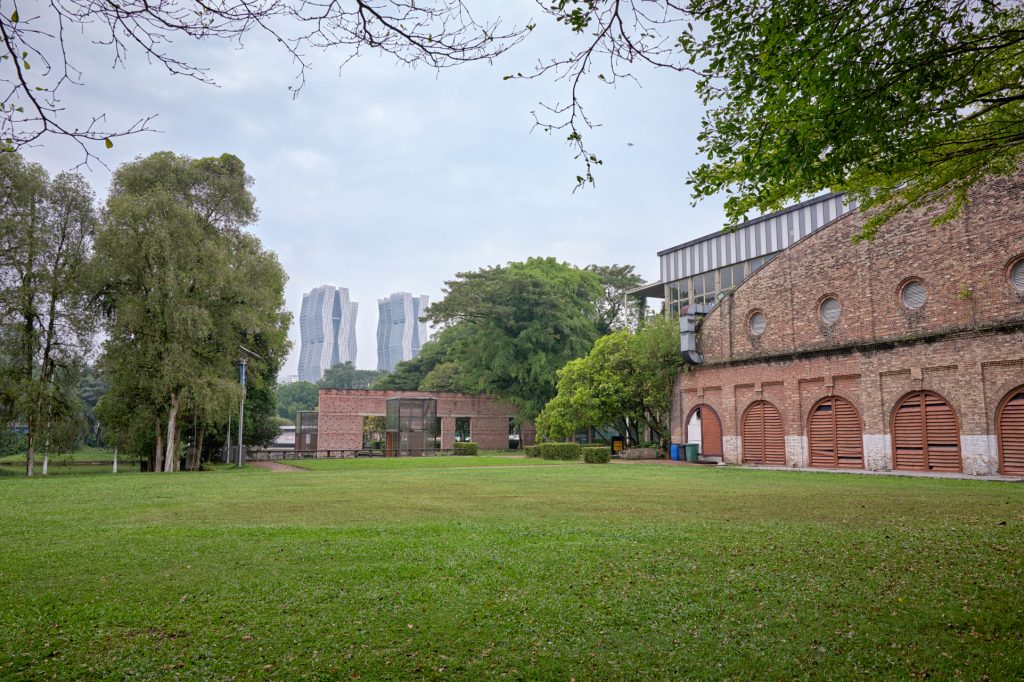
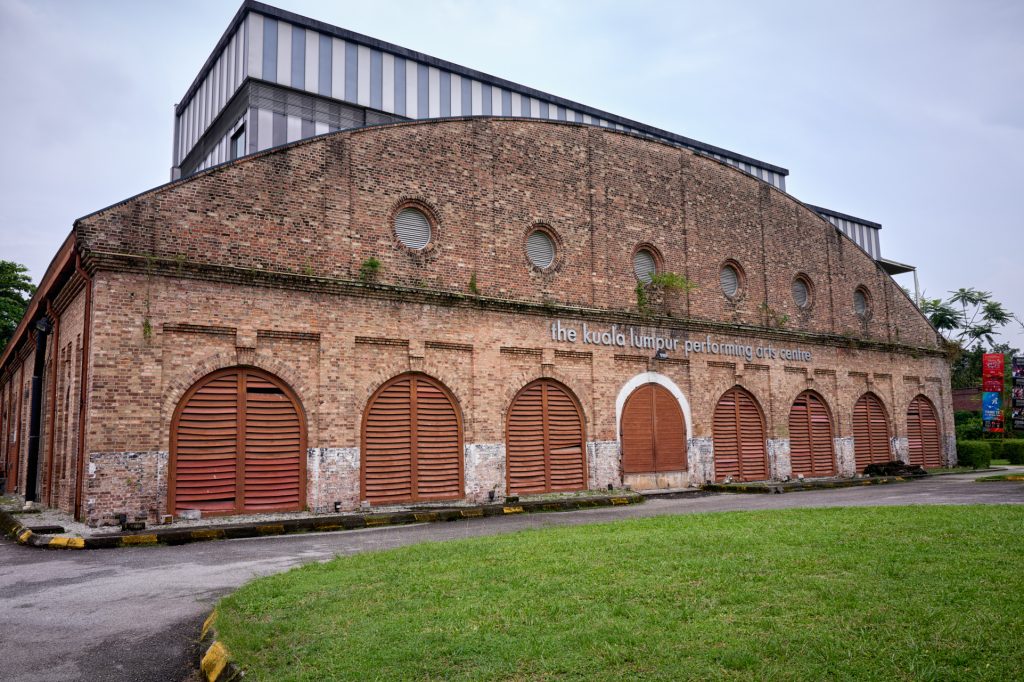
Most redevelopment, YTL argues, clears a place and moves its people out. In Sentul, the plan was to keep the history standing. The first test was the ruined former sawmill, which reopened as the Kuala Lumpur Performing Arts Centre in 2005. Its old façade was left intact and a four-storey steel-and-glass wing set beside it was described as “neutral, non-imposing and democratic.” These days, the parking space in front of klpac is also home to Kabut, a lively flea market. A year later, the railway officers’ old nine-hole golf course became Sentul Park.
Across the road from klpac, two former railway workshops became data centres in 2010 and 2012. Sim ended her tour of the works marvelling at the latent power of electricity. Behind those brick walls today, electricity is the whole business, kept running with backup upon backup, and since 2014 the buildings have held MSC Cybercentre status. In 2013 the railway’s old administration building, with Moorish-influenced arches like those of KTM’s head office and the old Kuala Lumpur station, became YTL’s sales gallery at Sentul Depot.
For the depot itself, YTL names its models as New York’s Meatpacking District and Shanghai’s Xintiandi. The test came over the Malaysia Day weekend in 2018, when Sentul Depot opened to the public for the first time in its 113-year history. More than 18,000 people came. Since then, it has hosted markets, cultural programmes, car launches, fashion installations and other events.
THE POP OF PADDLES AT SENTUL DEPOT
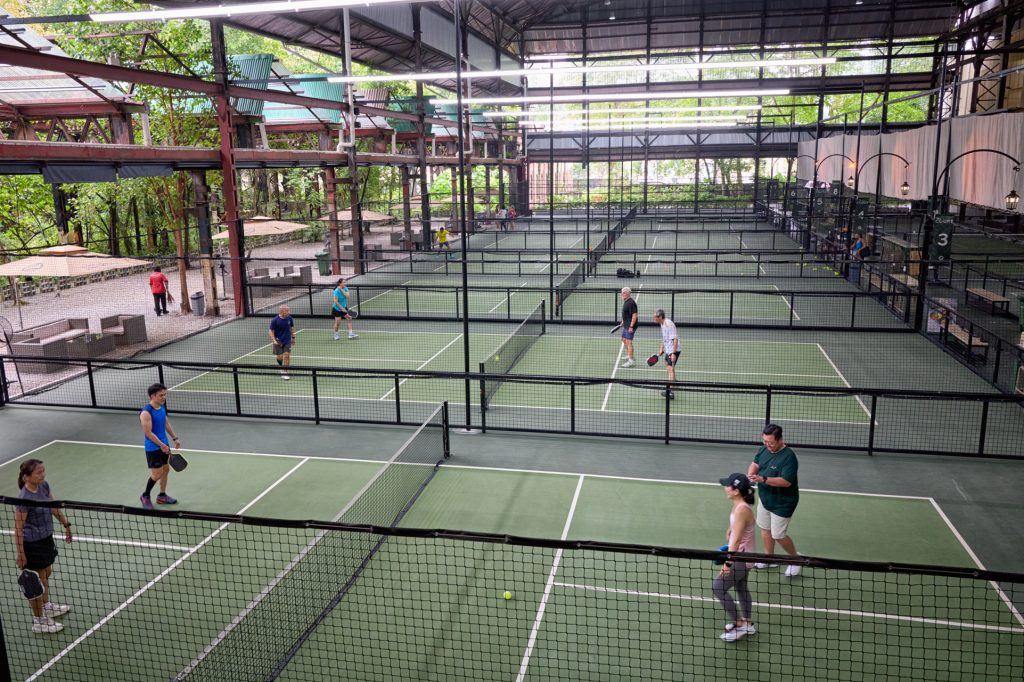
Workshop 2 is about 120 years old. Since July 2025 it has been Pickle Depot and Padel Depot: 50,000 square feet, twelve pickleball courts and four padel courts. The roof trusses overhead are the originals. Beneath them, glass-and-mesh padel cages stand on green artificial turf, with benches, sofas and potted plants lining the aisle between them and tall air coolers standing by. On one side, the brick wall of an older building, with its arched windows, shows through the netting. Elsewhere in the hall, a café counter sits beneath a white-railed mezzanine strung with fairy lights and rattan lanterns. A terrazzo floor gives way to a patch of turf set with café tables. The sound now is the pop of paddles on plastic balls, a dozen courts at once, and someone calling the score.
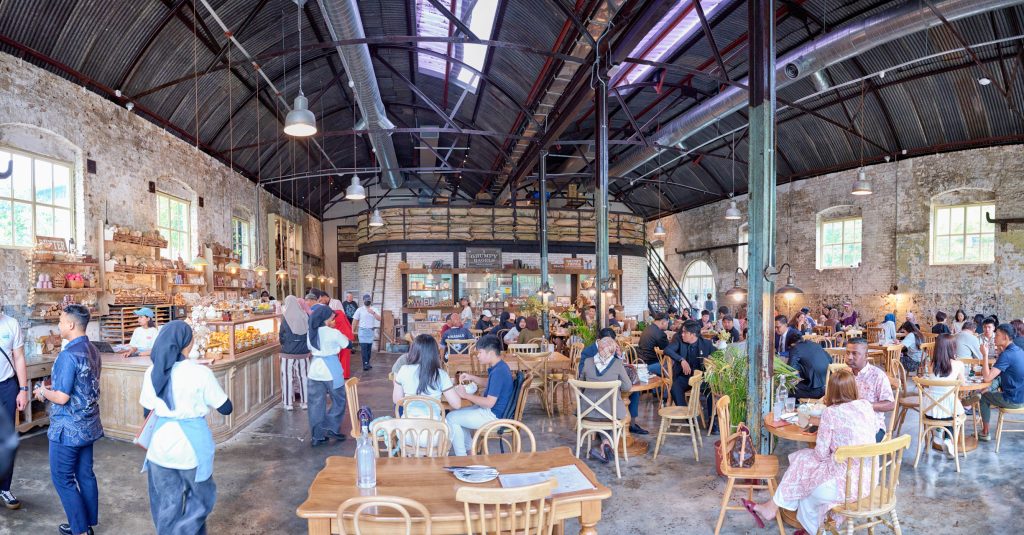
Across the road, the former Diesel Room now houses the ever-popular Grumpy Bagels. The building’s old front, in corrugated metal, had rusted badly. YTL rebuilt it in English bond brickwork, with rows of long brick faces alternating with rows of brick ends, a pattern taken from British industrial buildings. The new front rises in two curved gables side by side, each with a round window near its peak, with the words “Diesel Room” and “1905” lettered across the brick. Below them, tall arched windows and glazed doors are divided into small panes. Inside, skylights bring in the daylight.
The yard would once have rung with the sounds of industry, shed after shed of brick and steel stretching across the site. At 4pm, the final siren sent the workshop staff home, some on foot, many on bicycles, perhaps including Guna’s grandfather. Somewhere among these buildings, in 1958, Katherine Sim watched new profiles being cut on worn wheels, the steel curling away like wood shavings in vivid streaks of cobalt blue and violet.
Written by Manjeet Dhillon