


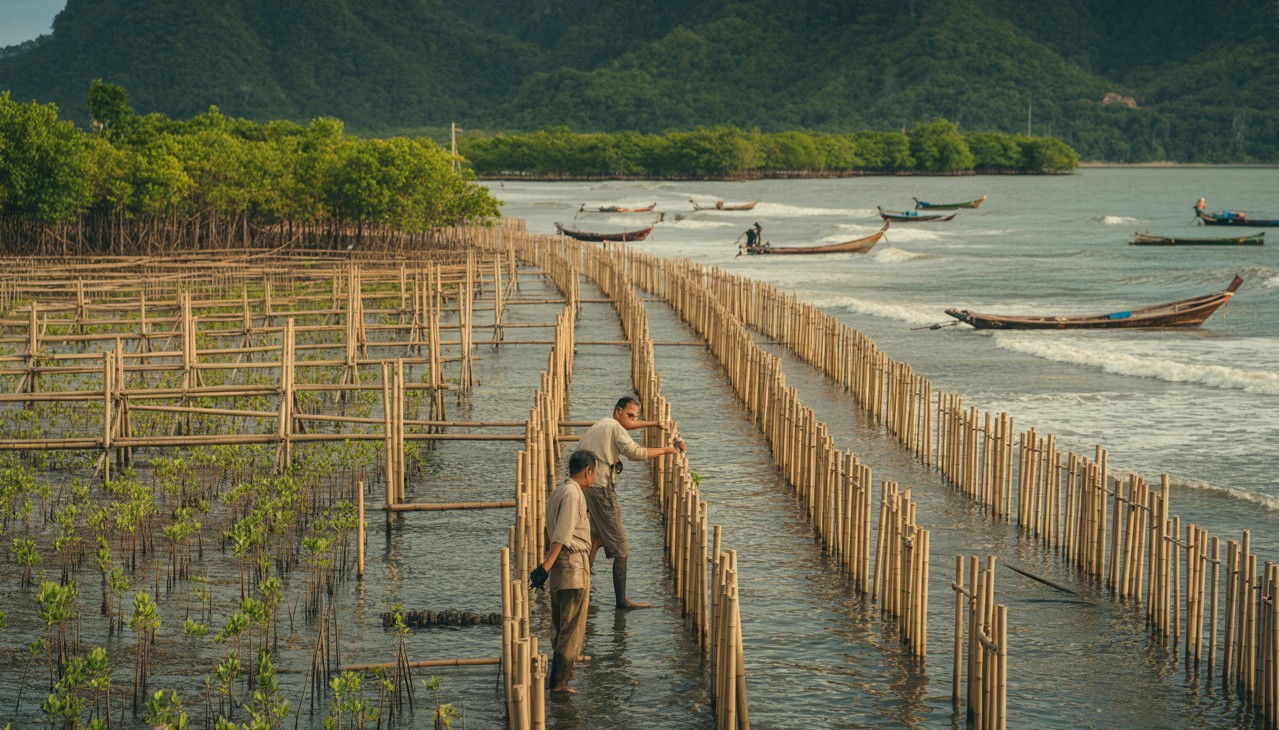
A quietly effective bamboo barrier programme along Thailand’s coastline is reducing wave energy, restoring mangroves, and slowing erosion – offering a practical model that could resonate across Southeast Asia, including Malaysia.
For decades, coastal protection has been largely dominated by a single assumption: that the only way to hold back the sea is with concrete. Seawalls, breakwaters, dikes, and rock armouring have become the default response to erosion and rising sea levels, despite their high cost, heavy carbon footprint, and frequent ecological side effects. In Thailand, however, a markedly different approach has been taking shape since the mid-2010s – one that relies not on heavy engineering, but on bamboo, sediment, and mangrove roots. A decade on, people around the world are now starting to sit up and take notice.
Along vulnerable stretches of Thailand’s shallow coastline, rows of vertically planted bamboo poles are being used to reduce wave energy by as much as 60 to 70 percent. The structures are modest in appearance, but their impact has drawn growing attention from environmental agencies, coastal engineers, and researchers studying nature-based solutions to climate adaptation.
At its core, the initiative is designed to address a problem that has become increasingly urgent across the region: accelerated coastal erosion driven by mangrove loss, land reclamation, aquaculture expansion, and rising sea levels. Thailand, like many coastal nations, has lost extensive mangrove coverage over recent decades. Once these dense root systems disappeared, shorelines were left exposed to tides and storm surges, with soil literally washed away year by year.
In some areas, entire villages began losing land to the sea. Roads collapsed, agricultural plots were abandoned, and protective buffers between communities and open water vanished. Climate change has compounded the issue, with stronger storms and shifting coastal currents creating what scientists now describe as “multifactorial coastal erosion.”
Replanting mangroves was widely recognized as part of the solution, but there was a practical problem. In heavily eroded zones, young mangrove seedlings cannot survive long enough to establish themselves. Without calmer waters and stabilized sediment, restoration efforts repeatedly failed.
THE BAMBOO BARRIER APPROACH
The breakthrough came with a deceptively simple idea: slow the water first.
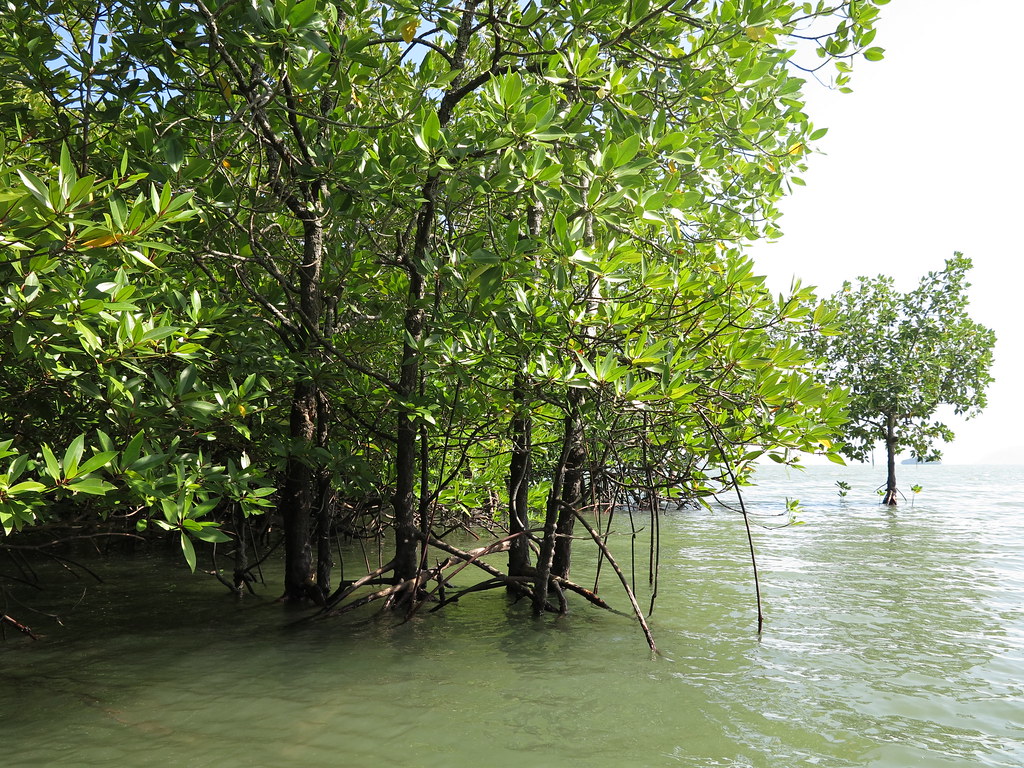
The bamboo barriers consist of double or triple rows of bamboo stakes driven vertically into the seabed, usually in shallow intertidal areas. The spacing between poles allows water to flow through, but breaks up the waves’ energy and reduces current velocity. Rather than blocking the sea, the barriers filter it and diminish its force.
Environmental monitoring conducted by Thai agencies shows that these bamboo installations can reduce wave force by up to 70 percent, depending on tide and wind conditions. That reduction is sufficient to allow suspended sand and mud to settle behind the barriers, gradually rebuilding sediment banks that had previously been lost.
Over time, these newly stabilised areas form the physical foundation needed for mangroves to return – either through active planting or natural regeneration. Bamboo, in effect, buys time. The ecosystem does the rest.
Compared with concrete structures, the advantages are significant. Bamboo barriers are inexpensive, quick to install, and modular, allowing damaged sections to be replaced without dismantling entire systems. They also integrate far more naturally with coastal environments, permitting the movement of fish and other marine life rather than cutting it off.
Importantly for coastal communities, bamboo is locally available and familiar. Installation and maintenance can involve local labour, creating a sense of ownership and participation that large infrastructure projects often lack.
MANGROVES AS A LONG-TERM DEFENCE
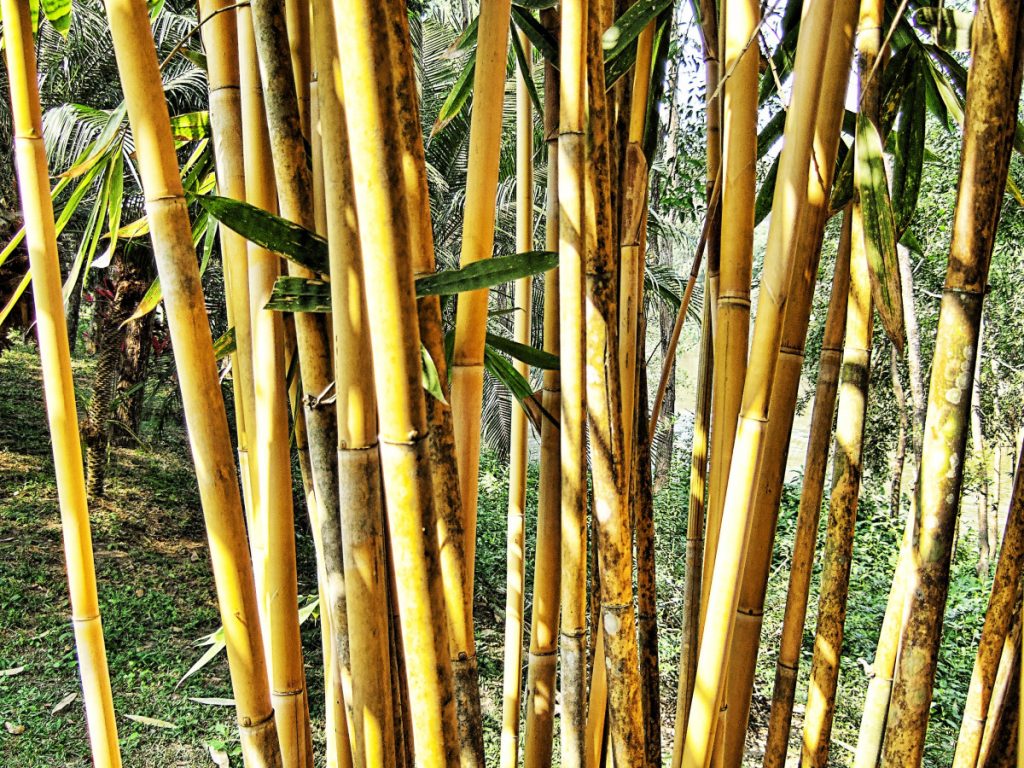
Once mangroves take hold, they become the true engine of coastal protection. Biologists often describe mangroves as ecological engineers, and the term is well earned.
Their root systems bind soil together, preventing it from being swept away by tides. Their dense above-ground structures further reduce wave energy, acting as a living buffer that absorbs impact rather than deflecting it. At the same time, mangroves support complex food webs, serving as nurseries for fish, crustaceans, and mollusks that sustain coastal fisheries.
There is also a climate dimension. Mangroves are among the most efficient carbon sinks on the planet, storing several times more carbon per hectare than many terrestrial tropical forests. Restoring them therefore contributes not only to coastal resilience, but also to broader emissions mitigation goals.
In areas where Thailand’s bamboo barriers have been in place for several years, surveys using drones, aerial imagery, and bathymetric measurements show clear results. Sediment has accumulated behind the barriers, mangroves have returned, and wildlife has followed. Crabs, fish, and coastal birds have reappeared in zones that were previously degraded and unstable.
For nearby communities, the benefits are tangible. Homes, temples, roads, and farmland are better protected from encroaching tides. The economic burden of constant repairs and land loss is reduced, and fishing livelihoods benefit from healthier nearshore ecosystems.
The contrast with conventional coastal defences is stark. Concrete walls may hold back waves, but they often worsen erosion elsewhere, disrupt habitats, and require continuous maintenance. Bamboo barriers, by contrast, are designed to disappear over time as mangroves take over their function.
This philosophy – working with natural processes rather than against them – is increasingly influential in coastal planning discussions worldwide. Similar concepts are now being studied or piloted in Bangladesh, Vietnam, Indonesia, the Philippines, and parts of the United States, where interest in low-carbon, low-impact coastal defences is growing.
Here in Malaysia, the implications are worth serious consideration. With extensive low-lying coastlines, historic mangrove loss, and rising exposure to storm surges, the country faces many of the same pressures Thailand has confronted. While site-specific conditions matter, the underlying logic is transferable: stabilize sediment, reduce wave energy, and allow nature to rebuild its own defences.
Thailand’s experience suggests that coastal resilience does not always require billion-dollar megaprojects. In some cases, it begins with modest materials, applied ecological knowledge, and patience.
Rather than standing as permanent monuments, bamboo poles quietly decay as mangrove forests advance. The sea is not forced back by walls, but gradually softened by roots and branches. It is a reminder that adaptation does not always have to look dramatic to be effective.
If this approach continues to deliver results, Thailand’s bamboo barriers may prove to be more than a local solution. They could become a regional template for Malaysia, Indonesia, and beyond – one that shows how lightweight infrastructure, applied ecology, and community involvement can reshape the future of vulnerable coastlines across Southeast Asia.