



The Nordic countries once again dominate another major global ranking, but there are a few surprises further down the list. Malaysia posts a respectable mid-table finish, while the United Arab Emirates outperforms both the UK and the US, proving that a country’s ranking alone rarely tells the full story.
If there seems to be a global ranking for everything these days, you’re not imagining it. And once again, the Nordic countries have done what they seem to do with remarkable regularity – occupy the very top of another international league table. Clearly, those guys are doing something right!
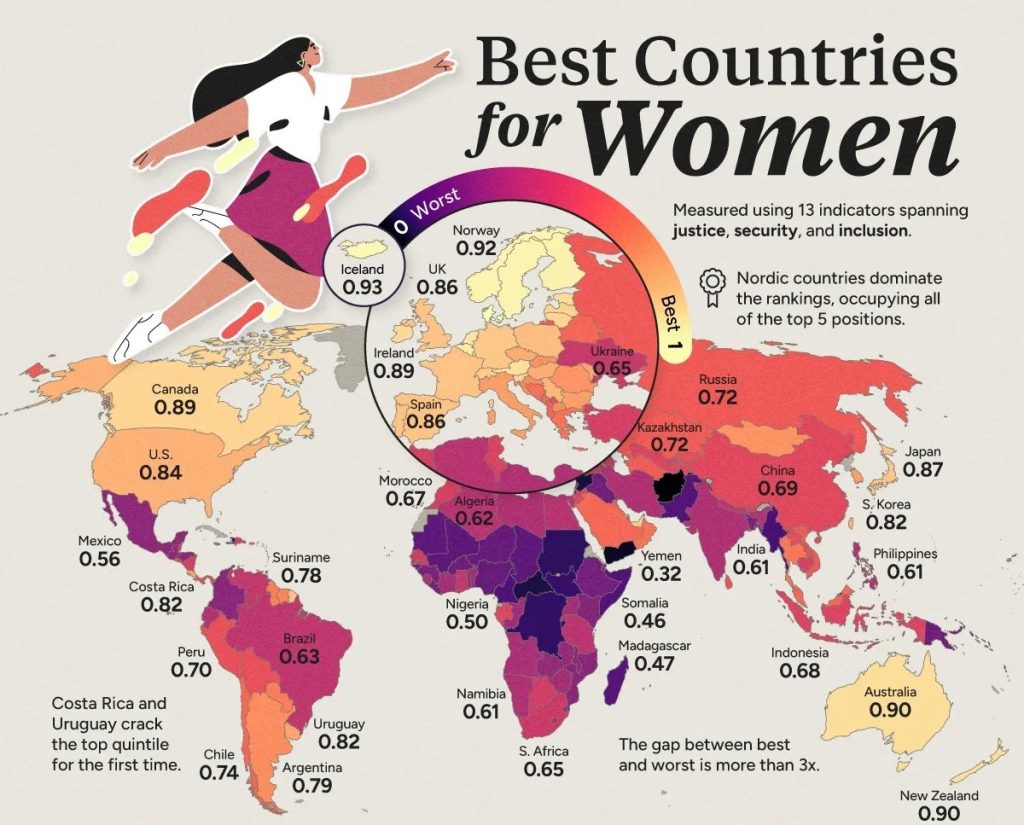
The latest Women, Peace and Security (WPS) Index, published by the Georgetown Institute for Women, Peace and Security and highlighted by Visual Capitalist, ranks 181 countries on how well they support women across three broad pillars: inclusion, justice, and security. Rather than focusing on a single measure, the index combines 13 indicators ranging from education and financial inclusion to legal protections, political participation, safety, and exposure to conflict.
The result is a comprehensive snapshot of women’s wellbeing around the world, and the familiar faces at the top will surprise few observers.
NORDIC COUNTRIES SET THE PACE
Denmark claims first place with an index score of 0.939, followed by Iceland, Norway, Sweden, and Finland. Completing the top 10 are Luxembourg, Belgium, the Netherlands, Austria, and New Zealand.
It’s hardly the first time the Nordic nations have dominated an international quality-of-life ranking. Whether measuring happiness, social trust, education, governance, or gender equality, Denmark, Finland, Iceland, Norway, and Sweden consistently appear near the summit. Strong public institutions, accessible healthcare, high levels of workforce participation, generous family policies, and relatively low levels of violence all contribute to their enduring success.
At the opposite end of the table are countries grappling with prolonged conflict or political instability. Afghanistan ranks last, followed by Yemen, the Central African Republic, Syria, Sudan, Haiti, the Democratic Republic of the Congo, Burundi, South Sudan, and Myanmar, underscoring the close relationship between security, institutional stability, and women’s wellbeing.
LOOK BEYOND THE RANKINGS
For Malaysians, the country’s position of 67th out of 181 nations is perhaps best described as comfortably middle-of-the-pack. It’s not a result that places Malaysia among the global leaders, but neither does it suggest poor performance. In fact, Malaysia sits ahead of numerous developing economies and many countries facing greater political or social challenges.
One of the more interesting outcomes is the performance of the United Arab Emirates, which ranks 20th globally, placing it ahead of both the United Kingdom (24th) and the United States (31st). At first glance, that may seem surprising given longstanding perceptions about women’s rights in the Gulf region.
However, it’s also a useful reminder that rankings can sometimes exaggerate real-world differences.
Just as we’ve seen with global passport rankings, moving 10 or even 20 places up or down the table does not necessarily reflect a dramatic gap in performance. In this case, the UAE’s score of 0.872 differs from the United States’ 0.840 by just 0.032 points on a scale running from zero to one. The numerical difference is relatively modest, even though the ranking gap appears much larger.
The same pattern repeats throughout much of the index, where clusters of countries are separated by only a few thousandths of a point. Readers should therefore pay as much attention to the scores themselves as to the ranking positions.
From the ranking, here’s a round-up of the top 10, bottom 10, and a few other selected countries of interest.
The WPS Index also serves as a broader indicator of institutional strength. Countries that perform well tend to combine stable governments, functioning legal systems, accessible healthcare, educational opportunities, economic participation, and personal safety. Those facing armed conflict or prolonged political instability typically struggle across several of these areas simultaneously.
No index can perfectly capture the lived experiences of millions of women across 181 countries, and cultural, economic, and regional differences inevitably influence the results. Even so, the Women, Peace and Security Index offers a valuable benchmark for comparing national progress over time while highlighting areas where further improvement remains possible.
For Malaysia, the latest results suggest there is room to climb, but they also place the country firmly within the global mainstream. As always with international rankings, the headline positions attract the attention, but the underlying data often tells the more interesting story.
Sources: Georgetown Institute for Women, Peace and Security (Women, Peace and Security Index 2025/26); Visual Capitalist.