



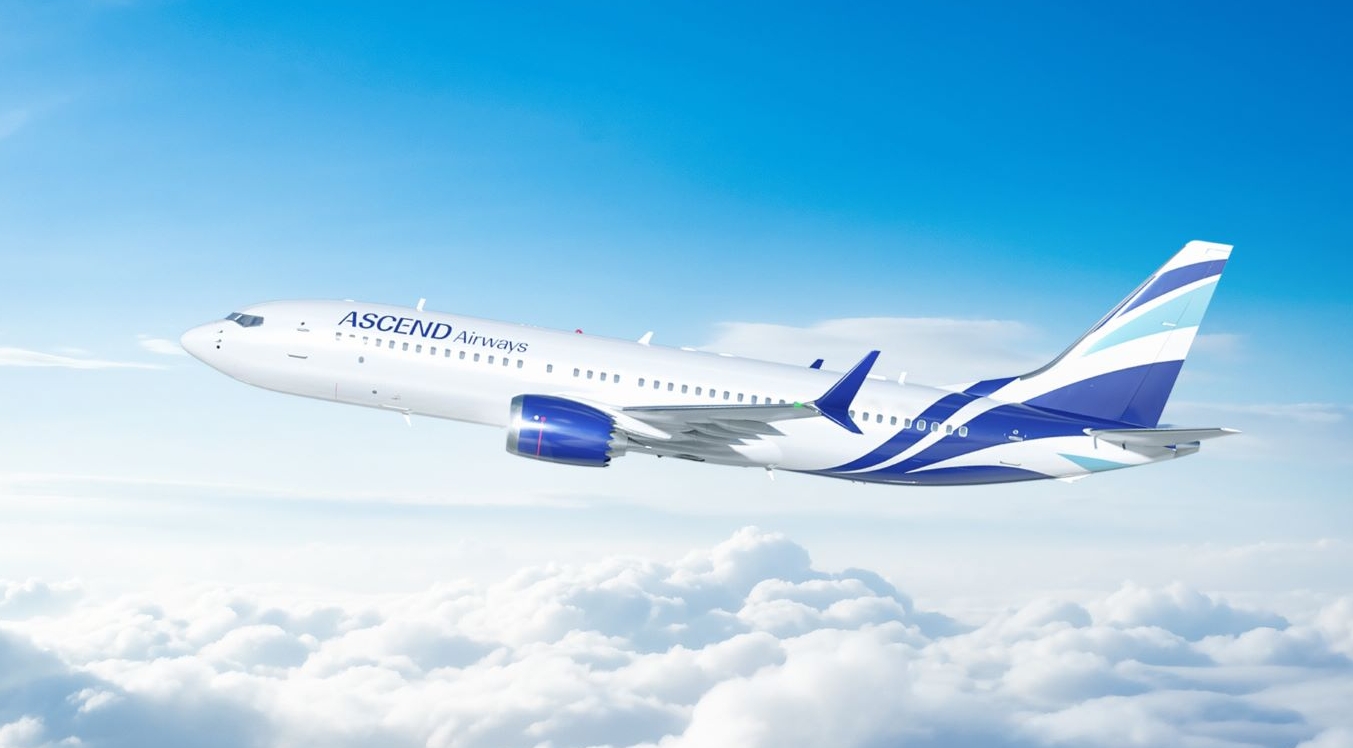
Ascend Airways Malaysia has just cleared another major regulatory hurdle for passenger operations, bringing the ACMI specialist closer to putting its Boeing 737-800s into commercial service.
Malaysia’s airline landscape could soon have another player in the skies, although would-be passengers might be wise to not get overly excited: Ascend Airways Malaysia is likely to be a rather different proposition from the country’s established passenger carriers.
The Malaysia-based airline has secured approval from the Civil Aviation Authority of Malaysia (CAAM) to include passenger operations in its Air Operator Certificate (AOC), following the successful completion of an AOC variation process. The approval adds its first passenger aircraft, a Boeing 737-800 registered as 9M-ASG, to its Operations Specifications, clearing an important regulatory hurdle on the way to passenger operations.
The airline says it expects to have three Boeing 737-800 passenger aircraft operating under aircraft, crew, maintenance and insurance (ACMI) arrangements by the end of 2026.
That last point is quite important. Ascend Airways Malaysia is not being positioned primarily as another traditional scheduled airline competing directly with the likes of Malaysia Airlines, AirAsia, Batik Air, or Firefly. Its core business is ACMI – essentially providing an aircraft complete with crew, maintenance, and insurance to another airline or operator that needs additional capacity. It can also undertake charter operations.
In practical terms, that makes Ascend something of an aviation utility player. Airlines can bring in an ACMI operator when they need additional aircraft quickly, perhaps to cover seasonal demand, fleet shortages, new routes, or aircraft undergoing maintenance, without having to buy or lease an aircraft and build the associated operational infrastructure themselves.
Ascend’s Malaysian operation is part of Avia Solutions Group, a major global aviation services group and one of the world’s largest ACMI providers. The group says its wider operations encompass hundreds of subsidiaries and a fleet of aircraft serving markets across multiple continents. Ascend Airways Malaysia was established specifically to strengthen that ACMI presence in Malaysia and the wider Asia-Pacific region.
FROM CARGO TO PASSENGERS
The airline’s Malaysian story actually began with cargo. Ascend received its Conditional Air Service Permit in 2024, followed by its full AOC and Air Service Permit in October 2025. It subsequently began cargo operations, including flights using a Boeing 737-800 converted to freighter configuration.
Passenger operations have taken longer to reach the runway, but the pieces have gradually fallen into place. Ascend’s first Boeing 737-800NG passenger aircraft arrived in Kuala Lumpur earlier this year, with the airline subsequently announcing plans to add two more.
There has also been considerable interest in the aircraft from other Malaysian aviation operators. Reports earlier this year indicated that three Boeing 737-800s supplied by Ascend were being prepared for wet-lease operations with Sarawak’s AirBorneo as it expanded into jet operations. A wet lease is, in effect, an ACMI arrangement, with the aircraft, pilots, cabin crew, maintenance, and insurance supplied by the lessor.
Ascend’s latest regulatory milestone follows another encouraging development: a passenger “proving flight” reportedly operated between Kuala Lumpur International Airport and Kota Kinabalu International Airport and back on August 10. Proving flights form part of the regulatory process used to demonstrate that an airline and its aircraft, crew, and procedures are genuinely ready for passenger operations.
For passengers, however, there is still one big unanswered question: where will Ascend actually fly?
The company has previously outlined ambitions to serve Malaysia and the broader Southeast Asian region, but it has yet to announce a conventional network of scheduled passenger routes. Given its ACMI-focused business model, some Ascend-operated flights may actually appear under the branding or flight numbers of other airlines rather than as a straightforward Ascend Airways network.
That could make the airline particularly useful in a region where demand can fluctuate dramatically. Southeast Asia’s aviation market is growing rapidly, while carriers regularly face capacity constraints, aircraft delivery delays, maintenance requirements, and seasonal peaks.
For now, Ascend Airways Malaysia is therefore less about the launch of another airline with a big consumer-facing route map and more about adding another piece to Malaysia’s increasingly important aviation infrastructure. Only time and the aviation market will tell if Ascend’s entry into the market will mean anything notably positive – such as lower fares or increased route capacity
With CAAM now having approved passenger operations and three 737-800s targeted by year-end, however, the distinction may soon become rather academic. The aircraft are coming, the regulatory hurdles are falling away, and Malaysia’s aviation scene is about to get a little more interesting.
Sources: Bernama; The Edge; Civil Aviation Authority of Malaysia; Ascend Airways Malaysia; Free Malaysia Today; New Straits Times; Lowyat.NET