



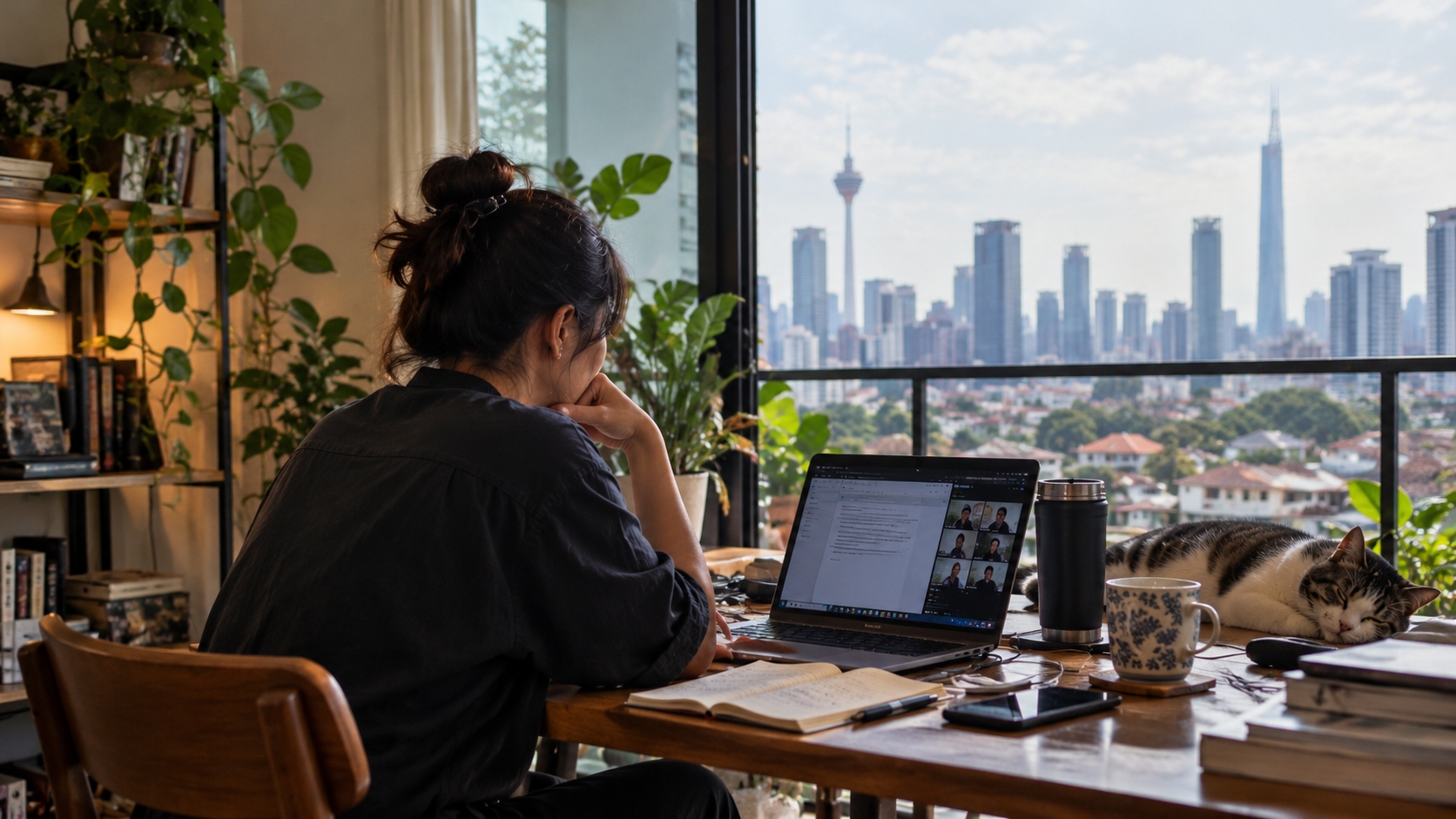
New research suggests that remote work can increase social isolation, while other studies point to better wellbeing and job satisfaction. For Malaysian employees navigating traffic, family commitments, and changing workplace expectations, the healthiest solution may lie somewhere in between.
The Covid pandemic changed the way we work, and for many employees, there was no looking back. Dining tables became desks, video calls replaced conference rooms, and the daily commute was reduced to the distance between the bedroom and the kitchen.
Working from home seemed to offer an attractive bargain: less time stuck in traffic, greater flexibility, more family time, and fewer of the small daily frustrations that can make office life exhausting. Many employees found they could accomplish just as much, if not more, without being tethered to an office desk.
Yet, as pandemic restrictions disappeared, employers began reconsidering their remote-working policies. Some embraced hybrid arrangements, while others increasingly insisted that employees return to the office, arguing that personal interaction strengthens workplace culture, collaboration, and productivity.
The debate remains contentious. Now, emerging research suggests that both sides have a point. Working remotely can bring substantial benefits, but it may also carry a less obvious cost to the employee: reduced social interaction and, for some people, deteriorating mental health.
THE HIDDEN COST OF WORKING FROM HOME
A study published in Science in June 2026 examined survey data from 588,322 Americans collected between 2011 and 2024, excluding the peak pandemic years. Researchers compared changes in wellbeing among people in occupations suited to remote work, such as marketing and software engineering, with those in jobs requiring a physical presence, including nursing and mechanical work.
The findings were striking. After the pandemic, workers in remote-friendly occupations spent more time alone, socialized less after work, and reported greater psychological distress. The effects were particularly pronounced among those living alone.
Researchers found that people in remote-friendly jobs spent approximately an additional hour alone per workday relative to those in occupations less suited to remote work. They also observed increases in mental healthcare use and antidepressant prescriptions.
The findings do not mean that working from home inevitably damages mental health. The study examined population-level changes and cannot establish that every individual will experience the same effects. Nevertheless, it highlights a potential problem that can develop gradually, especially if people are not keenly aware of it.

Working remotely removes more than a commute. It can also eliminate casual conversations with colleagues, spontaneous lunch invitations, and the simple reassurance of being around other people. For someone living alone, a day of online meetings may still involve remarkably little meaningful human contact.
Other research offers a different perspective. A study published in Frontiers in Psychology in July 2026, involving 7,704 employees at a US healthcare organization, found that fully remote workers reported the highest wellbeing, followed by hybrid employees and then those working entirely on-site.
The apparent contradiction illustrates an important point: work arrangements affect people differently. For some, remote work offers freedom and reduces stress. For others, it can become isolating.
WHAT THIS MEANS FOR MALAYSIAN WORKERS
In Malaysia, the discussion has an additional dimension. Anyone who regularly travels into Kuala Lumpur from surrounding areas knows that commuting can quite literally consume hours that might otherwise be spent sleeping, exercising, preparing meals, tending to household demands, or being with family.
Avoiding that journey can make a meaningful difference to daily life. Remote work can also help parents manage childcare, give employees greater control over their schedules, and make professional opportunities more accessible to people with disabilities or chronic illnesses.
A 2025 Malaysia Pulse Survey by professional services firm Aon found that employees valued flexible working for its potential to improve work-life balance, save time, and reduce expenses associated with commuting, parking, and meals. None of this should be surprising, but it’s noteworthy that, even several years after the pandemic, findings suggest that flexibility still remains an important consideration for both employers and employees.
The Malaysian Employers Federation has also reported that hybrid arrangements became widespread in the years following the pandemic. In a 2024 survey of 191 companies, 70.5% reported implementing some form of hybrid working, although the federation cautioned that flexibility was unlikely to replace conventional working arrangements entirely.
Malaysia’s Employment Act 1955 also provides a framework for flexible working arrangements, something of which many employees may be unaware. Under Sections 60P and 60Q, employees may apply in writing to vary their working hours, working days, or place of work. Employers must respond within 60 days and provide written reasons if an application is refused.
These provisions do not give every employee an automatic right to work from home, of course. They do, however, recognize flexibility as a legitimate workplace consideration.
For employers, the challenge is finding an arrangement that supports productivity without overlooking the human factors that influence it. A policy that requires employees to spend two hours travelling to an office simply to attend video meetings with colleagues working elsewhere is difficult to justify. Equally, a company that leaves remote employees disconnected from their teams risks losing the benefits of flexibility.
The answer may be to make office attendance purposeful, with time together devoted to collaboration, mentoring, problem-solving, and relationship-building rather than demanding in-office time spent on tasks that can be performed equally well elsewhere.
WHY HYBRID WORK MAY OFFER THE BEST OF BOTH WORLDS
Research published in Nature in 2024 provides encouraging evidence for this approach. In a six-month randomized trial involving 1,612 employees at a Chinese technology company, researchers compared staff working entirely in the office with those permitted to work from home two days a week.
Hybrid employees reported notably greater job satisfaction, while resignation rates fell by one-third. Performance ratings and promotion outcomes showed no evidence of deterioration.
The results are particularly relevant to employees with long commutes, for whom even two days at home can make a substantial difference. However, the trial involved a specific company and workforce, so its findings should not be treated as a guarantee that every hybrid policy will produce identical results.
As hinted at above, a genuinely well-designed arrangement needs more than a calendar specifying which days employees must appear in person. Managers should coordinate office days so that colleagues can actually work together, while remote employees should have equal access to communication, development opportunities, and recognition.
Employees also have a role to play in protecting their own wellbeing. Those working from home should establish boundaries between professional and personal time, take regular movement breaks, get outdoors (except, perhaps, on high-haze days), and make a concerted effort to maintain social connections. Office workers can benefit from the same habits, along with opportunities to move around and interact with colleagues rather than remaining seated all day.
For people with disabilities, flexibility can be especially important, which makes a lot of sense. Remote work can reduce barriers associated with commuting (and transportation in general), inaccessible workplaces, and the need to repeatedly request accommodations be made. Employers should consider accessibility alongside the social benefits of in-person work.
Ultimately, the question is not whether home or office is inherently healthier. It is whether the working arrangement allows people to do their jobs effectively while maintaining their physical health, mental wellbeing, and personal relationships. Both sides of the equation should be considered, and an employer requiring some in-office work from employees can be just as much about wanting to protect the wellbeing of the staff as it is to contribute to the company’s productivity and bottom line.
In some instances and with some types of work, that means being in the office most days. Others thrive working remotely, and the nature of the work itself may lend itself to this arrangement. For many Malaysian professionals, a sensible hybrid arrangement may provide the most practical balance.
The lesson for employers is coming into clearer and clearer focus as we move further away from the pandemic years and the changes that time wrought: attendance is not the same as productivity, and flexibility is not the same as disengagement. Rather than imposing a universal rule, companies would do well to consider what their employees need, what their work actually requires, and how both can be accommodated.
After all, the goal should be a healthier, happier, and more productive workforce, not simply a more well-attended office.
Sources: Science; NBC News; Frontiers in Psychology; Aon Malaysia; The Star; and Nature.