


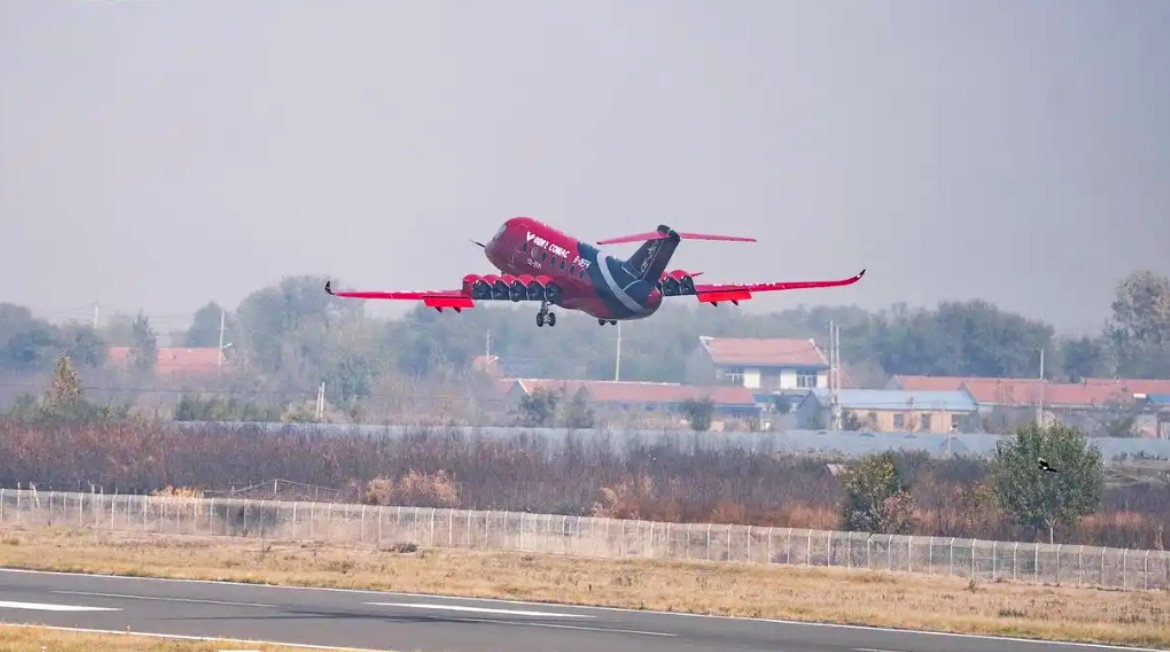
COMAC’s CE-25A has completed its first crewed flight in Shandong, advancing development of a 10-tonne electric aircraft designed for short intercity journeys. It is a significant milestone, although certification and commercial operations remain some way off.
For aviation geeks, there is some pretty cool news coming out of China. They’ve recently taken another step into the future of electric aviation, with the country’s first independently developed 10-tonne electric commercial aircraft completing its first crewed flight in Shandong Province on November 14.
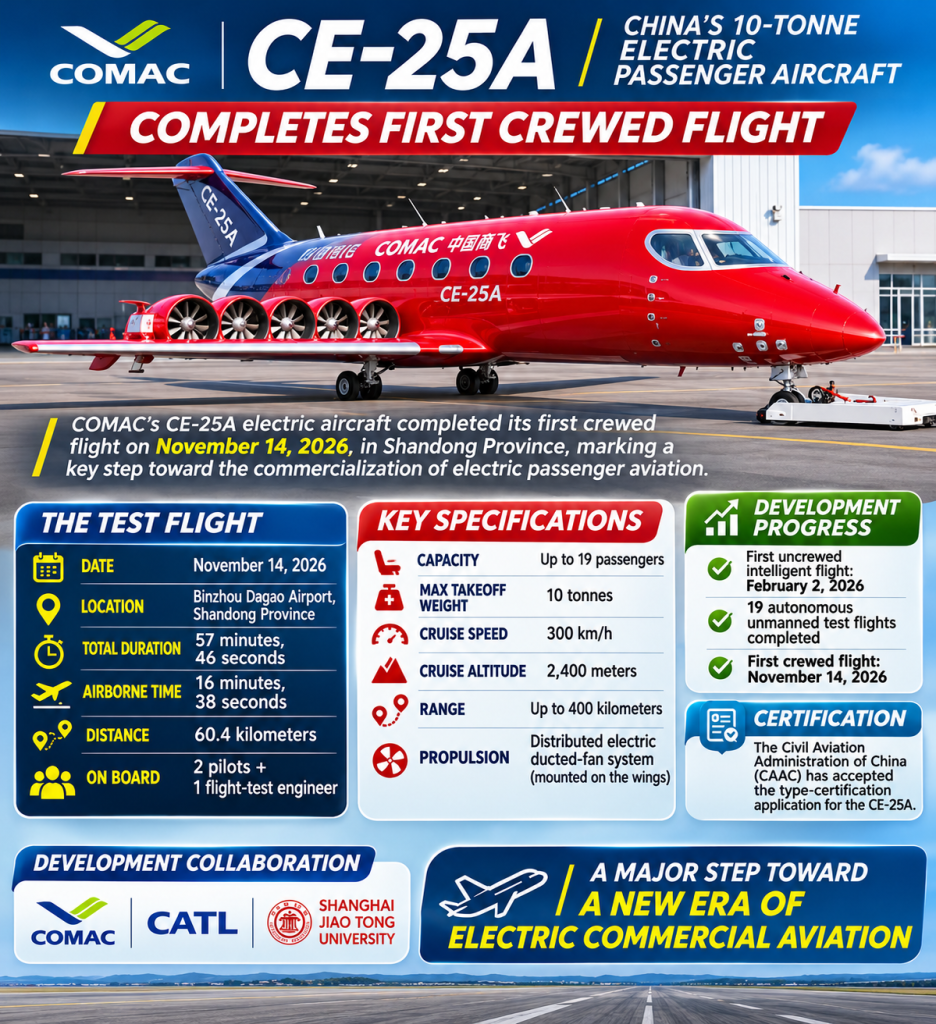
The CE-25A, developed by state-owned Commercial Aircraft Corporation of China (COMAC), carried two pilots and a flight test engineer during the test in Binzhou. According to information released by COMAC and reported by Xinhua, the aircraft performed normally, with all indicators meeting expectations.
The full test lasted 57 minutes and 46 seconds, although the aircraft spent 16 minutes and 38 seconds airborne, covering a distance of 60.4 kilometres. It marks an important stage in the development programme, but should not be confused with a demonstration of the aircraft’s full advertised range.
The flight follows the CE-25A’s first autonomous, uncrewed flight back on February 2 of this year. The aircraft has since completed 19 unmanned autonomous flight verification tests, providing a foundation for the transition to piloted operations.
DESIGNED FOR SHORT-DISTANCE TRAVEL
The CE-25A is COMAC’s first electric commercial aircraft, developed primarily for short-distance passenger services between cities. It has a planned capacity of 19 passengers and a maximum takeoff weight of 10 tonnes.
Its published specifications include a cruising speed of 300 kilometers per hour, a cruising altitude of 2,400 meters, and a range of 400 kilometers. These figures position it firmly in the regional and commuter aviation category, potentially serving shorter routes that would otherwise be operated by conventional turboprop aircraft.
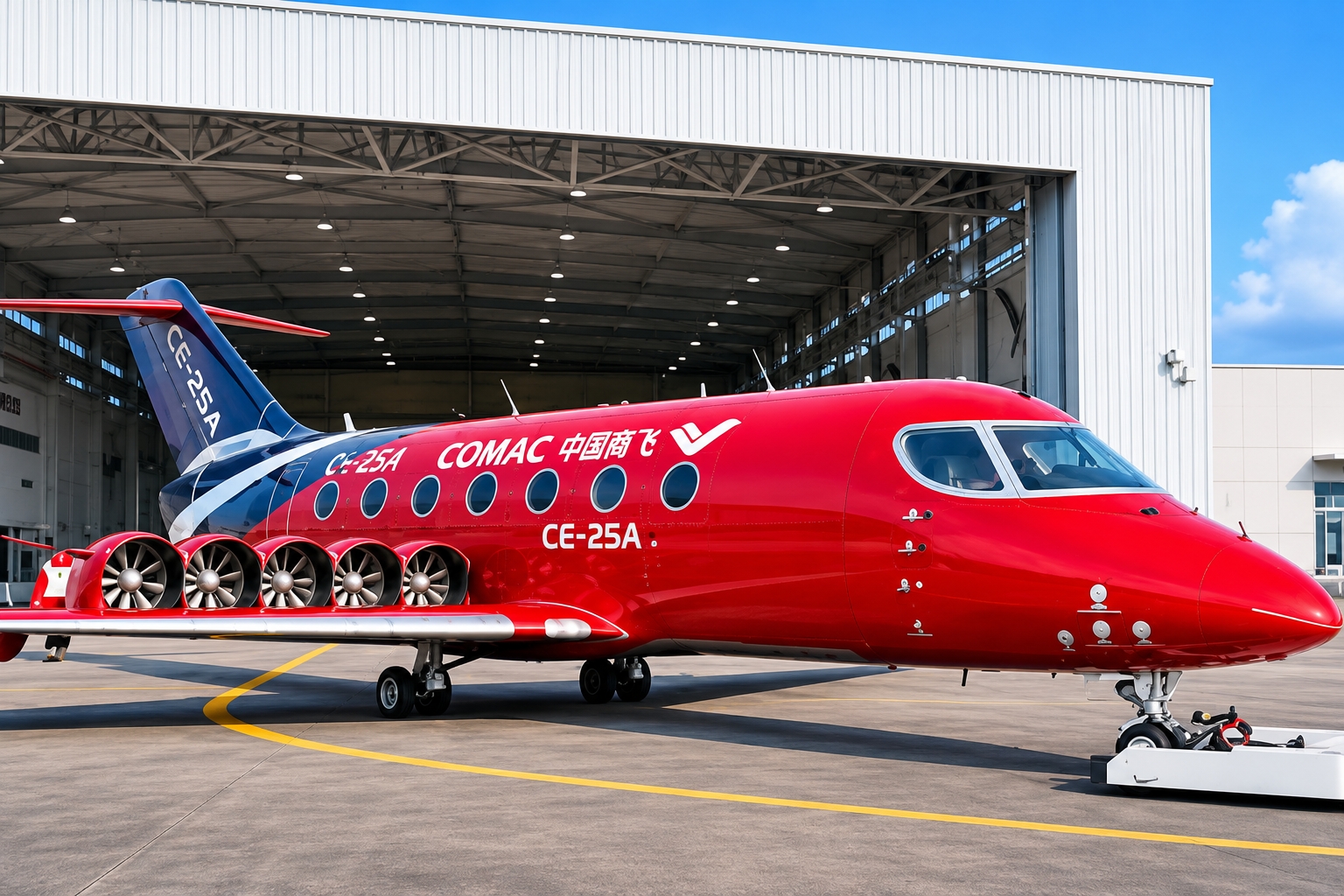
One of its most distinctive features is its distributed electric propulsion system, which uses electrically powered ducted fans mounted along the wings. Rather than relying on the conventional arrangement of one or two engines, the design distributes propulsion across multiple units. This approach offers aircraft designers opportunities to explore different aerodynamic configurations and propulsion efficiencies, although its practical advantages must ultimately be demonstrated through testing and certification.
The aircraft is being developed through a collaboration involving COMAC, battery manufacturer Contemporary Amperex Technology Co. Limited (CATL), and Shanghai Jiao Tong University, among other partners. CATL, one of the world’s leading battery manufacturers, brings considerable experience in energy-storage technology to a project in which battery performance will be central to the aircraft’s viability.
FROM TEST FLIGHTS TO CERTIFICATION
The CE-25A has now reached an important regulatory milestone, with China’s Civil Aviation Administration (CAAC) having accepted COMAC’s application for a type certificate.
That is a significant step, but it does not mean the aircraft has been certified or is ready to carry paying passengers. Type certification involves extensive assessments of an aircraft’s design, systems, performance, and safety, followed by further testing and regulatory approval before commercial operations can begin. No timetable for certification or entry into service has been announced.
The aircraft’s designation also reflects its intended regulatory category. The “C” represents China and COMAC, while “E” denotes electric propulsion. The number “25” refers to China’s CCAR-25 airworthiness requirements for transport-category aircraft, and “A” identifies it as the first model in the series.
THE CHALLENGE OF ELECTRIC FLIGHT
Electric propulsion has attracted considerable interest across the aviation industry, particularly for smaller aircraft and short regional journeys. It offers the prospect of quieter operations and no direct carbon emissions from the aircraft’s propulsion system during flight. The overall environmental benefit, however, depends on how the electricity is generated and the full lifecycle impact of the batteries.
The technology also faces a fundamental challenge: batteries store considerably less energy per unit of weight than conventional aviation fuel. That makes range, payload, endurance, and reserve requirements particularly difficult engineering considerations for electric passenger aircraft. A 400-kilometer design range is promising for a commuter aircraft, but how much of that capability can be achieved with a full passenger load and operational reserves will be an important question as testing progresses.
For China, the CE-25A represents another effort to expand its domestic aerospace capabilities beyond conventional commercial jets. COMAC is best known internationally for its C919 narrowbody passenger aircraft and C909 regional jet, but the electric programme opens a different avenue of development.
The successful crewed flight is an encouraging milestone, not the end of the journey. If the aircraft can meet its performance targets, secure certification, and prove commercially viable, it could eventually offer a new option for short-distance passenger transport. For now, China’s electric aviation ambitions have moved another step closer to becoming airborne reality.
Sources: Xinhua, COMAC, Air Data News, Aviation International News, Global Times, and The War Zone.