


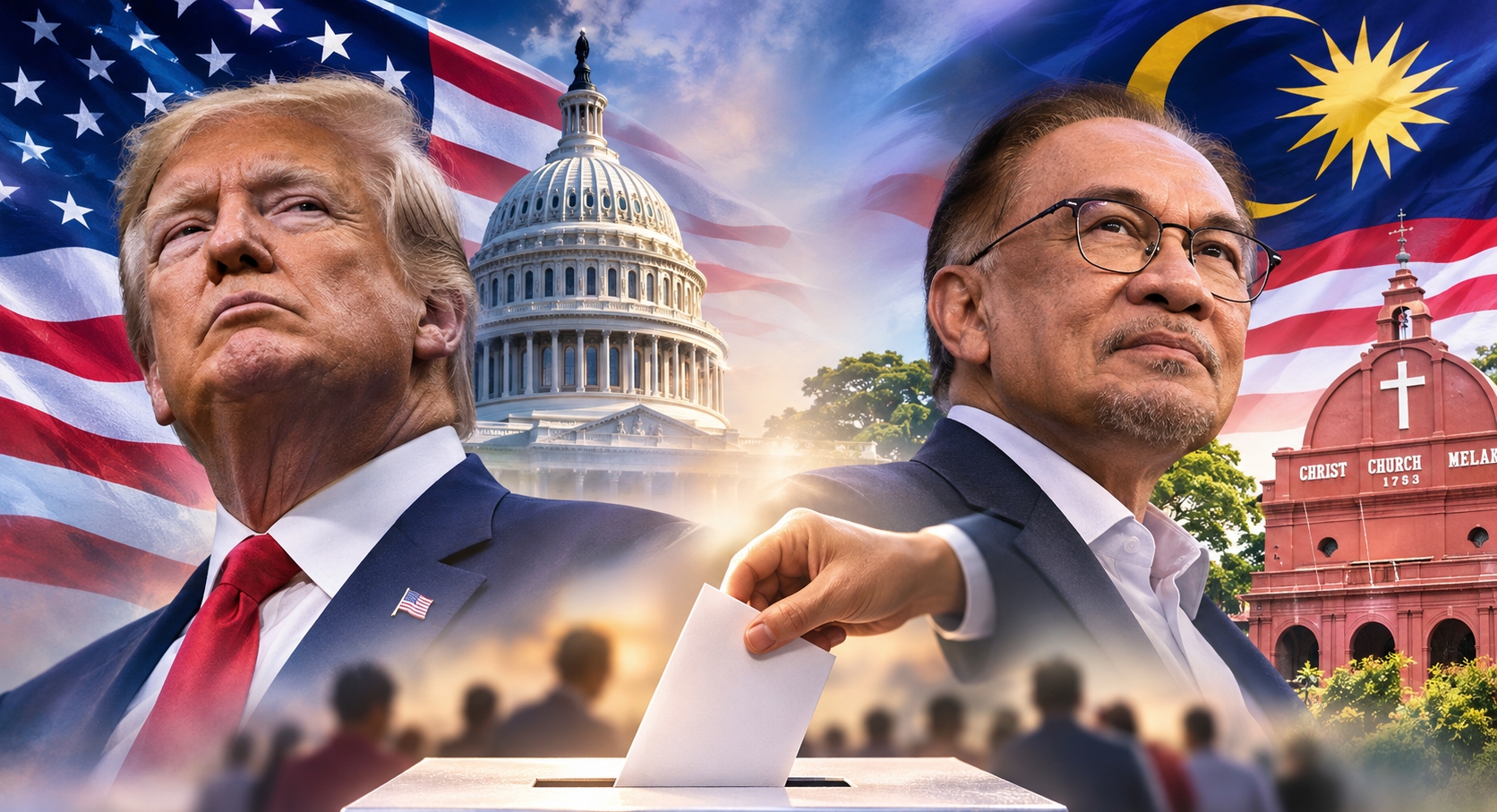
Two very different elections, two bruising messages for governing coalitions. In the United States, voters punished a president and annihilated his party for broken promises and a deeply unpopular record. In Melaka, identity politics and an increasingly consolidated Malay-Muslim vote exposed the vulnerabilities of Malaysia’s multiracial ruling coalition. The common message, however, is hard to ignore: voters want something better.
In Malaysia, expats and other foreign residents are prohibited from getting involved in the politics of the country. This is the correct stance, of course; we are guests here, and though we’re occasionally affected by the political winds, it’s not up to us to steer them. That right, and indeed that obligation, falls to the citizens of Malaysia. Still though, the political-minded among us do observe – often with fascination – the politics of our adopted home. And on the heels of a historic election in the United States a couple of weeks ago, and as an American expat living in Malaysia, I couldn’t help but notice some similarities as well as some striking differences between our recent midterm elections and the ones which were just held in Melaka.
The truth is, elections are rarely neat and tidy exercises in political cause and effect. Voters bring different grievances, shifting loyalties, complex expectations, and nuanced calculations to the ballot box every time. Yet occasionally, results arrive with such force that the message being sent is unmistakable. The recent US midterm elections and Malaysia’s Melaka state polls offer two interesting examples of this – although the reasons behind the respective electoral upheavals could hardly be more different.
In America, the result was a staggering coast-to-coast repudiation of Donald Trump and the Republican administration. Democrats swept into firm control of both chambers of Congress, resoundingly wiping out slim Republican majorities in the House of Representatives and Senate. They also made substantial gains in state-level contests, taking several governorships and flipping a remarkable number of legislative chambers.

For those outside of the US, it’s probably difficult to understand the generational, historic nature of the 2026 midterm election results. Talk of a “blue wave” (with blue representing the Democratic Party) quickly disappeared as the polls closed and the votes were counted. It quickly became evident that this was less of a wave and more of a “blue tsunami.” Then, in the subsequent days, even that term proved inadequate to convey the stunning enormity of the election’s results. “This was a blue supernova,” one political commentor noted.
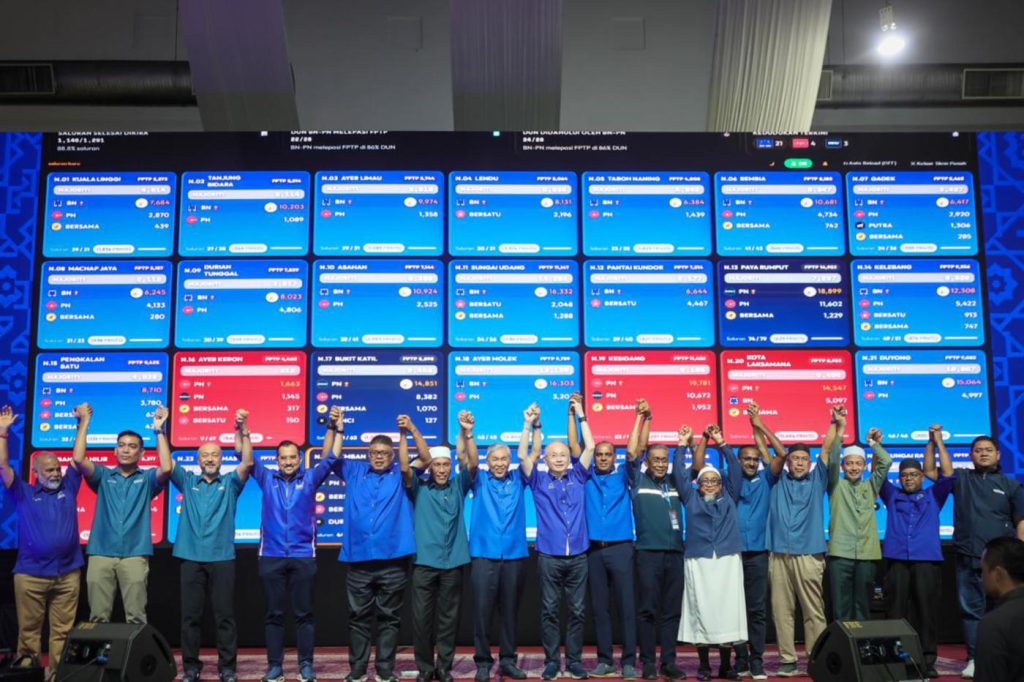
In Malaysia, the story was more complicated, partly because of the difference in the very structure of two countries’ governments, but also because while the US midterms were a whole-nation affair, the Melaka election was confined to one relatively small state. Pakatan Harapan (PH), the coalition led by Prime Minister Anwar Ibrahim at the federal level, suffered a devastating defeat in Melaka, retaining just four of the 24 seats it contested. All four went to DAP. Barisan Nasional (BN), which led the outgoing state government, won 21 seats, while its electoral partner, Perikatan Nasional (PN), secured three.
All of this is noteworthy for a couple of reasons: Melaka’s outgoing state government was not voted out. BN and PN won an overwhelming mandate. It was PH, part of the federal government but electorally squeezed by the BN-PN alliance, that took the indisputable beating.
Nevertheless, both elections offer a sobering lesson for those in power. Voters may disagree about what they want from government, and obviously there are always going to be ideological differences, but those same voters are very much capable of expressing their displeasure when they feel their interests are being ignored.
It’s a pretty long read ahead, but let’s try to unpack everything.
AMERICA: A STUNNING REBUKE THAT SWEPT THE COUNTRY
The scale of the Democratic victory in the United States was extraordinary to say the least. Democrats swept into control of both chambers of Congress, capturing a projected 259 seats in the House – a net gain of 44 – and building a 56–44 advantage in the Senate after flipping nine Republican-held seats, including Alaska, where Democrat Mary Peltola is strongly favoured to prevail. Along with Alaska, typically strong Republican states such as Texas, Iowa, South Carolina, and Mississippi also flipped to the Democrats.
A 44-seat net swing in the House and nine Senate pickups is not a routine midterm setback. It’s a political earthquake, the likes of which had not been seen in US politics in decades. Republicans will be sifting through the rubble of this resounding defeat for years.

The blue wave extended well beyond Congress. Democrats captured several governorships and flipped at least a dozen state legislative chambers, including in places where Republicans had enjoyed lengthy periods of control. Georgia’s state House, for example, changed hands for the first time in more than two decades. Texas, long a Republican stronghold, delivered a particularly emphatic slate of progressive victories, with Democrats winning every single statewide contest.
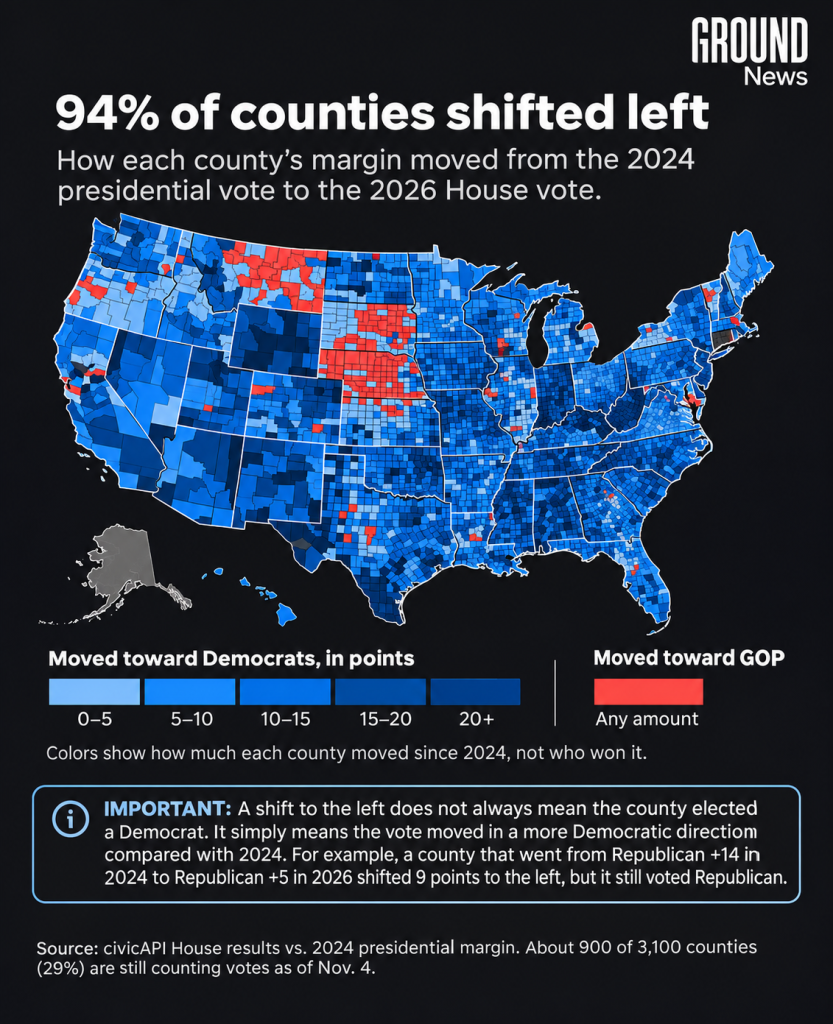
This was not simply a revolt by one demographic, one income bracket, or a narrow band of ideological opponents. Discontent was visible across diverse regions and voter groups, including younger voters and those who had previously supported Trump. The result was less an endorsement of the Democratic Party – whose own popularity remains far from overwhelming – than a determination to put a check on an administration many voters believed had gone badly off course. To put it numerically, there are 3,144 counties (or county equivalents) in the US, including Washington D.C. In the 2026 midterms, a staggering 94% of them shifted to the political left.
The reasons were fairly easy to identify. Trump had campaigned on bringing down prices, restoring prosperity, ending foreign wars, and putting ordinary Americans first. All of it was little more than fiction. Instead, over the last two years, voters faced persistent inflation and mounting costs for groceries, gasoline, healthcare, and housing. His tariffs added further economic uncertainty, while the administration’s decision to take the country into war with Iran became another source of anger. For many Americans, it was an unnecessary conflict with consequences that reached well beyond the battlefield and into their household budgets.
There has also been a profound and remarkably rapid shift in American public opinion regarding the country’s relationship with Israel. In the face of Israel’s continuing actions in Gaza, mounting civilian casualties, and growing sympathy for the Palestinian people, support for the traditionally unquestioning American backing of Israel has eroded dramatically. Recent polling found that six in 10 Americans now view Israel unfavourably, rising to around eight in 10 among Democrats and Democratic-leaning voters. And that shift is beginning to show up at the ballot box.
The American Israel Public Affairs Committee (AIPAC), for decades one of Washington’s most influential lobbying organizations, discovered that its considerable financial muscle no longer guarantees political success. AIPAC and affiliated groups poured approximately US$84 million into the midterm election cycle, yet nearly US$55 million went towards candidates who ultimately lost. Among the most conspicuous setbacks were its expensive efforts (US$31 million) to defeat Michigan’s Abdul El-Sayed, an outspoken critic of Israeli policy, and California’s Aisha Wahab (US$4.4 million). Both won, with El-Sayed becoming American’s first Muslim US Senator. Texas Senator-elect James Talarico, meanwhile, who defeated Republican Ken Paxton in a strongly Republican state, made a point of rejecting AIPAC funding and speaking openly about the need to reassess America’s position on Gaza.

Then there was the question of corruption. The administration’s conduct, Trump’s personal financial interests, the business dealings of associates and family members, and the extraordinary spectacle of a presidency seemingly preoccupied with its own enrichment and vanity projects all became part of the political conversation. The sense that the people running the country were looking after themselves while everyone else struggled proved particularly damaging to incumbents.
Perhaps most importantly, the administration appeared to take no actual interest in the electorate’s priorities. Voters wanted affordable living, economic security, competent government, no foreign wars, and a president focused on their concerns. Instead, they got an increasingly chaotic political spectacle, confrontational and rudderless foreign policy, unhinged and deadly immigration policies, and an administration seemingly determined to pursue its own agenda regardless of public sentiment.
The result could prove to be a generational turning point in American politics. The Democrats now have the congressional power to obstruct Trump’s legislative ambitions, stop funding for the Iran war, investigate his administration, and provide the checks and balances that many voters clearly felt had been missing. The longer-term implications for the Republican Party, and for the political landscape heading into 2028, could be both profound and long-lasting… but only if the Democrats deliver on what voters clearly communicated as priorities.

MELAKA: WHEN IDENTITY BECOMES THE BALLOT
Malaysia’s Melaka election was a different proposition. Yes, PH’s defeat was every bit as humiliating in terms of seats won, but the underlying dynamics were less about a straightforward rejection of government performance and more about the increasingly powerful influence of ethnic and religious identity in the country’s politics – something with which the US has struggled in its electoral history, too (including quite recently).
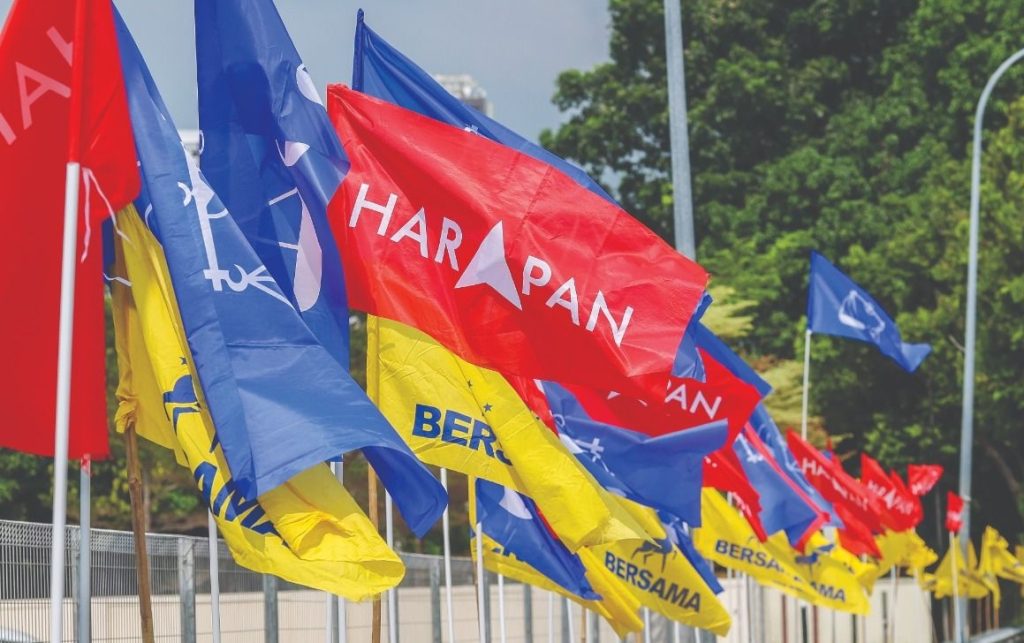
It admittedly all gets a bit confusing for outsiders, particularly those of us who – like Americans – weren’t raised under a parliamentary-style government. But here’s a simplified version, as best as I can see it: The BN-PN electoral pact proved to be highly effective in consolidating Malay-Muslim support. Rather than splitting votes between two competing coalitions, the arrangement brought together much of the electorate that might otherwise have been divided between UMNO-led BN and the PAS- and Bersatu-led PN. With 23 of Melaka’s 28 constituencies being Malay-majority seats, the arithmetic was always going to present a serious challenge for PH. In Melaka, the Bumiputera/Malay cohort accounts for over 71% of the state’s population.
The result was a resounding victory for the alliance, which secured 24 seats and a two-thirds majority. PH, meanwhile, was reduced to just four seats, all held by DAP. The coalition’s Malay-based parties, PKR and Amanah, failed to win a single constituency. Even Adly Zahari, PH’s Melaka chairman and a former chief minister, lost Bukit Katil.

To political analysts, the voting patterns reveal an increasingly polarized electorate. Estimates suggest Malay support for PH fell sharply, while DAP retained overwhelming backing among Chinese voters in its traditional strongholds. The Malay-Muslim unity narrative promoted by BN and PN appears to have helped consolidate one bloc of voters, while simultaneously reinforcing concerns among non-Malay voters and strengthening support for DAP.
That is a genuinely uncomfortable position for Anwar, who – to be fair – has never really enjoyed an especially strong, unified coalition to being with. PH’s political proposition has always rested on its ability to offer a broad, multiracial alternative to the country’s more ethnically defined political groupings. But if Malay voters increasingly gravitate towards BN and PN while non-Malay support remains concentrated in DAP, the coalition runs a real risk of weakening – sort of a political umbrella that no longer provides much shelter for everyone beneath it.
There are, naturally, other factors. PH has faced growing public disenchantment, and its difficulties in winning broad Malay support absolutely did not begin with this election. The alliance between BN and PN also removed the vote-splitting that had previously offered PH opportunities in Malay-majority constituencies. But the unmistakable message from Melaka is that identity politics, long already in play here, is becoming an increasingly potent electoral force, and will likely have consequences for the next General Election.

TWO DEFEATS, TWO VERY DIFFERENT RESPONSES
To me, one of the most revealing differences between the two elections is what happened immediately afterward, and I think Malaysia’s politicians deserve some real credit here.
In Melaka, PH conceded defeat and acknowledged that the result demanded serious reflection. Adly Zahari said the coalition respected the mandate given by voters and would undertake a comprehensive review of its performance, including at the presidential council level. He also acknowledged that PH needed to rebuild public confidence, particularly among younger voters. There was no attempt to pretend that losing 20 of the 24 seats contested was anything short of disastrous for the coalition.
That response absolutely deserves respect and applause. It is not enough to say voters got it wrong, blame the opposition, or insist that the electorate simply failed to appreciate the government’s achievements – all of which Donald Trump and various Republicans in the US have done in the wake of their massive defeat. Unlike them, PH has recognized that something is not working and that its electoral strategy, public engagement, and political direction all need to be reconsidered.

Obviously, the reaction from Trump and his Republican allies has been the polar opposite. Rather than treating the results as a warning that the administration has lost the confidence of a substantial part of the electorate, the public response has largely been to double down. Trump has sought to distance himself from the defeat, blame others, questioned candidate quality, and continued to frame the political landscape in terms of loyalty and opposition rather than the concerns that led to the result. Similarly, other Republican leaders have offered resistance rather than introspection. Outgoing Republican Speaker of the House Mike Johnson flatly declared that American voters “got it wrong.”
Moreover, just days after the election, Trump elevated Stephen Miller to White House Chief of Staff, installing one of the most uncompromising architects of his anti-immigrant agenda in the most powerful unelected position in the administration, horrifying political observers across the spectrum. Miller’s record goes well beyond hard-line immigration policy. An investigation by the Southern Poverty Law Center, based on more than 900 emails he exchanged with Breitbart editors, documented his promotion of white-nationalist literature, racist propaganda, and material from white supremacist websites, including narratives built around the conspiracy theory of a supposed “white genocide.” His elevation sends a fairly unmistakable signal: rather than reconsidering the open racism, xenophobia, and anti-immigrant cruelty that became central features of his administration’s first two years, Trump intends to double down on them.

It is an extraordinary refusal to learn a lesson from what was truly an electoral obliteration. Democrats did not win because every American suddenly became an enthusiastic supporter of their party. They won because enough voters decided that the people currently in charge were doing a terrible job, and that the country needed a different direction. That incredibly clear message somehow seems to have escaped the very people who most need to understand it.
THE UNIVERSAL LANGUAGE OF DISCONTENT
All that said, I do take note that there is a risk in drawing too many direct parallels between American and Malaysian politics. The electoral systems, systems of government, political cultures, party structures, and issues shaping voter behaviour are as vastly different as the two countries are in sheer size. The US midterms were a national referendum on a president, his administration, and Republican-controlled Congress. Melaka was a state election shaped by local dynamics, coalition manoeuvring, and a deeply entrenched politics of ethnicity and religion.
But from my perspective, the broader lesson is still very much there to see. Voters do not owe governing parties their blind loyalty. Electoral victories are not blank checks, and past achievements do not excuse present failures. Regardless of the country, I think most people just want governments that understand their concerns and deliver meaningful results they can actually see in their daily lives.
In America, that meant affordable groceries, gasoline, housing, economic stability, and a government that appeared to be working for ordinary citizens rather than the president and his circle. In Malaysia, the calculation is more complex, involving economic anxieties, political representation, racial and religious identity, and confidence in the coalitions competing for power (as well as their individual parties). But the underlying demand for effective leadership and a credible political alternative is just as real.
For Anwar and PH, political observers in Malaysia have said Melaka should be treated as an unmistakable warning ahead of GE16. It should now seem self-evident that the ruling coalition can’t rely on its federal incumbency, its existing support base, or the assumption that its component parties will somehow hold together. Political pundits say that PH needs to demonstrate that it can deliver, reconnect with Malay voters without alienating others, and offer a compelling reason for Malaysians to give it another mandate. From where I sit, though, in the face of the Melaka election results, that seems to be getting further and further out of reach.
For Trump and the Republicans, however, the message from America is far more direct and immediate. The midterms were an utterly stunning rebuke of Trump and his MAGA movement. It was not even a close race. Voters annihilated Republicans in all areas of the country, and in all levels of government. Republican control of Congress has been lost, traditional strongholds have fallen, and from state legislatures to the halls of Washington, Democrats will hold new power. And if they do not deliver the expected change, voters will surely let their wrath be known at the ballot box in 2028.

The bottom line, at least as I see it, is that even though there were some interesting similarities, the two elections were not identical expressions of the same political mood. One was a sweeping, nationwide rejection of a governing administration’s record; the other exposed the increasingly divisive power of identity politics and the fragility of a multiracial governing coalition. But both should remind politicians of a basic democratic truth: voters are not there to serve the interests of political parties. Political parties are there to serve voters.
As Senator-elect Abdul El-Sayed plainly noted in a recent interview, “The point of these jobs is not just to sit in the seat. The point of the job is to use the seat to serve the public.”
And in any democracy, no matter how flawed or fractious it may be, when the people in government forget where their power actually comes from, the voters – from whose consent that very power is derived – have a very effective way of reminding them.
Sources: Associated Press, Ballotpedia, International Institute for Strategic Studies, Channel NewsAsia, The Edge, The Star, Malaysiakini, and the National Conference of State Legislatures.