

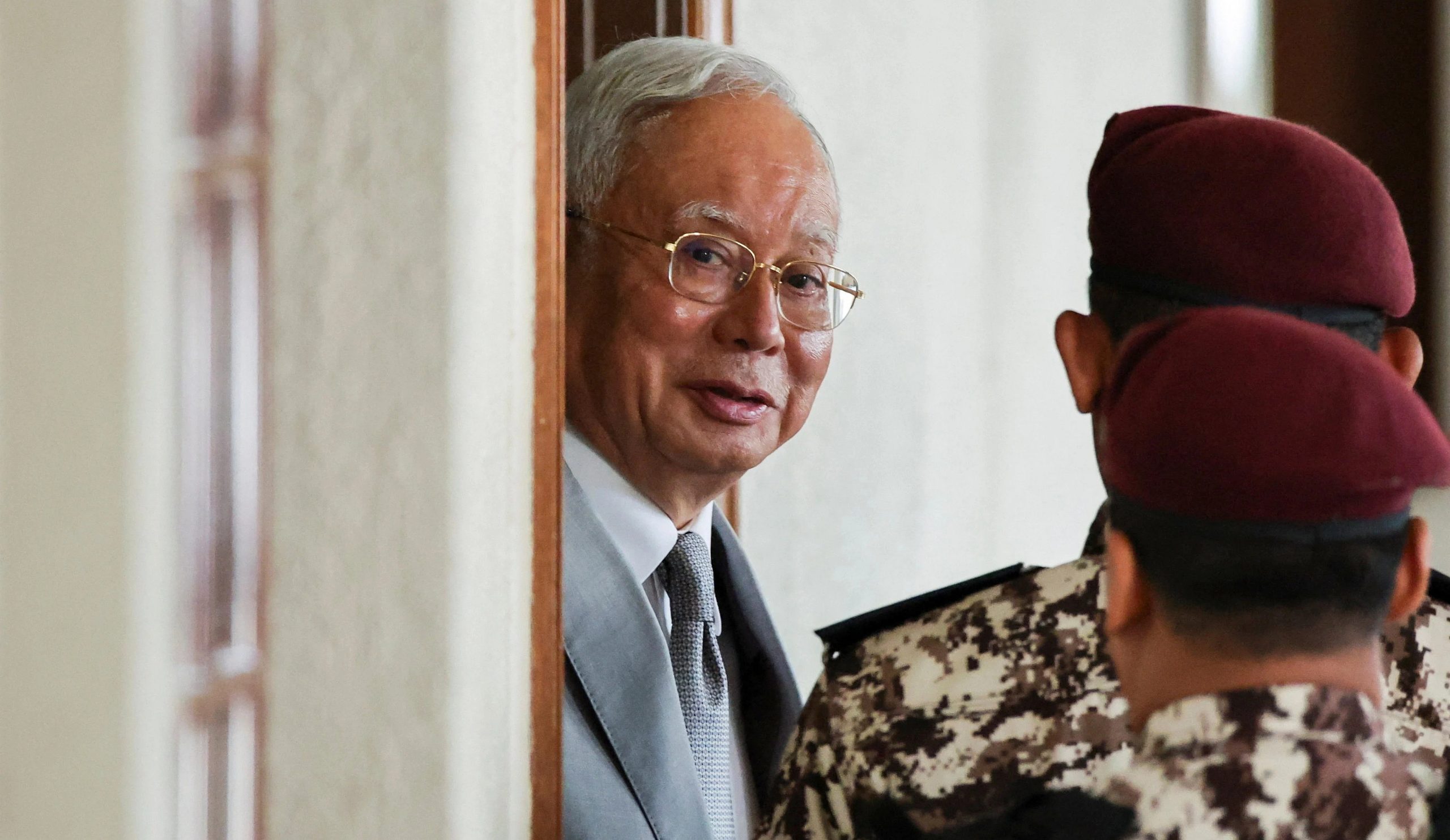
A sweeping High Court ruling deepens the downfall of Malaysia’s former prime minister, delivering one of the most consequential judgments in the country’s legal and political history.
Malaysia’s former prime minister Najib Razak was sentenced on Friday to a further 15 years in prison and fined RM11.39 billion in connection with abuse of power and money laundering linked to the 1Malaysia Development Berhad (1MDB) scandal, a landmark ruling that closes one of the most significant chapters in Malaysia’s fight against grand corruption while opening new fault lines within the country’s governing coalition.
The decision, delivered after a five-hour verdict reading by High Court judge Collin Lawrence Sequerah, found Najib guilty on all four counts of abuse of power and all 21 money laundering charges. The court ordered that the prison terms be served concurrently, commencing after Najib completes his current sentence in 2028, following an earlier conviction in a separate 1MDB-linked case.
In addition to the prison term, Najib was ordered to pay RM11.39 billion in fines, with the court directing that RM2.08 billion in assets be recovered. Failure to comply with the financial penalties would result in additional jail time.
The ruling represents the heaviest judicial reckoning yet for Malaysia’s most divisive modern political figure and the most substantial outcome in a scandal that investigators in Malaysia and the United States say saw at least US$4.5 billion siphoned from the state investment fund Najib co-founded in 2009.
A VERDICT GROUNDED IN EVIDENCE, NOT POLITICS
In rejecting Najib’s long-standing defence that he was deceived by subordinates and external actors, Judge Sequerah described the argument as implausible, stating that to accept it would “stretch the imagination into the realms of pure fantasy.”
“The contention by the accused that the charges against him were a witch hunt and politically motivated were debunked by the cold, hard and incontrovertible evidence,” the judge said, adding that Najib had abused the extensive powers vested in him at the apex of the decision-making structure at 1MDB.
Najib, now 72, has consistently maintained that more than US$1 billion that flowed into accounts linked to him were donations from Saudi royalty, a claim repeated throughout years of investigations and court proceedings. That argument was again dismissed, with the judge noting that the purported donation letters were likely forgeries and that the funds could be traced back to 1MDB.
Describing Najib as “no country bumpkin,” the judge pointed to his British education, political lineage, and seniority in government, concluding that he possessed superior intelligence and full awareness of the transactions in question.
Central to the court’s findings was Najib’s relationship with fugitive financier Low Taek Jho, better known as Jho Low. Judge Sequerah said the evidence revealed an unmistakable bond between the two, with Low acting as Najib’s proxy and intermediary in 1MDB affairs. Low has been charged in the United States for his alleged role in the scandal but denies wrongdoing and remains at large.
Najib, who appeared subdued in court, issued a statement through his lawyer urging Malaysians to remain calm and rational. He said his continued legal battle was not an attempt to evade responsibility, but an effort to uphold justice and constitutional integrity. His lead counsel, Muhammad Shafee Abdullah, confirmed that an appeal would be filed.
FROM FINANCIAL SCANDAL TO POLITICAL STRESS TEST
The verdict lands at a sensitive moment for Malaysia’s ruling alliance, led by Prime Minister Anwar Ibrahim, whose coalition includes the United Malays National Organisation (UMNO), the party Najib once dominated and over which he continues to wield influence despite his imprisonment.
Najib’s conviction comes just days after a court rejected his bid to serve his existing sentence under house arrest, a request that followed a controversial decision in 2024 by a pardons board chaired by the former king to halve his original jail term to six years. That partial royal pardon reignited debate over judicial independence, executive influence, and political accommodation.
Within UMNO, reactions have been mixed. Some senior figures expressed disappointment at the court’s refusal to grant leniency, while others criticised celebratory social media posts by members of Anwar’s coalition following the decision. Anwar himself urged restraint, calling on all parties to accept the ruling with patience and wisdom.
The verdict also underscores the long and often obstructed path taken by investigators. The Malaysian Anti-Corruption Commission has previously acknowledged that its probe faced significant legal, technical, and jurisdictional challenges, particularly during Najib’s tenure in office, when former officials and political observers alleged systematic interference with domestic investigations.
While Malaysian probes encountered plenty of what critics say was politically orchestrated resistance, foreign authorities in the United States, Switzerland, and Singapore pressed ahead, seizing assets and securing settlements linked to 1MDB funds. US civil forfeiture cases detailed how misappropriated funds were used to finance luxury purchases, including a US$120 million superyacht, private jets, high-end real estate, artworks, jewellery, and the Hollywood film The Wolf of Wall Street.
Low, a savvy networker with access to global elites, was known for attending lavish parties with American celebrities, a lifestyle that became emblematic of the excesses associated with the scandal.
For Malaysia, the implications of Friday’s ruling extend beyond Najib himself. It is widely seen as a defining test of the country’s institutional resilience and judicial credibility, particularly as the government continues to position itself as committed to reform, accountability, and the rule of law.
MACC chief commissioner Azam Baki described the decision as neither celebratory nor personal, but rather the fulfilment of a national duty. “It reflects the responsibility we carry to the country,” he said.
As reported today, December 30, Najib has filed an appeal against the conviction and the sentence.
SOURCES: Reuters, Malaysian High Court proceedings, Bernama, Malaysian Anti-Corruption Commission statements, US Department of Justice filings