

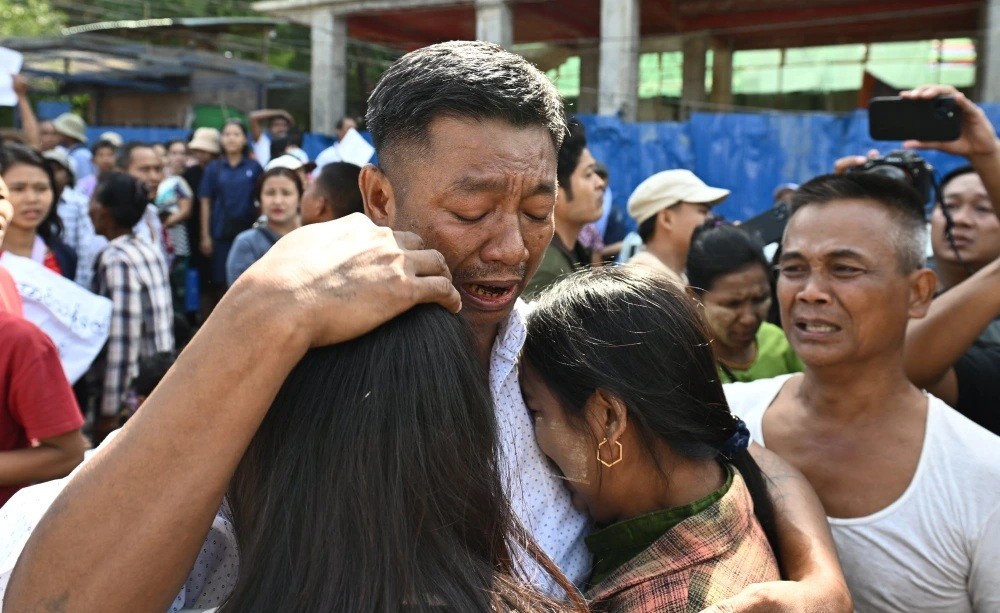
This past Sunday, Myanmar’s military authorities announced the release of more than 6,100 prisoners to mark Independence Day, a familiar symbolic gesture that offers brief relief for some families while raising deeper questions about political detainees, legitimacy, and the country’s unresolved crisis.
Myanmar’s military government marked the 78th anniversary of the country’s independence from Britain on January 4 with a mass prisoner amnesty, granting freedom to more than 6,100 inmates and reducing the sentences of many others. Such releases are a long-standing feature of national holidays in Myanmar, often framed as gestures of goodwill or reconciliation. Yet, as with similar announcements in recent years, the latest amnesty has been met with a mixture of cautious hope, scepticism, and unanswered questions.
State-run MRTV reported that Senior General Min Aung Hlaing, head of the ruling military council, had pardoned 6,134 prisoners. A separate statement confirmed that 52 foreign nationals would also be released and deported. As is typical in these cases, authorities did not publish a comprehensive list of those freed, making it difficult to assess who exactly benefited from the move and whether it included any significant number of political detainees.
The timing of the announcement is notable. The amnesty comes as the military presses ahead with a month-long, three-stage election process, which critics argue is carefully structured to preserve military dominance while projecting an image of democratic progress. Against this backdrop, the prisoner releases have been viewed by many observers less as a turning point and more as a calculated signal aimed at both domestic and international audiences.
The terms of the amnesty underline its conditional nature. Prisoners convicted of serious crimes such as murder and rape, as well as those jailed under various security-related laws, were excluded from sentence reductions. Those released were also warned that any future legal violations would trigger the reinstatement of their original sentences, in addition to any new punishment imposed. For many families, relief is therefore tempered by uncertainty and fear of what lies ahead.
The releases began on Sunday and are expected to take several days to complete. In Yangon, buses were seen leaving Insein Prison after late morning, carrying freed inmates as friends and relatives waited outside from early hours, scanning faces and holding onto the hope that a familiar figure might emerge. Scenes like these have become familiar in Myanmar, where moments of celebration are often entwined with long periods of political repression.
Among those reported to have been freed from Insein Prison was Ye Htut, a former senior army officer who later served as information minister and presidential spokesperson in a previous military-backed government. According to the pro-army outlet Popular News Journal, Ye Htut had been arrested in October 2023 and sentenced to 10 years in prison the following month. His conviction stemmed from Facebook posts that authorities said amounted to sedition and incitement, charges that have become increasingly common tools for silencing dissent.
His release, while notable, has done little to reassure those campaigning for the freedom of Myanmar’s most prominent political prisoners. There has been no indication that the amnesty includes former civilian leader Aung San Suu Kyi, who was deposed in the military takeover of 2021 and has since been held largely incommunicado. Now 80 years old, Suu Kyi is serving a combined 27-year sentence following a series of convictions that her supporters and international observers have widely criticized as politically motivated.
THE WIDER CONTEXT OF DETENTION AND CONFLICT
Since the military seized power three years ago, Myanmar has been locked in a cycle of resistance and repression. What began as widespread nonviolent protests has evolved into a complex and increasingly violent conflict involving armed resistance groups across large parts of the country. Civilian casualties, displacement, and humanitarian needs have risen sharply, while political dialogue has remained elusive.
According to the Assistance Association for Political Prisoners, an independent group that tracks arrests and casualties related to Myanmar’s political turmoil, more than 22,000 political detainees were in custody as of last week. This figure includes Suu Kyi and thousands of activists, journalists, elected officials, and ordinary citizens accused of opposing military rule.
A significant number of these detainees have been charged under incitement laws, a broadly defined offence that carries a sentence of up to three years and has long been criticized for its vague wording and ease of misuse. In practice, it has become one of the most effective legal instruments for detaining critics and suppressing public dissent.
International reaction to the latest amnesty has been muted but pointed. U.S. Secretary of State Marco Rubio issued a statement on Sunday urging Myanmar’s military authorities to cease violence, allow unhindered humanitarian access, release those unjustly detained, and engage in meaningful dialogue aimed at a peaceful and lasting resolution of the crisis. Similar calls have been repeated by regional and global organizations, though with limited impact so far.
The choice of Independence Day as the occasion for the amnesty adds a layer of symbolism. Myanmar became a British colony in the late 19th century and regained independence on January 4, 1948, following years of nationalist struggle. The anniversary is traditionally marked with ceremonies that emphasize sovereignty, unity, and national pride. This year, celebrations in the purpose-built capital Naypyitaw included a flag-raising ceremony at City Hall, broadcast by state media.
Yet the contrast between official imagery and the country’s lived reality remains stark. While flags were raised and speeches delivered, large swathes of the population continue to experience insecurity, economic hardship, and political exclusion. For families waiting outside prison gates, Independence Day was less about history and ceremony, and more about the immediate question of who might be coming home.
For seasoned observers of Myanmar, the latest amnesty fits a familiar pattern. Prisoner releases on major holidays are not new, and they often serve multiple purposes: easing prison overcrowding, projecting clemency, and shaping international perception. Rarely, however, have they signalled a broader shift in political direction.
Whether this latest move will open the door to wider dialogue or further releases remains unclear. For now, it offers freedom to some, disappointment to many others, and another reminder that in Myanmar, gestures of goodwill often coexist with deeply entrenched power structures. Independence Day may commemorate liberation from colonial rule, but the question of political freedom inside the country remains unresolved.
SOURCES: NBC News, UN bulletins