

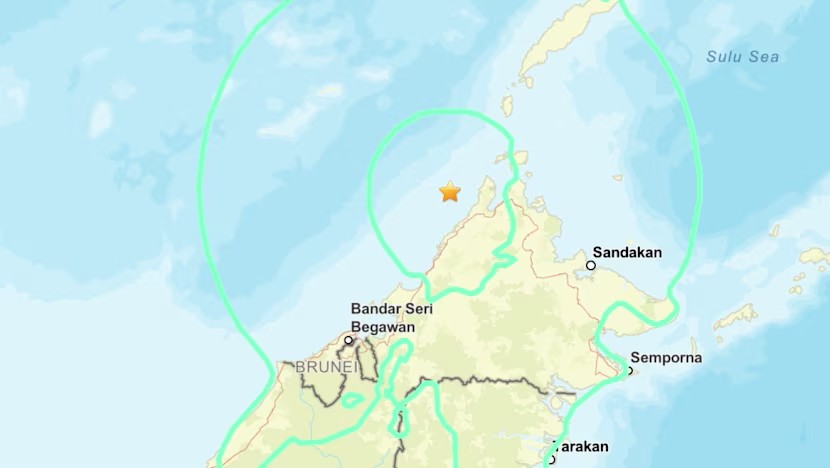
A deep-sea quake struck off Sabah early Monday morning, February 23, registering 6.8 in magnitude. Authorities report no tsunami threat and only mild tremors onshore.
A 6.8-magnitude earthquake struck off the coast of Sabah at 12.57am on Monday, February 23, marking the strongest quake to affect Malaysia in recent memory.
According to the Malaysian Meteorological Department, MetMalaysia, the epicentre was located about 49km west of Kudat, Sabah. Tremors were felt across parts of Sabah, Sarawak, and even in sections of Peninsular Malaysia. Despite its strength, the quake posed no tsunami threat.
MetMalaysia director-general Dr Mohd Hisham Mohd Anip said that, based on departmental records, the previous strongest earthquake recorded in Malaysia occurred on June 5, 2015, in Ranau, Sabah. That 6.0-magnitude quake claimed 18 lives and remains one of the most significant seismic events in the country’s history.
The latest tremor, however, differed in a key respect. Dr Mohd Hisham explained that the February 23 earthquake occurred at a depth of 678km beneath the Earth’s surface. Because the epicentre was so deep, only mild tremors were experienced by the public.
“We are monitoring the situation closely and will continue to do so. No aftershocks have been recorded so far.
“Because the earthquake’s epicentre lies deep beneath the Earth’s surface, at a depth of 678km, only mild tremors were felt by the public,” he said, as reported by Bernama.
Sabah’s exposure to seismic activity is not new. The state lies close to the Pacific Ring of Fire, a seismically active belt shaped by the movement and interaction of tectonic plates. While Malaysia is generally considered less prone to major earthquakes compared to some neighbouring countries, East Malaysia, particularly Sabah, sits nearer to active fault lines.
In the immediate aftermath of Monday’s quake, authorities moved into precautionary mode. Deputy Prime Minister Datuk Seri Dr Ahmad Zahid Hamidi said the Operations Control Centre of the Fire and Rescue Department would conduct continuous field monitoring. Patrols were carried out in coastal areas near the Sabah International Convention Centre, alongside inspections in districts including Putatan, Kudat, and surrounding areas to ensure public safety.
So far, no major damage or injuries have been reported.
Importantly, experts have urged calm. Universiti Malaysia Sabah geologist Prof Emeritus Dr Felix Tongkul said the deep-sea earthquake does not signal a heightened risk of a similar event to the deadly 2015 Ranau quake.
“At this stage, there is no evidence that these deep earthquakes mean increased earthquake danger for Sabah,” said Prof Tongkul, who is attached to UMS’s Natural Disaster Research Centre.
For now, the February 23 quake stands as a reminder of Sabah’s geological setting rather than a sign of escalating seismic risk. Monitoring continues, but early indications suggest that Malaysia has, once again, avoided serious consequences from a powerful natural event.