


Malaysia has dropped seven places in the latest World Press Freedom Index, with watchdogs citing growing pressure on journalists and increased scrutiny of critical reporting.
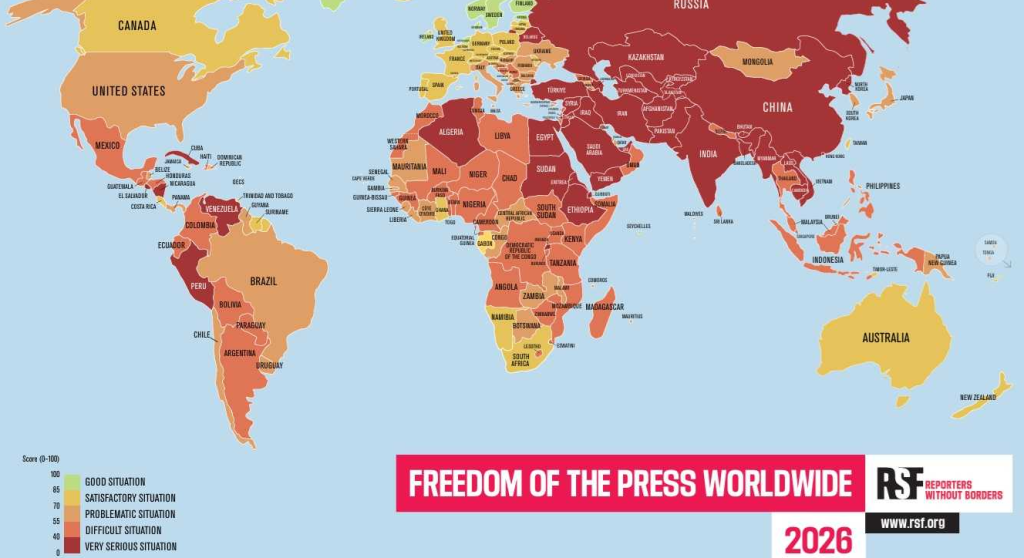
Malaysia has fallen in the latest World Press Freedom Index, slipping seven places to 95th out of 180 countries, according to the annual report by Reporters Without Borders. The country’s overall score declined to 52.73 from 56.09 the previous year, leaving it within what the organization classifies as a “problematic situation.”
The index, widely regarded as a global benchmark for assessing media freedom, evaluates countries based on factors such as pluralism, media independence, legislative framework, and the safety of journalists. Malaysia’s latest position reflects developments over the past year, including increased scrutiny of media outlets and a number of high-profile investigations involving journalists and news organizations.
Among the concerns highlighted are actions taken against online dissent, as well as investigations into international financial news outlet Bloomberg following reports related to alleged abuses involving the Malaysian Anti-Corruption Commission (MACC). The report suggests that such developments have contributed to a more constrained operating environment for media practitioners.
The latest ranking comes shortly after police conducted a raid on the home of a journalist from Malaysiakini, B Nantha Kumar, in connection with reporting on Malaysia’s migrant worker recruitment system. The move drew criticism from press freedom advocates and added to concerns about the direction of media governance in the country.
A MIXED TRAJECTORY
Malaysia’s drop in the 2026 index follows a notable improvement the previous year, when it rose to 88th place after a weaker showing in 2024. That earlier jump had been met with both cautious optimism and criticism, as some observers questioned whether it fully reflected on-the-ground conditions, particularly given expectations for reform under the administration of Anwar Ibrahim.
Critics argue that progress has been uneven, with reforms to strengthen media independence and freedom of expression proceeding more slowly than anticipated. The latest figures appear to reinforce those concerns, suggesting that the broader media landscape remains under pressure.
Within the Southeast Asian region, Malaysia’s position places it just one spot above Brunei and behind countries such as Timor-Leste, ranked 30th, and Thailand, which sits at 92nd. The comparison underscores the varying trajectories of press freedom across ASEAN, where regulatory approaches and political contexts differ widely.
Beyond the region, Malaysia also trails several predominantly Muslim-majority countries, including Qatar, Senegal, Albania, Kosovo, Bosnia and Herzegovina, and Chad.
LEGAL AND STRUCTURAL PRESSURES
In its regional assessment, RSF pointed to the use of strategic lawsuits against public participation (SLAPP suits) as a recurring issue in parts of the Asia-Pacific. These legal actions, often initiated by political or economic elites, can place significant financial and psychological strain on journalists and media organizations.
The report notes that such cases are typically enabled by legal frameworks that offer limited protection for the press, creating an environment where investigative reporting can carry heightened risk. In Malaysia, existing laws related to defamation, sedition, and communications continue to shape how media outlets operate, particularly in politically sensitive areas.
At the same time, the digital landscape has become an increasingly important battleground. Online platforms provide space for diverse voices, but they are also subject to regulatory oversight, which can lead to tensions between efforts to manage misinformation and the need to safeguard free expression.
GLOBAL CONTEXT
The decline in Malaysia’s ranking comes amid a broader global trend. RSF’s latest report highlights a general deterioration in press freedom worldwide, with economic pressures, political interference, and security risks affecting journalists in many regions.
In the United States, for example, RSF noted that media relations have become increasingly strained. “US President Donald Trump has turned his repeated attacks on the press and journalists into a systematic policy,” the organization said. The US now ranks 64th, also falling seven places compared to the previous year.
This wider context serves as a reminder that challenges to press freedom are not confined to any single region, but are part of a shifting global media environment.
For Malaysia, the latest index presents both a signal and an opportunity. While the drop in ranking reflects current concerns, it also highlights areas where improvements could be made, particularly in strengthening protections for journalists and ensuring a more open media landscape.
For the full report, visit https://rsf.org/en/2026-rsf-index-press-freedom-25-year-low
SOURCES: Reuters; CNN Asia; Reporters Without Borders (World Press Freedom Index 2026); Malaysiakini; Bloomberg; Malaysia Now