



The overwhelming majority of expatriates work hard to become respectful members of their adopted communities. Unfortunately, it only takes a few entitled individuals to reinforce the very stereotypes that responsible expats spend years trying to overcome.
You may have heard about the big, ugly running club kerfuffle in Bali recently. The backlash was swift, fierce, and, at least when taken in a broader context, understandable.
Last week, two Dutch nationals living in Bali found themselves deported and barred from re-entering Indonesia after authorities determined they were behind a popular running club that allegedly excluded Indonesians while welcoming foreign applicants.
What began as leaked screenshots on social media quickly snowballed into an international story, with accusations of discrimination, entitlement, and what many viewed as lingering echoes of colonial-era “white privilege” dominating the conversation. Indonesian immigration officials didn’t mince words, describing the situation as creating “a state within a state,” something they said foreign residents have no right to establish.

The widely shared images are honestly a bit off-putting, I cannot deny. It looks like a huge mob of foreigners seemingly rampaging down a narrow street in Bali. Of course, that’s not what was happening, but I can see exactly how the photos – without any context or underlying narrative – would be received by a local living in that community.
IS THERE ANOTHER SIDE TO THE STORY?
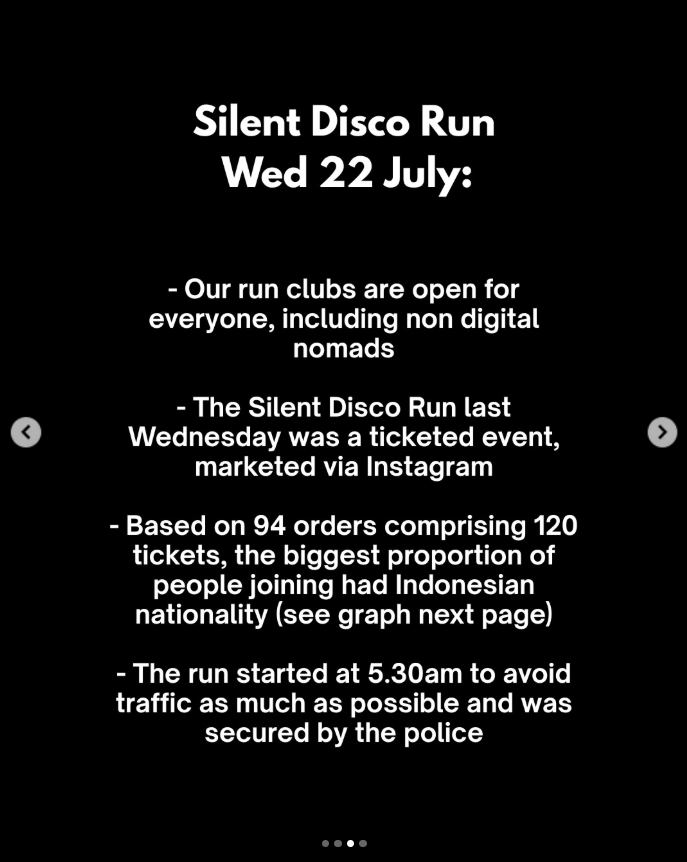
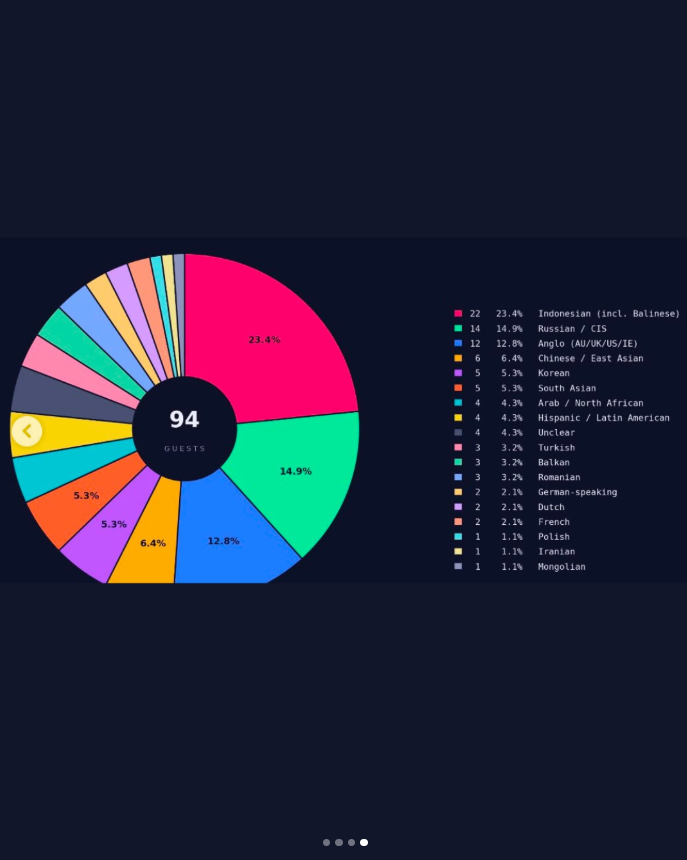
Before serving up my own hot take, however, there’s another perspective worth considering. In the days after the controversy erupted, Entourage Bali published a detailed four-part statement on Instagram apologizing for the offence caused while disputing the suggestion that Indonesians had been intentionally excluded from its activities (see below). The organizers maintained that their public running clubs had always been open to everyone and pointed to participation data from the Silent Disco Run at the centre of the controversy, showing Indonesians comprised the largest single national group, accounting for nearly one-quarter of all tickets sold.

If those figures are accurate, that certainly complicates the whole “excluding locals” narrative. However, on the other hand, you can simply just look at the photos of the club’s events and… well, suffice it to say that it sure doesn’t appear that one out of four participants are Balinese or Indonesian. In fact, in poring over several posted photos of club events, I couldn’t see any locals at all. So who really knows? Whatever the case, Indonesian authorities were clearly unmoved by the group’s apology and pushback.
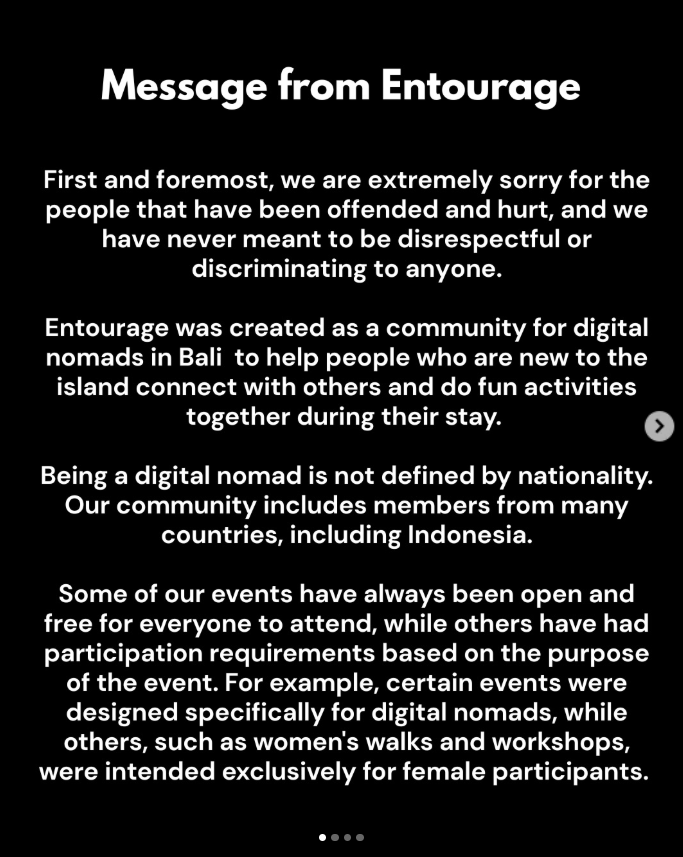
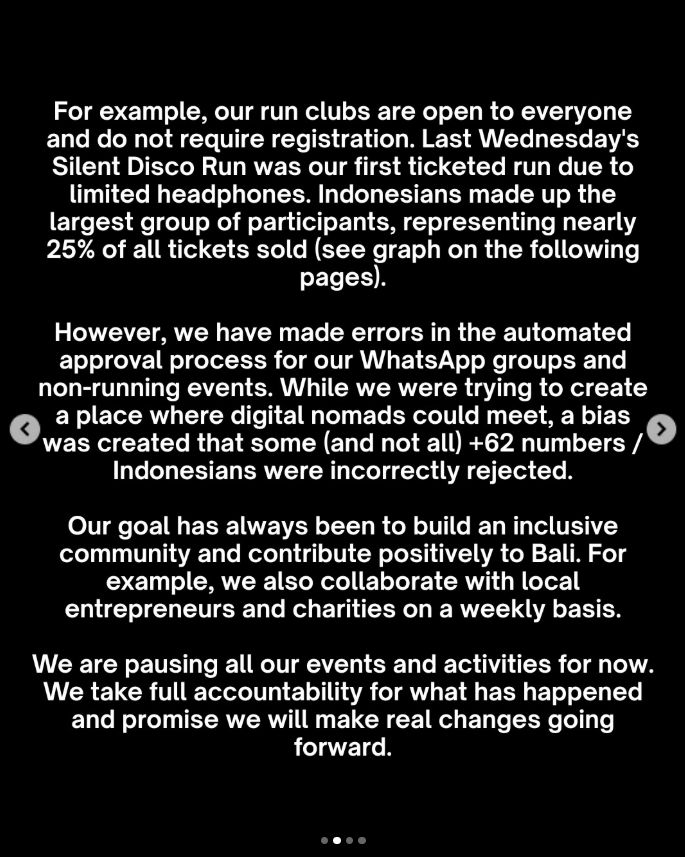
The group acknowledged that an automated approval process for certain WhatsApp groups and non-running events had mistakenly rejected some Indonesian phone numbers. According to the organizers, the system was intended to identify digital nomads by screening for non-Indonesian numbers, but it inadvertently excluded some local applicants as well. Whether that explanation was ultimately convincing is almost beside the point. In politics, marketing, and increasingly in social media, the saying “perception often becomes reality” applies pretty frequently.
Moreover, by the time a fuller picture emerges, public opinion has usually settled on its verdict. That appears to be what happened here. The perception that foreigners had deliberately sought to exclude locals had already taken hold, and once that happened, there was little room left for nuance. Even if it hadn’t actually been the case, at a certain point, unfortunately, it just didn’t matter. The outrage was building, and social media always demands its pound of flesh. In this case, authorities provided it and deported the two Dutch founders of the organization.
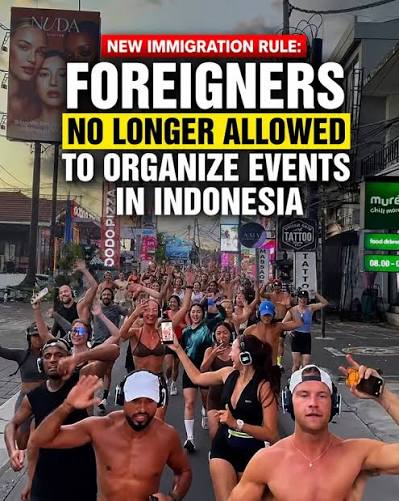
Now, Indonesia has gone a step further and declared that foreign nationals can no longer organize any events in the country at all. That honestly seems a bit of an irrational overreaction to me, but it’s important to note that the running club controversy did not occur in a vacuum. To many Indonesians, this was never really about a single incident and a single running club.
The controversy landed in the middle of a much broader conversation about foreigners who arrive in a place renowned for its hospitality, only to behave as though local people are little more than supporting characters in someone else’s tropical lifestyle. Whether or not that description fairly fit Entourage Bali almost became secondary. The incident likely came to symbolize frustrations that had been building for years, and it seems to have also served as a pressure-relief valve for this long-simmering anger at how foreigners behave – both as tourists and as residents.
For those of us who have spent years living abroad, that’s perhaps the most concerning part. Not because people who genuinely break the rules shouldn’t be held accountable. If they were in the wrong, they should absolutely face the consequences.
It’s concerning because every incident like this makes life just a little more difficult for everyone else who genuinely tries to be a good guest.

WE ARE ALL AMBASSADORS, WHETHER WE LIKE IT OR NOT
Here’s the simple truth: living overseas is a privilege, not an entitlement.
Like most long-term foreign residents, I occasionally get frustrated by the day-to-day realities of life in Malaysia. I’ve lived here for many years, I pay taxes here, I’m part of my neighbourhood community, and I’m genuinely a real, proper resident in almost every sense of the word. So naturally, there are times when I feel I have every right to complain about something, just as any local might.
Even so, I never lose sight of the fact that I’m a guest. I live here because the Malaysian government has granted me that opportunity. My visa can be either renewed or not renewed, and it’s not my call whatsoever. If at any point, the government decides that I must leave, then that’s how it has to be. This lack of absolute certainty, always lurking in the background, is simply the reality of long-term expatriate life, and I think it contributes to a healthy perspective to maintain – one of humility and gratitude.
I obviously can’t speak for every expat, but I believe most of us appreciate overseas life for what it is: an opportunity to experience another country, another culture, another way of thinking. We embrace different customs, different cuisines, different traditions, and in doing so we inevitably come away changed. More often than not, I’d argue, we come away better for the experience.
Unfortunately, every so often a story emerges that reinforces exactly the opposite impression, much like the running club incident.
Anyone who follows regional news knows Bali has experienced more than a few such incidents in recent years. Indonesian authorities have cracked down on foreigners who disrespect sacred sites, breach visa conditions, operate illegal businesses, or simply behave as though local laws are optional.

And again, the running club controversy was hardly an isolated case. Another prominent example was PARQ Ubud, the sprawling mixed-use development that became known locally as “Russian Village” because it attracted large numbers of Russian entrepreneurs, digital nomads, and long-term residents. Whatever the merits of foreigners choosing to live near one another, the development came to symbolize concerns that these communities were becoming increasingly self-contained and disconnected from Balinese society.
When authorities closed the complex in early 2025, they emphasized that the action was based on repeated planning and licensing violations rather than merely the nationality of its residents. But most people knew there was more to it than just that. The complex had become that “state within a state” that Balinese officials have increasingly spoken out against. Foreigners have no right to come to a host country and set up an exclusionary enclave to be a little copy of their own homeland, existing as a bubble in someone else’s country. The sense of entitlement and open flouting of laws and business licensure requirements were understandably not at all well-received by locals, and after a couple of years of this, following months of investigations, authorities made their move.
The raid and closure of PARQ Ubud made headlines, of course. The actions were carried out by dozens of officers from the Gianyar Civil Service Police Unit, and footage that circulated online at the time showed officers removing a number of individuals from what quickly became a tense scene, followed by days (if not weeks) of controversy in the media and in the online community.
Thailand has faced similar challenges. In Phuket, the rapid growth of the island’s Russian community following the invasion of Ukraine brought investment and tourism, but also complaints about illegal business ownership, visa abuses, and attempts to circumvent foreign ownership laws. Thai authorities responded with investigations and enforcement actions aimed at businesses operating outside the legal framework.
The circumstances differed from those in Bali, but the underlying message was much the same. Countries may welcome foreign residents, overseas investment, and international talent, but they also expect newcomers to respect local laws, integrate into the communities around them, and remember that living abroad is a privilege extended by the host country, not a licence to create insular parallel societies.

As far as I can tell, the common thread in all these stories isn’t nationality, race, or wealth – though each may play some role. At the heart of these stories is something much simpler: entitlement.
Every time a foreign resident behaves as though the host country exists primarily for their convenience rather than as a place deserving respect, the rest of us inherit a little of the suspicion and ill will they leave behind.
Perhaps that’s why so many expats reacted to the Bali story with embarrassment rather than defensiveness, despite the possibility of facts that might lend nuance to the populist narrative. Most of us know how quickly public opinion can shift. One viral incident becomes another cautionary tale, another headline, another reason for locals to question whether foreigners truly appreciate the countries they’ve chosen to call home.
THE QUIET MAJORITY TELLS A STORY, TOO
Negative news has always attracted attention – this is nothing new. In today’s social media landscape, it also generates clicks, shares, and endless commentary. It’s hardly surprising, then, that the stories making international headlines are often the ones that are the least representative of expatriate life.
Across Malaysia, for example, long-established expat organizations have spent decades raising funds for children’s homes, supporting education initiatives, organizing environmental clean-ups, mentoring young entrepreneurs, and contributing countless volunteer hours to local charities. I’ve had the privilege of working alongside many of these groups over the years, always grateful to be invited into their efforts and continually impressed by their commitment to giving something back to the communities they’ve chosen to call home.

Foreign chambers of commerce tell a similar story, devoting significant resources to scholarships, community outreach, and partnerships that benefit Malaysians far beyond their own memberships.
The same pattern can be found throughout the region. In Bali, despite the clickbait attention attracted by a handful of badly behaved foreigners, countless expats quietly volunteer with beach clean-ups, animal welfare organizations, coral restoration projects, and community education initiatives. Elsewhere across Southeast Asia, foreign chefs champion local ingredients and mentor young cooks, artists help preserve traditional crafts, business owners invest in local talent, and retirees devote their time to charitable causes. None of these people makes international headlines because they’re not seeking attention. They’re simply becoming part of the communities around them. It’s not flashy, and it might even be a little boring, but it’s also vastly more indicative of how most expats live their lives.

I’d like to think these are the expats most locals know personally. They’re certainly the ones who are the most frustrated whenever another story of entitled foreign behaviour goes viral. Not because they fear being associated with it forever, but because they know how easily isolated incidents can colour public perceptions. Fairly or unfairly, one person’s behaviour can influence how others are viewed, at least for a while.
The minority – those who flout local laws, disrespect cultures, and behave boorishly – are the ones who inevitably attract the headlines. Unfortunately, though, it goes beyond that: they also shape perceptions far beyond themselves. And when that happens, all the positives that expats bring to their host communities suddenly gets buried in the negative headlines.

The Bali controversy will ultimately fade from memory, replaced by the next social media outrage or the next international headline. But the lesson it leaves behind shouldn’t.
Whether we call ourselves expats, migrants, foreign workers, or simply even tourists visiting another country, we represent something larger than ourselves every time we step outside our front door. Most of the time, thankfully, we do that well. The challenge is making sure the exceptions never become the only stories people remember.
Sources: ABC News Australia; ANTARA News; The Straits Times; Associated Press; South China Morning Post; local reporting on Bali immigration enforcement and the Entourage Bali running club controversy.