


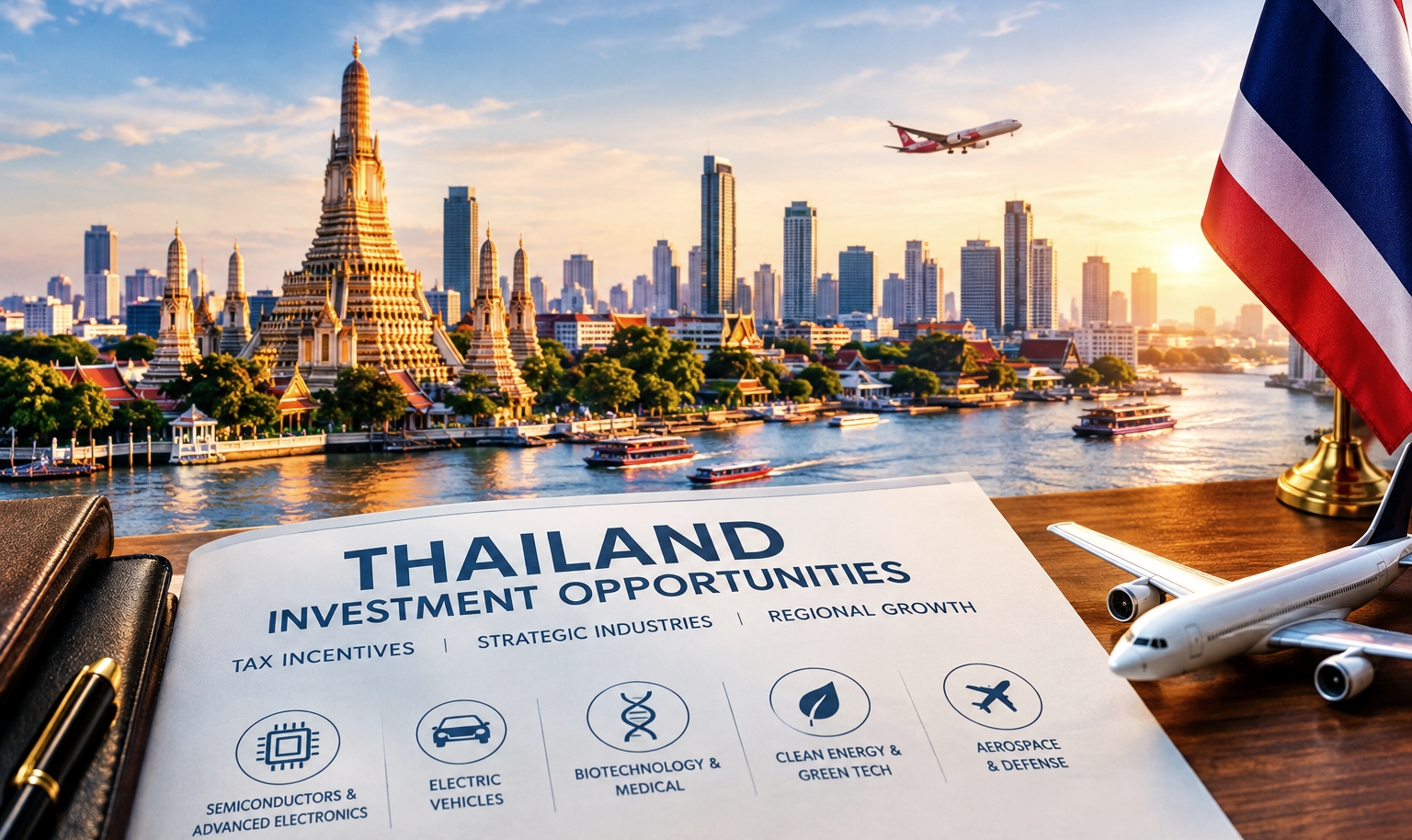
Thailand is stepping up its efforts to attract Malaysian investment, offering substantial tax incentives and targeting industries ranging from semiconductors and electric vehicles to biotechnology, clean technology, aerospace, and advanced medical technology.
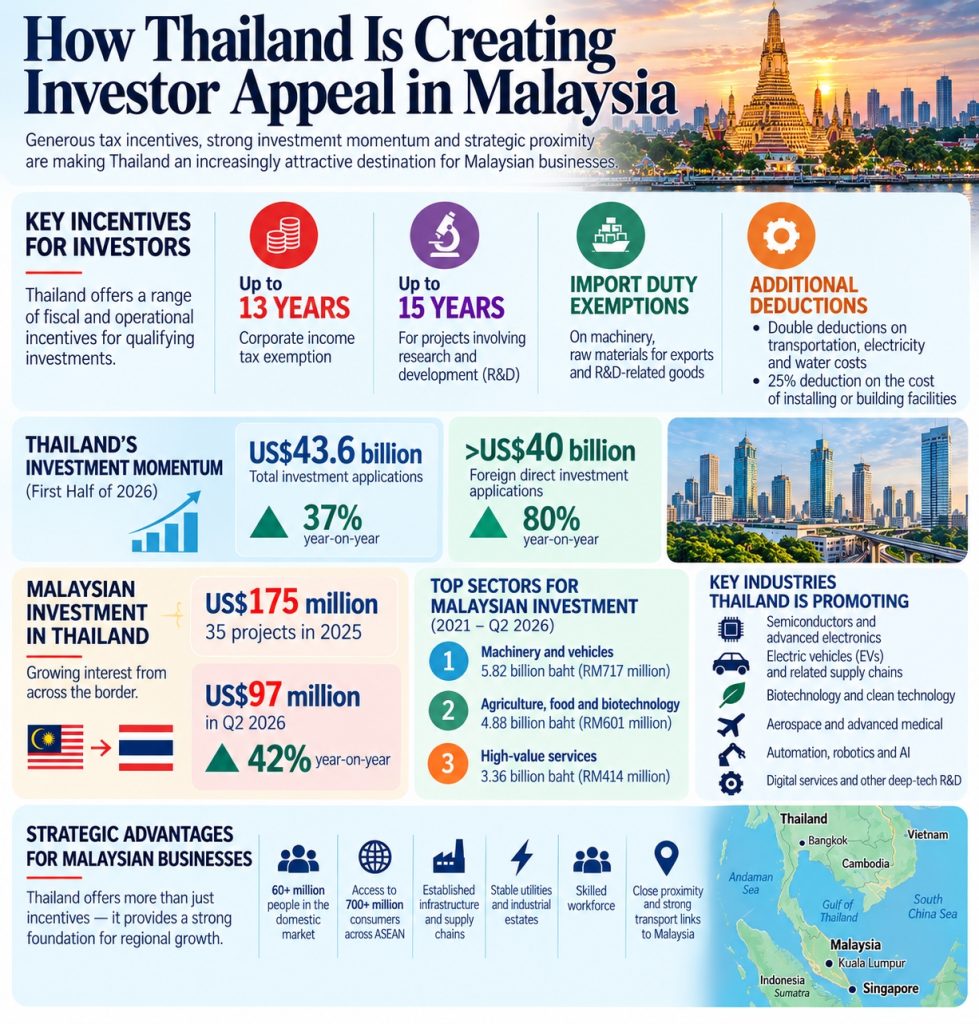
Thailand is making a fresh pitch to Malaysian businesses, particularly companies in the northern states, with a package of investment incentives that can include up to 13 years of corporate income tax exemption, exemptions from certain import duties, and additional deductions for operating and infrastructure costs. For qualifying projects involving research and development, the tax incentives can be extended further, making Thailand’s offer particularly relevant to companies looking beyond straightforward manufacturing.
The initiative was highlighted at a recent presentation in Penang by the Thailand Board of Investment (BOI), which is positioning the country as a convenient base for Malaysian companies seeking to expand into wider Southeast Asian markets. The pitch is particularly aimed at businesses in northern Malaysia, where the physical proximity of Thailand can make cross-border investment considerably easier than establishing a presence farther afield.
And Thailand has plenty of momentum to point to. Investment applications in the country reached approximately US$43.6 billion in the first half of 2026, representing a 37% increase from the same period a year earlier, with digital infrastructure and artificial intelligence data centres among the major drivers. Foreign investment applications increased even more sharply, rising by about 80%.
For Malaysian investors, Thailand’s incentives can include corporate income tax exemptions of up to 13 years, depending on the activity and applicable conditions, as well as exemptions from import duties on machinery, raw materials used in export production, and materials brought in for research and development. Investors can also receive enhanced deductions for certain expenses, including transportation, electricity, and water, while qualifying projects can claim a deduction equivalent to 25% of the cost of installing or constructing facilities.
The attraction is not simply about tax. Thailand is offering something that can be considerably harder for a company to build from scratch: an established industrial ecosystem. According to BOI investment promotion senior officer Patarakrit Vichitbhat, investors can tap into existing infrastructure, industrial estates, supply chains, utilities, skilled labour, and a domestic market of more than 60 million people, while also gaining access to the much larger ASEAN market.
For Malaysian companies, particularly those already operating in manufacturing, food production, automotive, electronics, or technology, that regional connectivity could make Thailand an extension of an existing business rather than an entirely new venture.
FROM MANUFACTURING TO DEEP TECH
The sectors Thailand is promoting are also revealing. Traditional manufacturing remains important, but the country is clearly trying to move further up the technology ladder, with biotechnology, semiconductors, advanced electronics, electric vehicles, clean technology, aerospace, advanced medical industries, automation, robotics, artificial intelligence, and digital services all identified as areas with investment potential.
Thailand’s semiconductor and advanced electronics sector has already attracted substantial interest. The BOI says the sector received hundreds of investment applications in recent years, covering activities ranging from printed circuit boards and semiconductor assembly to testing, chip design, and other advanced electronics.
For Malaysian businesses considering the electric vehicle sector, the opportunity similarly extends well beyond assembling cars. Thailand is promoting investment in batteries, components, charging infrastructure, and associated supply chains, reflecting the increasingly complex ecosystem required to support EV manufacturing.
The numbers from Malaysia itself, however, suggest there is considerable room for growth. Malaysian investment applications in Thailand totalled US$175 million (RM717.5 million) across 35 projects in 2025, while applications in the second quarter of 2026 rose 42% year-on-year to US$97 million (RM398 million). Between 2021 and the second quarter of 2026, the largest areas of Malaysian investment were machinery and vehicles, at 5.82 billion baht (RM717.3 million), followed by agriculture, food and biotechnology at 4.88 billion baht (RM601.5 million), and high-value services at 3.36 billion baht (RM414 million).
For Thailand, the opportunity is therefore to persuade more Malaysian companies to look across the border when planning their next factory, regional headquarters, research facility, or supply-chain operation.
The argument is particularly compelling for businesses in Penang, Kedah, Perlis, and other parts of northern Malaysia. Thailand’s southern provinces are geographically close, while established road, rail, air, and maritime connections make cross-border movement of goods and people increasingly practical. For a company whose customers or suppliers are already spread across ASEAN, locating part of its operation in Thailand can potentially create a more integrated regional footprint.
Thai Consul-General in Penang Pusisit Wongsurawat summed up the pitch rather neatly: “We hope more Malaysian investors, particularly from the northern region, will consider Thailand when establishing or expanding their businesses.”
The broader message is that Thailand does not necessarily have to compete with Malaysia for every investment. In an increasingly integrated ASEAN economy, the two countries can form parts of the same supply chain, with Malaysian companies using Thailand as a manufacturing, research, logistics, or regional operating base while retaining significant operations at home.
For Malaysian businesses, however, Thailand’s increasingly aggressive investment incentives do mean that the decision about where to put the next factory, technology operation, or regional expansion is becoming a more complicated one. Tax holidays may be the headline attraction, but infrastructure, labour, logistics, supply chains, market access, and proximity could ultimately prove just as important.
Sources: The Star; Thailand Board of Investment