


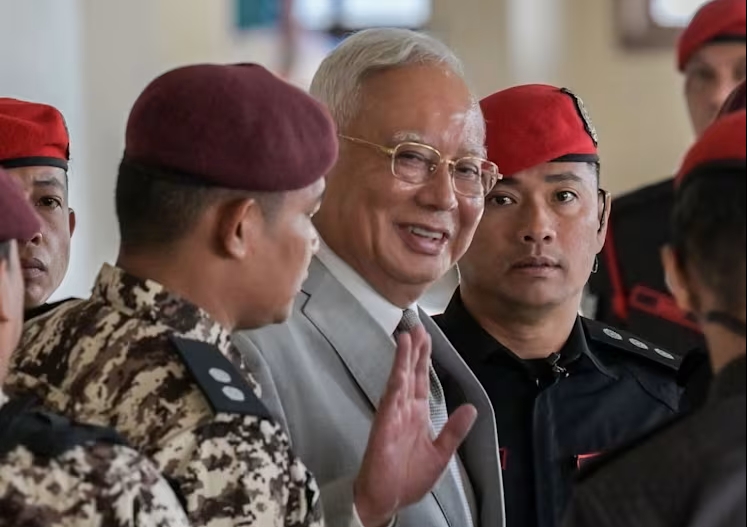
News that former prime minister Najib Razak could serve the remainder of his prison sentence at home has triggered a torrent of debate, fundraising, criticism, political recriminations, and misinformation across Malaysia’s social media platforms.
Malaysia has had little chance to digest the extraordinary weekend news that former prime minister Najib Razak has been granted a conditional pardon allowing him to serve the remainder of his prison sentence under house arrest.
Within hours, social media was awash with reactions ranging from jubilation among Najib supporters to anger and disbelief from critics, while the RM50 million payment attached to the pardon quickly became a story in its own right. There were also fake documents, competing political narratives, fundraising appeals, sarcastic commentary, and a steady stream of speculation about what house arrest will actually mean in practice.
The sheer speed with which the story moved online is hardly surprising. Najib remains one of the most polarizing figures in Malaysian politics, and the decision by the Federal Territories Pardons Board, chaired by the King, Sultan Ibrahim, has touched several of the country’s most sensitive political and institutional fault lines at once.
For expats, who are prohibited from getting involved in Malaysian politics, even being on the sidelines as a third-party viewer can be intriguing. The explosive saga may seem confusing to some – particularly those who are relatively new arrivals in the country – while being characterized as “typical politics” by others. If nothing else, the unfolding drama gives expats an opportunity to compare and contrast Malaysia’s political theatre with that in their own home countries.
As for the spark that set all this off with a September 18 announcement, the official decision allows Najib to serve the remainder of his reduced six-year sentence under house arrest until August 23, 2028, but only if he pays a RM50 million fine and complies with all other conditions. Failure to meet those conditions would result in the conditional pardon being revoked.
For now, Najib remains at Kajang Prison. Additionally, his lawyers said on September 20 that a substantial portion of his assets, bank accounts, and properties remain subject to freezing orders and government enforcement proceedings, meaning their disposal is not entirely within his control. The legal team said Najib was considering his options for satisfying the RM50 million condition.
Even that seemingly straightforward explanation has generated yet another wave of online discussion.
FROM FUNDRAISING TO FAKERY
Perhaps the most striking development has been the sheer speed with which Najib’s supporters have mobilized to help meet the RM50 million requirement.
UMNO launched a Najib Razak Solidarity Fund almost immediately after the pardon was announced. The party said it collected RM165,645 within the first hour, more than RM634,000 within three hours, and RM1 million by the following morning. UMNO secretary-general Asyraf Wajdi Dusuki said many contributions were as small as RM10 or RM50.
That fundraising effort has itself become a major social-media story, with supporters celebrating the response while critics have questioned the idea of ordinary party members contributing towards a legitimate fine imposed on a former prime minister.
Some of the online reaction has been sarcastic. The Vibes reported comments from Threads users, including one asking people who would not contribute to “give this a like” so that the scale of opposition could be seen. Other users reportedly suggested they would rather donate the money to charities or orphanages.
Najib’s family, meanwhile, has stressed that contributions are entirely voluntary. His daughter, Nooryana Najwa, said on Facebook that her father was surprised by the number of people willing to help and did not want to burden UMNO or the public. Najib’s lawyers similarly said he was “profoundly grateful” for the support but did not want party members or members of the public to feel obliged to contribute.
The social media frenzy actually began before the conditional pardon was officially announced. On September 18, a purported house-arrest order bearing what appeared to be the signature of Federal Territories Minister Hannah Yeoh circulated widely online. Yeoh quickly denied signing it, pointing out that the Pardons Board had not even convened when the document appeared. Her press secretary lodged a report with the authorities, including the Malaysian Communications and Multimedia Commission.
The episode perhaps offered an early warning of just how quickly unverified information could travel with regard to the Najib story. By the time the genuine decision was announced, social media in Malaysia had already been primed for a major political event.
Unsurprisingly, the reaction has also spilled into the political arena. DAP secretary-general Anthony Loke’s decision to offer his resignation as Transport Minister, while other DAP ministers remain in government, added another highly visible dimension to the online debate. Loke said the decision was intended as DAP’s response to the pardon, while the party would remain in government to maintain political stability.
At the same time, UMNO president and Deputy Prime Minister Ahmad Zahid Hamidi welcomed the pardon, while Prime Minister Anwar Ibrahim has maintained that the King’s constitutional authority to grant pardons does not alter the government’s commitment to fighting corruption or the requirement that Najib’s other ongoing legal matters proceed according to due process. Needless to say, that assertion has been both defended and derided by Malaysians online.
Amid all the furore, there is still considerable uncertainty about what happens next. The Attorney General has said the Prisons Department is expected to establish standard operating procedures covering matters such as visitors, security, and monitoring of Najib’s movements. Malaysia currently has no specific house arrest legislation, although the government has agreed in principle to draft a House Arrest Bill, primarily in response to prison overcrowding.
That uncertainty and the continuing release of new information is likely to keep the subject firmly in Malaysia’s social media spotlight.
For supporters, the conditional pardon represents an opportunity for Najib to return home after four years in prison. For critics, the central questions concern accountability, fair and equal treatment under the law, and the implications for public confidence in Malaysia’s institutions. After all, the 1MDB scandal wasn’t just a massively impactful financial issue; it was a global embarrassment for the country, and many took some solace in the fact that at least some accountability was delivered. And now, in between those positions lies a rapidly developing story in which the legal conditions, political consequences, and practical mechanics of house arrest are still being worked out.
Sources: Reuters, Associated Press, Channel NewsAsia, The Straits Times, Malaysiakini, The Vibes, Malay Mail, Bernama.