



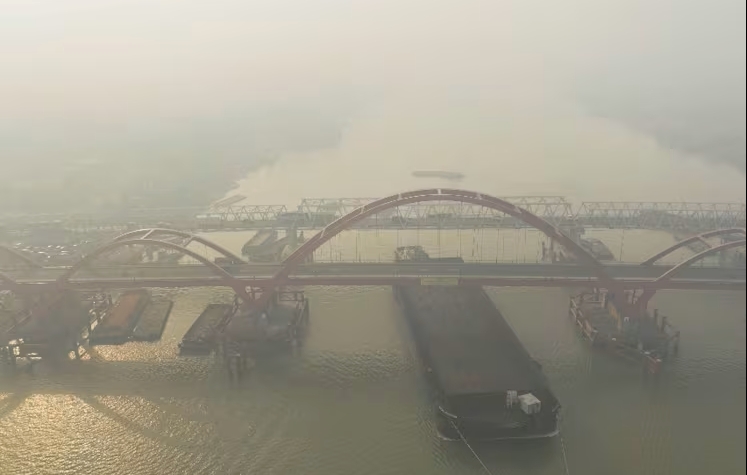
Indonesia is battling a worsening fire crisis that has already caused more than 170,000 respiratory cases, while shifting winds and prolonged dry conditions leave Malaysia facing another anxious wait for what the future may bring to the nation’s skies.
For anyone in Kuala Lumpur who has looked out of the window over the past couple of days and thought the sky seemed a little less murky, there is some good news: the haze has eased in the Malaysian capital.
The less encouraging news is that the regional conditions responsible for it have not gone away.
Indonesia is in the grip of its worst wildfire season in more than a decade, with fires burning across parts of Sumatra, Kalimantan and Papua and smoke spreading into neighbouring countries. Indonesia’s Health Ministry said Tuesday that 174,694 cases of acute respiratory infection had been recorded between August and September 21 in seven provinces affected by forest and land fires. More than 40,000 of those cases involved toddlers.
The figure is up sharply from the more than 113,000 cases reported just two weeks earlier, underlining the scale of a crisis that is now far more than an environmental nuisance.
Malaysia has already had a taste of what could lie ahead. On September 4, the government declared an emergency in Serian, Sarawak, after the local Air Pollutant Index (API) climbed to 519, well into the hazardous category. Schools were closed in affected areas, while cloud seeding and firefighting operations were deployed.
Peninsular Malaysia has also been affected, although conditions have fluctuated considerably. On September 22, Putrajaya recorded an API of 153 in the morning, while Cheras in Kuala Lumpur reached 116. By midday, however, readings in Selangor had fallen back into the moderate range, with Petaling Jaya at 91 and Cheras at 91.
That improvement is absolutely welcome, but it is hardly a declaration of victory. The ASEAN Specialised Meteorological Centre is warning that the southern ASEAN region remains vulnerable to transboundary haze, with prevailing winds generally from the southeast or south. Strong El Niño conditions, below-normal rainfall, and prolonged dry periods are creating conditions conducive to further fires. Some increased rainfall around October could provide relief, but the regional outlook still carries an elevated risk of smoke and haze.
A FIRE SEASON WITH EXTRA FUEL
The underlying problem is particularly stubborn this year. Indonesia’s fires are occurring during an unusually strong El Niño, which is bringing hotter and drier conditions across much of Southeast Asia. Reuters reports that the phenomenon is expected to persist into early 2027, while Indonesia’s rainy season is now forecast to arrive later than previously expected, in November rather than October in many areas.
But El Niño is an accelerant, rather than the whole explanation.
Forest degradation, drained and dried peatlands, and the use of fire for land clearing all contribute to the severity of Indonesia’s fire seasons. Once peat catches fire, it can continue smouldering underground, making the resulting fires particularly difficult to extinguish. Reuters reported last week that Indonesia had launched 219 criminal investigations into suspected fire offences, with 162 suspects named and 95 companies under scrutiny.
The Indonesian government is throwing considerable resources at the problem. More than 50 aircraft have been deployed for water bombing and cloud seeding, while some 54,000 personnel and 64 aircraft were reported to be involved in firefighting operations across Borneo and Sumatra this week. Malaysia has also offered assistance, with Indonesia agreeing to receive help from its neighbour.
For Malaysia, the concern is therefore less about whether the haze can return than whether the combination of fires, weather and wind allows it to build again over populated areas.
Kuala Lumpur may be enjoying somewhat clearer skies this week, but the regional fire season is still unfolding, and Indonesia’s forestry authorities have warned that some fires could continue into early November. So enjoy the relatively less hazy skies for now, but maybe don’t put that box of face masks away just yet.
Sources: Channel NewsAsia, Reuters, Associated Press, The Straits Times, The Guardian, ASEAN Specialised Meteorological Centre, The Star, Media Selangor.