




Malaysia plans to replace its 20-year-old Electronic Commerce Act with legislation that could strengthen accountability among online marketplaces and sellers, improve consumer protection, and address challenges involving overseas businesses.
Malaysia is preparing a new law to regulate online shopping, with the government seeking to make e-commerce platforms and sellers more accountable for the products they offer and the transactions they facilitate.
Prime Minister Anwar Ibrahim announced in his Budget 2027 speech on October 9 that the proposed E-Commerce Bill would be tabled at the next parliamentary sitting. The legislation is intended to replace the Electronic Commerce Act 2006, which provides legal recognition for electronic transactions but does not comprehensively define the responsibilities of online marketplaces and other participants.
The initiative follows a review by the Ministry of Domestic Trade and Cost of Living (KPDN), completed in October 2025, which identified gaps in the existing regulatory framework. Domestic Trade Minister Armizan Mohd Ali subsequently confirmed that the government had approved the policy decision to replace the legislation, with drafting and consultations involving several ministries and industry stakeholders.
WHAT COULD CHANGE FOR ONLINE SHOPPERS?
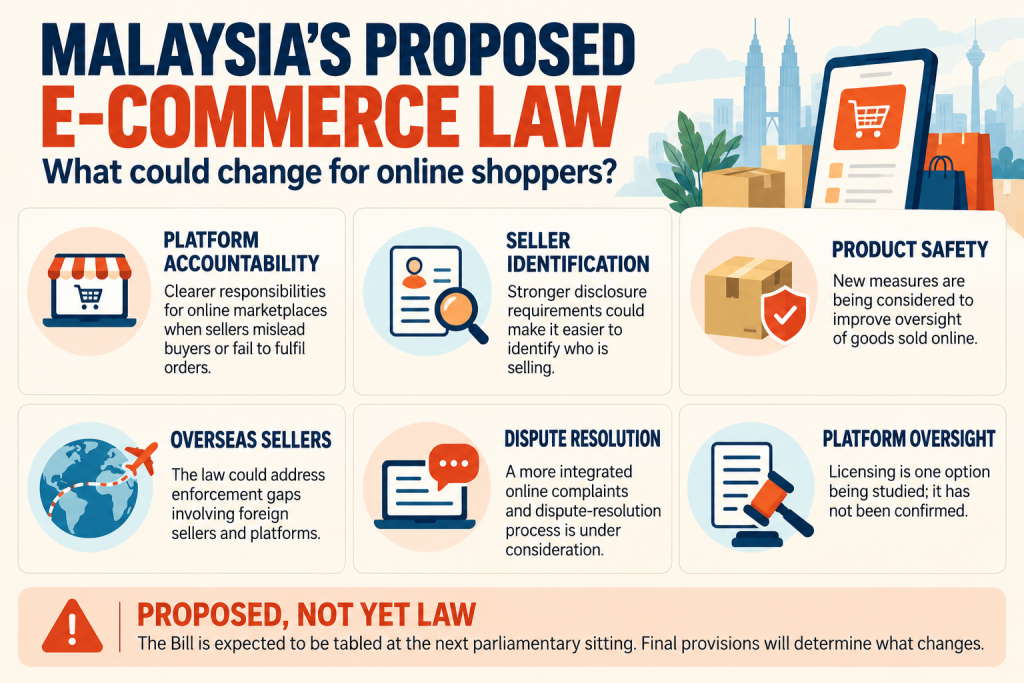
One of the central aims is to establish clearer responsibilities for platforms and sellers, particularly when transactions involve misleading product descriptions, questionable business practices, or goods that may pose safety risks.
At present, the Electronic Commerce Act primarily establishes the legal validity of electronic transactions. Consumer protection is addressed through other legislation, including the Consumer Protection Act 1999 and the Consumer Protection (Electronic Trade Transactions) Regulations 2024.
A new law could create a more comprehensive framework for regulating how online marketplaces operate, including the responsibilities of intermediaries that advertise products, connect buyers and sellers, and facilitate transactions.
Stronger seller-identification and information-disclosure requirements are also among the areas considered in KPDN’s review. These could make it easier for consumers to establish who is actually selling a product, particularly when purchasing through large marketplaces hosting thousands of businesses.
GREATER SCRUTINY OF OVERSEAS SELLERS
Cross-border e-commerce presents a particular challenge. When a seller operates outside Malaysia and has no local business presence, pursuing a complaint over defective goods, missing orders, or misleading claims can be considerably more difficult.
The government has identified the regulation of foreign platforms and sellers as an area requiring greater attention. It is also studying the possibility of introducing a licensing regime for e-commerce platforms, with consumer safety, competition, and the sustainability of local micro, small, and medium enterprises among the considerations.
Licensing remains a proposal under consideration, rather than a confirmed requirement under the new law. Any eventual framework will need to balance stronger oversight with the convenience and commercial opportunities that online marketplaces provide.
A MORE STRAIGHTFORWARD COMPLAINTS PROCESS?
Another potential improvement concerns dispute resolution. In February 2026, Armizan told Parliament that KPDN was considering an integrated online dispute-resolution platform that would allow complaints to be handled digitally, from the initial filing through to adjudication or a decision.
The proposal follows 33,400 complaints involving e-commerce transactions received by the ministry between 2023 and 2025. An effective digital process could make it easier for consumers to pursue disputes without relying on procedures that require physical attendance or manual processing.
However, the final scope of the proposed platform, its relationship with existing consumer redress mechanisms, and the remedies available to shoppers have yet to be established.
WHAT HAPPENS NEXT?
The proposed Bill’s detailed provisions will determine how significantly Malaysia’s online shopping landscape changes. Until Parliament passes the legislation and it comes into force, existing laws and regulations remain applicable.
For consumers, the prospect of clearer accountability, better seller information, and more accessible dispute resolution is encouraging. The challenge will be translating those ambitions into rules that work in practice, including when transactions involve overseas businesses.
Sources: Prime Minister’s Office of Malaysia, Bernama, Malay Mail, and the Ministry of Domestic Trade and Cost of Living (KPDN).