



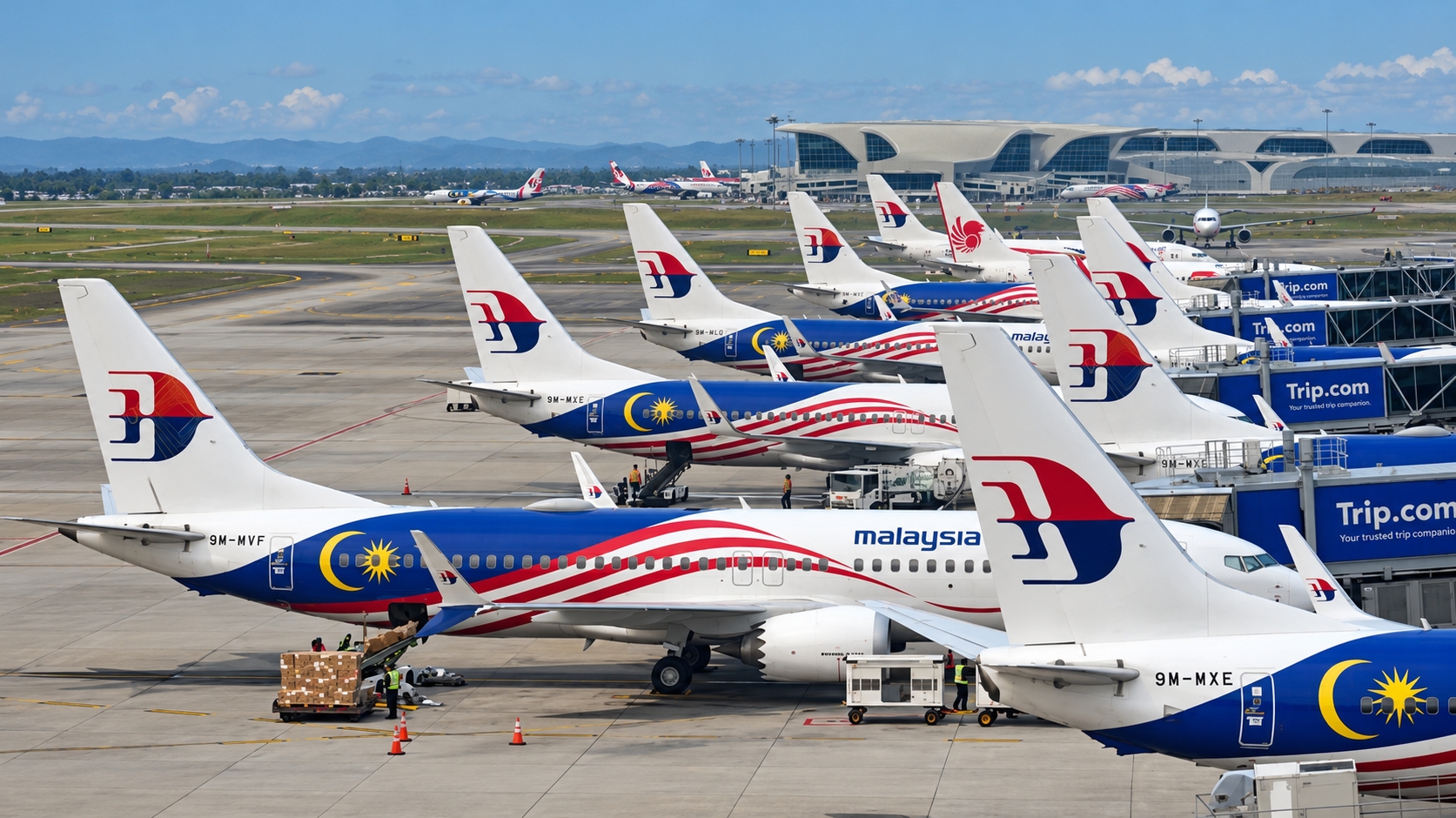
Malaysia Aviation Group chief executive Nasaruddin Bakar says a passenger levy remains an option as the industry confronts the high cost of cleaner aviation fuel, raising fresh questions about how the transition to lower-emission air travel will be funded.
Malaysia Airlines passengers could eventually face an additional “green levy” as the aviation industry seeks to reduce its carbon footprint without making air travel prohibitively expensive.
Malaysia Aviation Group (MAG) president and group chief executive Captain Nasaruddin A. Bakar said Monday that the company had not ruled out introducing a green tax to help offset the cost of sustainable aviation fuel (SAF), which remains considerably more expensive than conventional jet fuel.
“We are looking at all options,” Nasaruddin told The Associated Press on the sidelines of an aviation sustainability conference. “Consumers must be able to afford it. The airline must be able to afford to buy it.”
Any such levy in Malaysia would ultimately be a government decision. However, the prospect comes as neighbouring Singapore prepares to introduce a mandatory sustainable aviation fuel levy, adding another potential expense for travellers already contending with higher airfares and volatile fuel prices.
A COSTLY TRANSITION
Aviation accounts for approximately 2.5% of annual global carbon emissions, according to the International Energy Agency. With demand for air travel continuing to grow, the International Civil Aviation Organization, a United Nations agency, has established a goal of net-zero carbon emissions for international aviation by 2050.
SAF is expected to play a significant role in achieving that ambition. Produced from renewable feedstocks such as used cooking oil, waste fats, and agricultural residues, it can be blended with conventional jet fuel and used in existing aircraft without requiring wholesale changes to engines or fuelling infrastructure.
The potential environmental benefits are substantial. Depending on the feedstock and production process, SAF can reduce lifecycle carbon emissions significantly compared with conventional jet fuel. The International Air Transport Association estimates that SAF could contribute approximately 65% of the emissions reductions needed for aviation to reach net zero by 2050.
The challenge is scaling up production. SAF currently accounts for less than 1% of global jet fuel consumption, according to IATA, with limited supply and competition for sustainable feedstocks restricting wider adoption. Its higher price remains another major obstacle for airlines operating on tight margins.
For carriers, the transition presents an uncomfortable balancing act: invest in cleaner fuel to meet long-term environmental commitments, but avoid passing so much of the expense to passengers that demand suffers.
Nasaruddin said regulators, airlines, and fuel suppliers would need to work together to bring down SAF costs. Simply transferring the additional expense to travellers would not be a sustainable solution, particularly in a price-sensitive market.
SINGAPORE SETS THE PACE
Singapore has already established a framework for financing the transition. Its Sustainable Aviation Fuel Levy will apply to flights departing the country from January 1, 2027, for tickets and services sold from October 1, 2026.
The levy varies according to destination and cabin class. Economy passengers will pay S$1 for flights to Southeast Asia, S$2.80 for destinations in Northeast Asia, South Asia, and Australia, S$6.40 for destinations including Europe, and S$10.40 for the Americas. Charges for business and first-class passengers will be four times the corresponding economy rates.
The money collected will go into a dedicated fund used to procure SAF and associated environmental attributes, with the aim of supporting aviation decarbonization while keeping costs manageable.
Singapore initially planned to introduce the levy earlier, but postponed implementation amid the impact of the conflict in the Middle East on airlines and passengers. The revised timetable highlights the difficulty of pursuing environmental targets while the industry faces immediate financial pressures.
Whether Malaysia will adopt a similar mechanism remains uncertain. Nasaruddin’s comments indicate that a passenger levy is under consideration, not that a decision has been made.
FLEET RENEWAL AND FUEL PRESSURES
MAG is also pursuing emissions reductions through fleet modernization and improved fuel efficiency. Malaysia Airlines has orders for 40 Airbus A330neo aircraft and 55 Boeing 737 MAX jets, both designed to consume less fuel than older-generation aircraft.
Newer aircraft can help reduce fuel consumption and emissions per passenger, although fleet renewal alone will not eliminate aviation’s environmental impact. SAF is expected to complement these improvements as supplies become more widely available and production costs decline.
In the meantime, airlines are facing pressure from rising conventional jet fuel prices linked to the war involving Iran. Nasaruddin said the group had limited room to recover higher operating costs through ticket prices, a constraint that would also apply to sustainable fuel.
The amount that could be passed on to passengers would depend on how expensive SAF becomes, he explained.
“If the cost is not that high, maybe some more of it can be passed on to the passenger,” he said. “If the cost is just too high, we won’t be able to do that.”
Asked about the possibility of further fare increases, Nasaruddin offered no guarantees, saying flatly, “I don’t have a crystal ball.”
For travellers, the prospect of a green levy adds another consideration to the cost of flying. For the industry, the larger question is more centred on how to finance a cleaner future without pricing people out of the skies. The answer will depend not only on airlines and governments, but also on whether sustainable aviation fuel can be produced at a scale and price that makes widespread adoption commercially viable.
SOURCES: Associated Press; Civil Aviation Authority of Singapore; Free Malaysia Today; The Star.