




Thailand’s decision last week to abandon its long-discussed Land Bridge project removes a potential rival to one of the world’s busiest shipping corridors while underscoring the enduring importance of the Strait of Malacca, a vital trade artery that continues to benefit Malaysia’s ports, logistics sector, and wider economy.
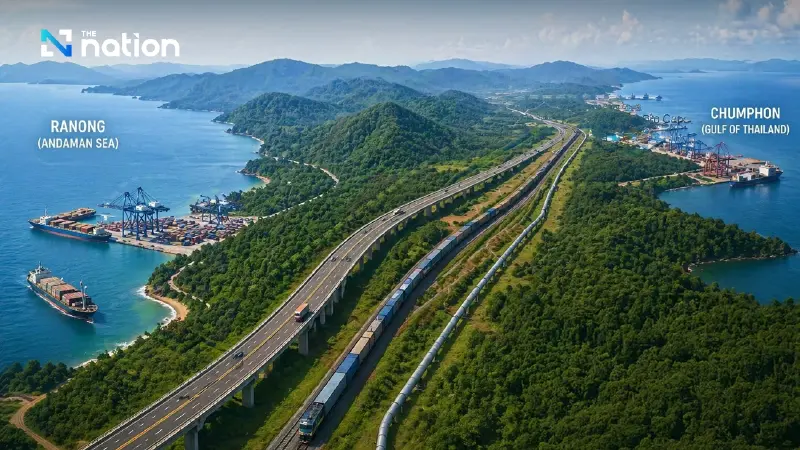
For decades, Thailand’s proposed Land Bridge – the idea itself pitched as a more realistic alternative to the long-dreamed-off canal cut across the Kra Isthmus – has periodically resurfaced as one of Southeast Asia’s most ambitious infrastructure ideas. Envisioned as a coast-to-coast logistics corridor linking the Gulf of Thailand with the Andaman Sea, the project promised to offer shipping lines an alternative to sailing through the Strait of Malacca.
Now, after years of planning, changing political priorities, and renewed attention earlier this year, the project appears to have reached its conclusion.
Thailand’s government has announced plans to scrap the estimated one trillion baht (US$29.7 billion) megaproject after an updated feasibility study concluded it was no longer commercially viable and carried significant environmental risks. The review found expected financial returns had fallen sharply, projected cargo volumes were lower than previously forecast, and the project would ultimately lose money.
For Malaysia, we believe the decision represents a quietly positive development. It might not be anything you hear a lot of noise about, but in this case, the silence is a good thing.

THE STRAIT OF MALACCA REMAINS IRREPLACEABLE
The original proposal called for two new deep-water ports connected by approximately 100 kilometres of highways and rail across southern Thailand. Cargo would have been unloaded on one coast, transported overland, and reloaded onto another vessel, allowing ships to avoid the lengthy voyage around the Malay Peninsula and bypass the Strait of Malacca altogether.
The concept gained renewed momentum in 2026 after disruptions around the Strait of Hormuz highlighted the vulnerability of global supply chains and prompted governments to examine alternative trade routes. At one point, Thailand’s government pledged to accelerate the project in the hope of attracting international investors.
Ultimately, however, economics proved more persuasive than ambition.
The latest government study concluded that projected returns had declined from 8% to just 4.8%, while expected cargo volumes were as much as 16% lower than earlier forecasts. Officials also noted that nine of the world’s ten largest shipping lines had already committed investment to competing logistics infrastructure, leaving relatively little commercial appetite for the Land Bridge itself.
The findings reinforce what many maritime analysts had argued for years: bypassing the Strait of Malacca is far more complicated than simply shortening a voyage.
Every container transferred from one ship to another introduces additional handling costs, operational complexity, scheduling risks, and potential delays. While a land bridge may save sailing distance, those savings can quickly be offset by unloading, rail transport, storage, and reloading operations. Earlier independent assessments also questioned whether the overall transit time would be materially better than remaining at sea.
For Malaysia, maintaining the Strait of Malacca as the region’s principal maritime corridor carries important economic implications, although perhaps not in the way many assume.
Malaysia does not charge ships a transit fee simply for passing through the Strait. Under international maritime law, vessels enjoy transit passage through the waterway. Instead, Malaysia benefits indirectly through the extensive maritime ecosystem that has developed around one of the world’s busiest shipping lanes.
Major ports such as Port Klang, Tanjung Pelepas, Penang Port, and Johor Port handle vast volumes of international cargo, generating employment and investment across shipping, logistics, warehousing, bunkering, ship repair, customs services, and related industries. The continued prominence of the Strait also strengthens Malaysia’s position as a regional logistics hub and supports ongoing investment in port expansion and transport infrastructure.
That doesn’t mean alternative transport corridors have no future.
Thailand has indicated it will instead pursue more targeted improvements, including expanding Ranong Port and strengthening associated rail links, rather than proceeding with the full Land Bridge concept. Such investments could still improve domestic logistics and regional connectivity without attempting to compete directly with the established maritime route through the Strait of Malacca.
The decision also reflects a broader reality confronting many large infrastructure projects. As construction costs rise, environmental expectations become more demanding, and private investors grow increasingly selective, ambitious megaprojects must demonstrate not only engineering feasibility but also compelling commercial logic.
With this particular proposal, that case appears not to have been made.
For Malaysia, the outcome preserves the status quo for one of the country’s most strategically important geographical assets. While competition among regional ports will undoubtedly continue, the Strait of Malacca remains the shortest, simplest, and most efficient maritime gateway between the Indian Ocean and the Pacific for the overwhelming majority of global shipping.
Sometimes, the biggest victory is simply that nothing changes.
Sources: The Straits Times; Bloomberg; The Edge Malaysia; Channel NewsAsia; Reuters.