


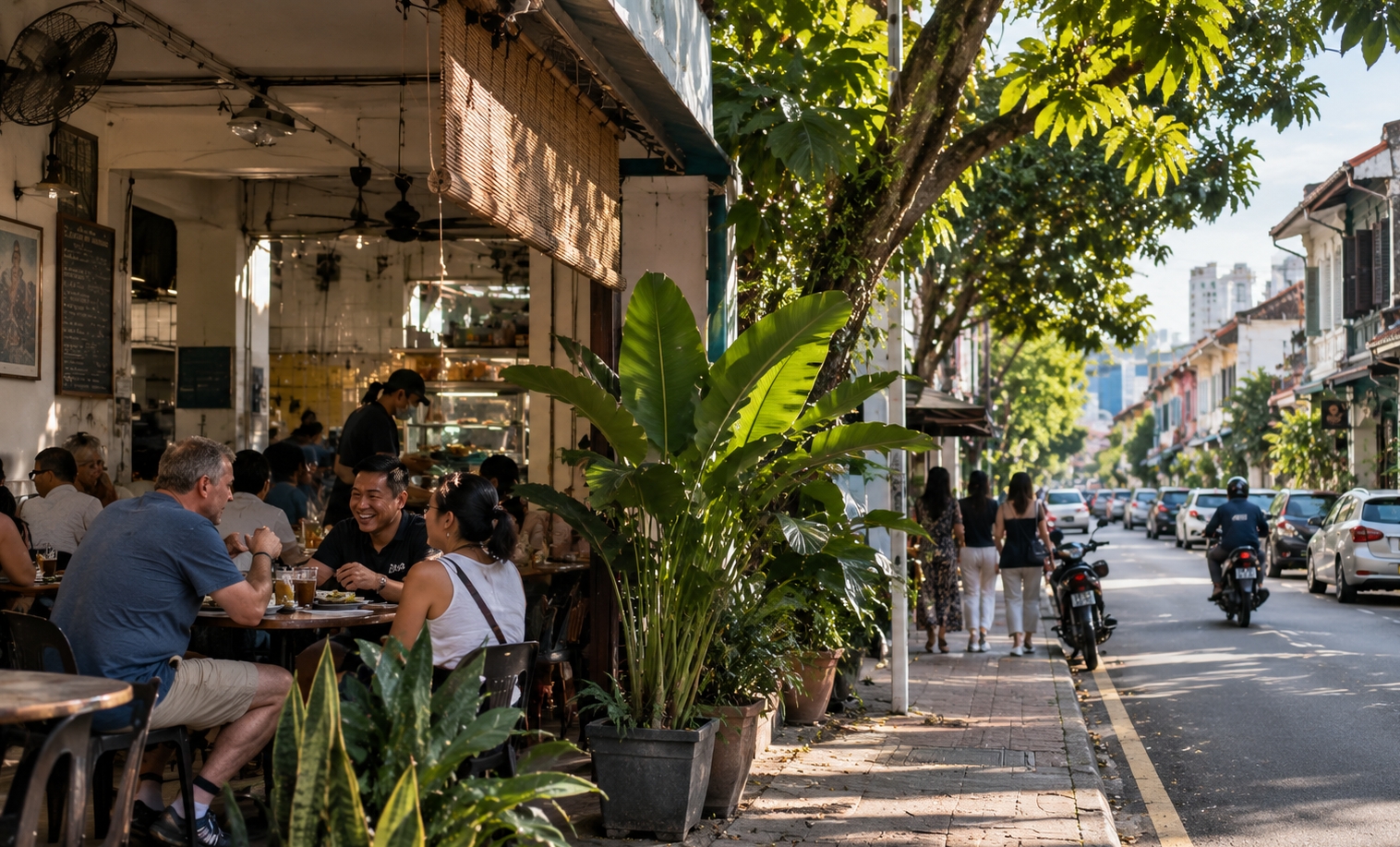
Wait… what? A new global relocation index puts Malaysia behind only Estonia and Singapore, but its very specific methodology is a useful reminder that “best place to live” is a much harder thing to measure than a league table suggests.
It’s very safe to say that expats love Malaysia. We have lived here, worked here, raised families here, built businesses here, retired here… and we’ve also spent enough time navigating its traffic and fruitlessly searching for a parking spot to know that no country is perfect. So when a new ranking announces that Malaysia is the third-best country in the world to live in, ahead of places like Portugal, Japan, New Zealand, Canada, the UK, Australia, and a very long list of other familiar contenders, we are naturally intrigued.
We are also a little skeptical.
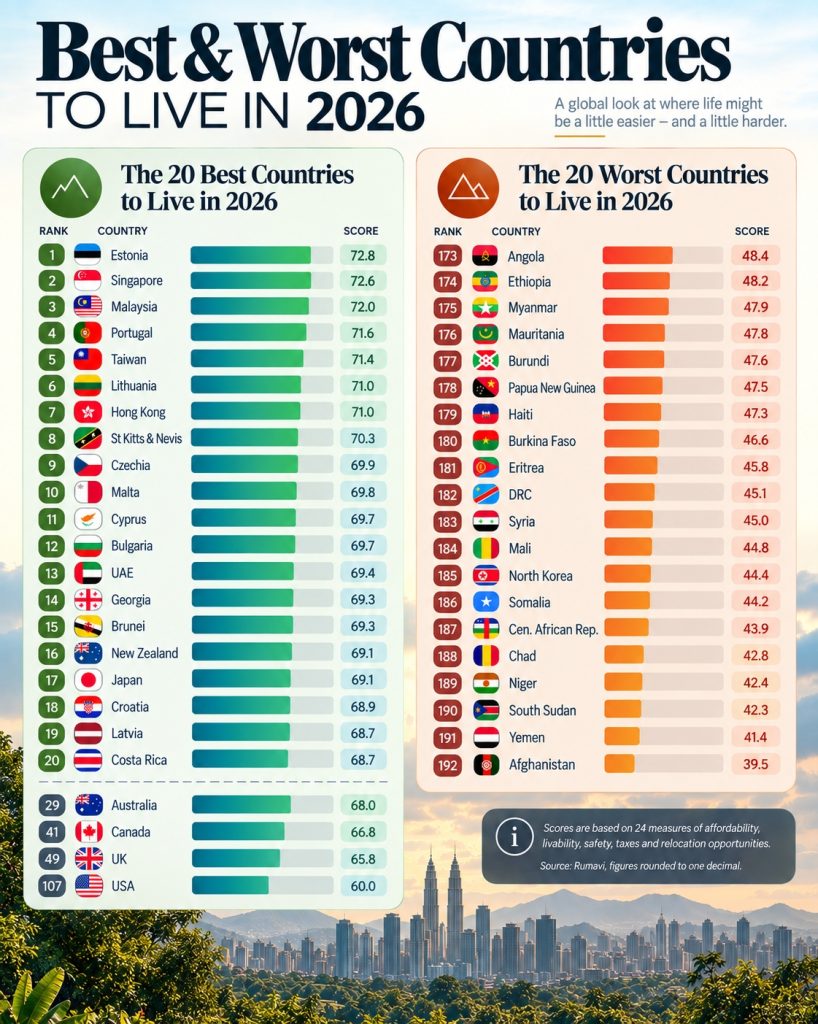
The 2026 Rumavi Global Relocation Index places Malaysia third among 192 countries and territories, with a score of 72.0 out of 100. Only Estonia, at 72.8, and Singapore, at 72.6, rank higher. Portugal, Taiwan, Lithuania, Hong Kong, St. Kitts and Nevis, Czechia, and Malta round out the top 10.
And yes, that is a rather extraordinary result for Malaysia. But just looking at that extremely eclectic top 10, it’s easy to think that maybe there’s more to this ranked list than meets the eye.
Diving in, it’s clear that’s exactly the case. The index is not claiming to measure some universal, scientifically definitive concept of “quality of life.” It is a relocation index, designed around the question of where someone might be able to build a life. Rumavi assesses 24 metrics under four broad pillars: financial and tax; livability and health; safety and stability; and settling and opportunity. The individual measures include affordability, taxation, healthcare, housing, climate, infrastructure, street safety, rule of law, political stability, property rights, visa ease, education, business opportunity, language and English access, and the startup ecosystem.
That is a fairly broad basket, but it is still a very specific basket. And we think it’s one that may hold worthwhile meaning for expats and retirees who are considering Malaysia as a new home. After all, this is a relocation-biased index, and for anyone who is moving to a new country, the metrics this index gauges tend to be fairly important ones.
But there is an important caveat: Rumavi itself says that the data quality varies between countries, with around 127 having strong-to-full coverage across institutional metrics, while the remaining 65 have lower-confidence data that should be regarded as directional, not absolute. It explicitly says the index is a starting point for a decision, rather than a substitute for advice tailored to an individual’s circumstances.
In other words, Malaysia being No. 3 does not mean Malaysia is objectively the third-best place on Earth to live. It means Malaysia performs extremely well according to this particular set of metrics. Cynics, of course, will note that once again, Singapore has bested Malaysia in yet another ranked list.
But still, we can’t deny that placing 3rd out of 192 countries is still quite a nice feather in Malaysia’s cap.
MALAYSIA MAKES A VERY GOOD CASE
There are certainly reasons the result feels plausible to anyone who has spent time here. Malaysia combines relatively affordable living with good private healthcare, extensive infrastructure, a sophisticated food and hospitality scene, a tropical climate, English-language accessibility, relatively straightforward regional travel, and a well-established expatriate community.
It also performs strongly in Rumavi’s more specialized rankings. Malaysia is seventh for families, 37th for entrepreneurs, and receives bonuses in the index’s retiree and digital-nomad assessments for programs such as MM2H and the DE Rantau Nomad Pass.
Still, the overall ranking produces some fascinating results.
The United States, for example, comes in at No. 107, with a score of 60.0, while Canada is No. 41 and the UK No. 49. Australia is No. 29. India is No. 100, while Thailand is No. 28 and Indonesia No. 84.
At the other end of the table, Afghanistan ranks 192nd (last), followed by Yemen, South Sudan, Niger, Chad, the Central African Republic, Somalia, North Korea, Mali, and Syria. The bottom of the ranking is dominated by countries facing war, severe political instability, weak institutions, ongoing conflict, or major economic and infrastructure challenges.
Curiously, Southeast Asia has the distinction of having three of the countries ranked best to live in (Singapore, Malaysia, Brunei, at 2nd, 3rd, and 15th places, respectively) and, at 175th place, one of the worst (Myanmar).
There is another interesting wrinkle. The same 24 underlying metrics can be re-weighted for six different types of people: general, retirees, digital nomads, families, entrepreneurs, and tax-focused movers. Rumavi notes that the same country can move dramatically depending on who is asking the question.
That, we think, is probably the most useful lesson here. A young entrepreneur, a retired couple, a family with school-age children, and a digital nomad may have four completely different definitions of a great place to live. Malaysia’s No. 3 ranking is therefore best viewed as a fun, encouraging snapshot rather than a definitive one-size-fits-all verdict.
However, like most Malaysians, as resident expats here, we’ll happily take the compliment! And for anyone else reading this who’s already living here, perhaps the most entertaining takeaway is this: apparently, we’re doing pretty well. Even if we are definitely still going to complain about the traffic.
TOP 20: THE RUMAVI 2026 GENERAL RANKING
🌍 Top 20 Countries to Live in 2026
Rumavi Global Relocation Index · General ranking
Source: Rumavi Global Relocation Index 2026. Scores are out of 100.
BOTTOM 20: THE RUMAVI 2026 GENERAL RANKING
🌍 Bottom 20 Countries to Live in 2026
Rumavi Global Relocation Index · General ranking
Source: Rumavi Global Relocation Index 2026. Scores are out of 100.
Sources: Rumavi Global Relocation Index 2026; Rumavi methodology; Visual Capitalist