

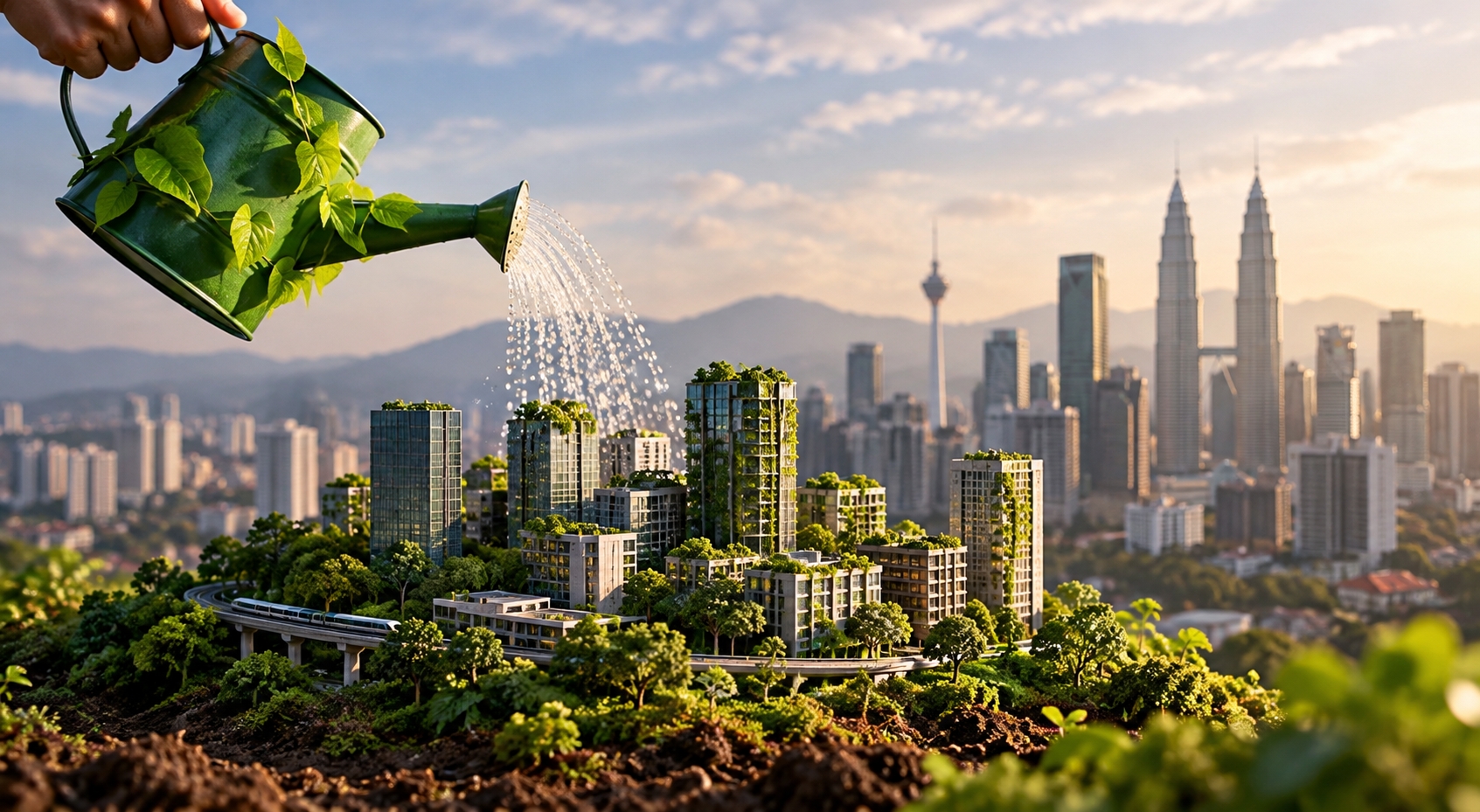
As Malaysia strengthens its sustainability reporting and assurance requirements, a new concern is emerging alongside greenwashing: good environmental intentions whose ambitions outpace actual impact, often promising more than the evidence can ultimately support.
This post contributed by Dr Mirza Rayana Sanzana
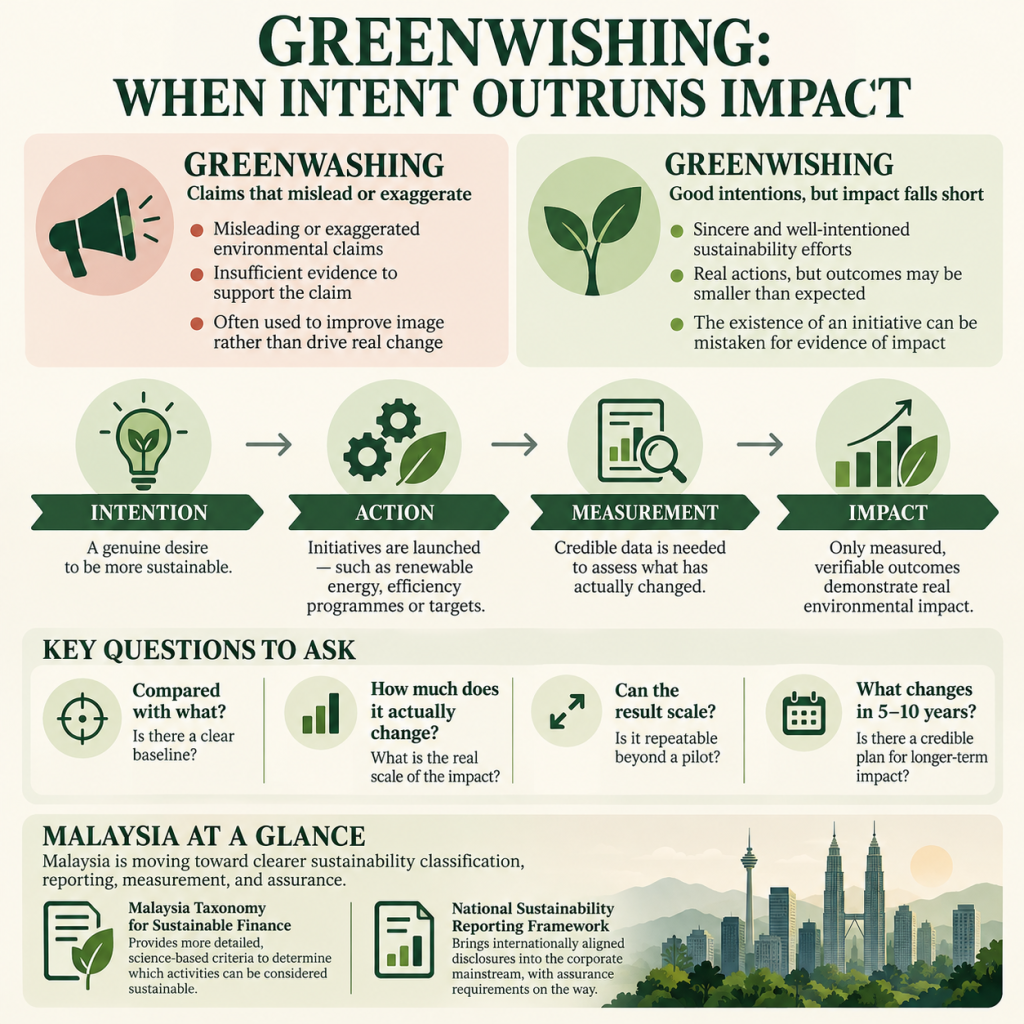
Greenwashing has become one of those words that scarcely needs an introduction. Broadly, it refers to making environmental claims that are misleading, exaggerated, or insufficiently supported by evidence. Put “eco-friendly” on a product, describe a new development as “green,” or announce an ambitious net-zero target, and increasingly someone will ask what sits behind the claim.
Malaysia’s regulators are asking much the same question. Bank Negara Malaysia and the Securities Commission are developing a unified Malaysia Taxonomy for Sustainable Finance with more detailed, science-based criteria for determining which activities can credibly be considered sustainable. Among its stated objectives is safeguarding against greenwashing.
Sustainability reporting is becoming more rigorous, too. Malaysia’s National Sustainability Reporting Framework is bringing internationally aligned disclosures into the corporate mainstream, while independent assurance of certain greenhouse-gas disclosures is also on the way. All of this should make it progressively harder to paint something green and hope nobody looks too closely. But there is a more awkward possibility that better regulation alone cannot eliminate: what if nobody is actually trying to fool us?
The term “greenwishing” was coined in 2019 by sustainability thinker and former investment manager Duncan Austin to describe the tendency to believe that well-intentioned sustainability efforts are achieving more meaningful change than they really are. The distinction from greenwashing is useful. A questionable sustainability initiative need not begin with deception. A company can sincerely invest in solar energy, launch an efficiency programme, or establish a net-zero target and genuinely expect it to make a substantial difference. The problem begins when the existence of the initiative becomes evidence of impact in its own right.
Buildings provide a useful example. A commercial property installing rooftop solar has certainly done something positive, but the panels alone tell us surprisingly little about overall performance. How much electricity do they generate? What percentage of the building’s annual consumption does that represent? Is total electricity use falling? The same applies when a building reports saving 500 MWh of electricity. That sounds impressive, but considerably more context is needed if it previously consumed 50,000 MWh than if it consumed 1,000 MWh. Neither example is necessarily misleading; they simply demonstrate why sustainability claims become much more meaningful when there is a baseline.
WHEN GOOD INTENTIONS MEET THE NUMBERS
Malaysia has just received a timely reminder of how difficult that evidence can be.
On September 17, the Advisory Committee on Sustainability Reporting announced that mandatory reasonable assurance of Scope 1 and Scope 2 greenhouse-gas disclosures for the first group of companies covered by the National Sustainability Reporting Framework would begin in 2028, a year later than originally planned. The decision followed a review of the first 91 listed issuers reporting under the new standards, which found that disclosure quality still needed improvement.
That should certainly not be interpreted as evidence that Malaysian companies are greenwashing. If anything, it demonstrates how much work sits behind credible sustainability claims. MITI has reported a similar capacity challenge: among organisations using its i-ESGReady assessment, 77.5% had limited or no understanding of sustainability-reporting data requirements. Its broader i-ESG framework therefore takes companies beyond simply producing a report, encouraging them to assess readiness, set targets, take action, track progress, report performance, and reassess. Sustainability, after all, is not supposed to end when the report is published.
This is also where the line between greenwishing and greenwashing becomes more interesting. Imagine that a company launches an environmental initiative genuinely expecting substantial results, only for the data a year later to show that the impact was much smaller than anticipated. There is nothing particularly scandalous about that. Technologies underperform, assumptions prove optimistic, and successful pilots turn out to be expensive to scale. The company can improve the intervention, revise its expectations, or acknowledge that the results were more modest than hoped. Continuing to promote the original environmental story after the evidence underneath it has changed, however, is much harder to defend.
For consumers, residents, and investors in Malaysia, there is a practical lesson here that requires no knowledge of sustainability-reporting standards. When a condominium, office tower, product, or company is described as sustainable, look at what sits underneath the adjective. If something is “30% more efficient,” compared with what? If a building is “powered by renewable energy,” how much of its total demand is actually renewable? If a green pilot succeeds, can it be repeated at meaningful scale? And if net zero is promised by 2050, what is expected to change within the next five or 10 years?
Malaysia’s sustainability institutions are increasingly moving in this direction, from broad environmental ambition towards clearer classification, measurement, disclosure, and eventually assurance. That raises the standard for what should impress us. Greenwashing taught us to question environmental claims when the story sounds better than the evidence. Greenwishing suggests that the same scrutiny is useful even when everyone involved genuinely wants the story to be true. An inefficient building does not consume less electricity because it has a sustainability strategy, and a distant target does not become more achievable simply because it appears in a report. When it comes to sustainability, the numbers eventually get the last word.
About the Author

Dr Mirza Rayana Sanzana is a Lecturer (Teaching & Research) in the School of Information Technology at Monash University Malaysia. Her research spans artificial intelligence, energy systems, and sustainable infrastructure, with a particular interest in how technology can address real-world energy challenges. She is also an HRD Corp Accredited Trainer, technical speaker, and writer. The views expressed are her own.