


Singapore’s strict laws – and its reputation as a tightly regulated “nanny state” – are back in focus after a teenager’s ill-advised prank, filmed and shared online, landed him in serious legal trouble.
Singapore’s long-standing reputation for strict enforcement of public behaviour has once again come into sharp focus, following an incident involving a foreign teenager that has drawn widespread attention across the region.
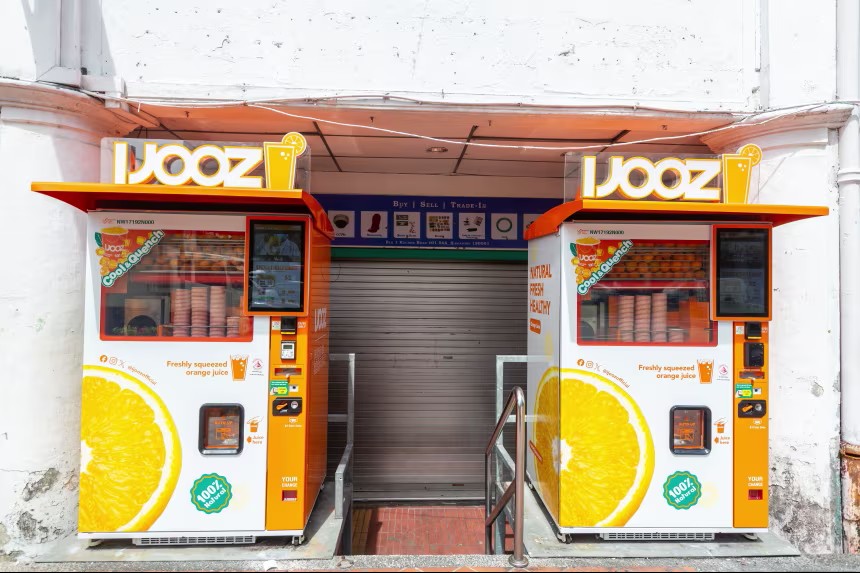
An 18-year-old French student is facing potential jail time after allegedly tampering with a vending machine at a shopping centre on March 12. According to Singapore police, the teenager – identified as Didier Gaspard Owen Maximilien – is accused of licking a straw from an orange juice vending machine before placing it back into the dispenser.
If proven, the act could carry significant legal consequences. He has been charged with two offences – public nuisance and mischief – under Singapore law.
The public nuisance charge is punishable by up to three months’ imprisonment and/or a fine of up to S$2,000, equivalent to roughly RM6,200. The more serious mischief charge carries a potential jail term of up to two years, a fine, or both.
For many observers in Malaysia, the case is a reminder of Singapore’s well-earned – and often debated – reputation as a “nanny state”, where seemingly minor infractions can carry disproportionate consequences. Yet it is precisely this firm approach that has underpinned the city-state’s image as one of the cleanest, safest, and most orderly urban environments in the world.

A VIRAL MOMENT OF FOOLISHNESS RESULTS IN A LEGAL RESPONSE
What makes this case particularly striking is not just the act itself, but how it came to light. The teenager allegedly filmed the incident and – of course – uploaded it to social media, where it quickly went viral and subsequently drew the attention of authorities.
It is a pattern that has become all too familiar in the digital age – individuals documenting questionable or outright illegal behaviour for online attention, only to find that the same footage becomes evidence against them. If you’re from a more non-digital generation and find yourself thinking that filming oneself breaking the law and posting it online is the height of idiocy, you’re not alone. Raymond Surette, a criminal justice professor in the U.S., summed it up pretty bluntly, saying, “Stupidity comes to mind. You might as well go down to the police station and commit the crime in the lobby.”
In an interview with The Guardian, media psychologist Pamela Rutledge explained, “Social media is the new way of bragging for those who commit crimes to gain a sense of self-power or self-importance. The audience is larger now and, perhaps, more seductive to those who are committing antisocial acts to fill personal needs of self-aggrandizement.”
Rutledge went on to suggest that the psychological allure of a large social media audience can overwhelm common sense and even a sense of self-preservation, leading to people filming and publishing the very evidence that law enforcement can then use to catch and prosecute them.
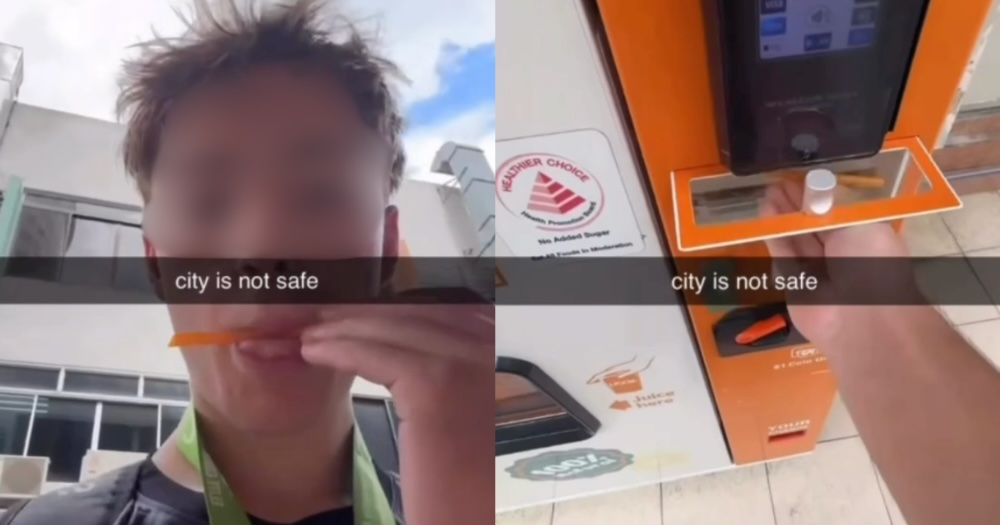
In this instance, what may have been intended as a fleeting prank has instead triggered a formal police investigation and criminal charges. For businesses, the impact is more immediate and tangible. IJOOZ, the company operating the vending machines, reportedly had to replace all 500 straws in the affected unit, highlighting the real-world consequences of what might otherwise be dismissed as a trivial act. Though in this case, the actual cost is admittedly quite minimal, that isn’t necessarily always the case.
The teenager is reportedly a student at the Singapore campus of ESSEC Business School, a French institution with an international presence. The school has confirmed his enrolment and indicated that it is in contact with his family, while declining further comment due to ongoing legal proceedings.
He has been offered bail set at S$5,000 – approximately RM15,500 – and is scheduled to appear in court again on May 22.
Singapore’s legal system is well-known for its consistency and firmness, particularly when it comes to maintaining public order and hygiene standards. While some may view the potential penalties as severe, they are nevertheless in line with the country’s broader approach to governance, where deterrence plays a central role.
A HISTORY OF STRICT ENFORCEMENT
This is far from the first time a foreign national has encountered the realities of Singapore’s legal framework. One of the most widely known cases dates back to 1993, when American teenager Michael Fay was convicted of vandalism and possession of stolen property.
Fay was sentenced to four months in prison and six strokes of the cane – a punishment later reduced to four strokes following international pressure, including intervention from then-U.S. President Bill Clinton. Despite the short-term diplomatic fallout, Singapore proceeded with the caning, underscoring its commitment to enforcing local laws regardless of nationality.

That case helped cement Singapore’s global image as a country unwilling to compromise on discipline and order, even under external scrutiny.
From a Malaysian standpoint, the contrast is often noted. While Malaysia has its own legal framework governing public behaviour, enforcement generally tends to be less rigid in everyday scenarios. The Singapore model, by comparison, prioritizes strict compliance and swift consequences.
However, observers have noted that cases like this also highlight a broader point that transcends borders – personal responsibility, particularly in an era where actions are so easily recorded and shared.
The idea of filming oneself committing a potentially unlawful act and then broadcasting it online understandably seems foolhardy, yet such incidents continue to surface with surprising regularity. In jurisdictions like Singapore, where surveillance, regulation, and enforcement are closely intertwined, the risks of such behaviour are especially pronounced – and the fact that people continue to do this is genuinely baffling.
For visitors, students, and expatriates alike, the takeaway is straightforward and applies in Malaysia as surely as it does in Singapore: understanding and respecting local laws is not optional. What might be brushed off as harmless in one country can carry serious implications in another. Particularly in a highly regulated environment like Singapore, the margin for error is slim – and the consequences, as this teenager may soon learn, can be far from trivial.