



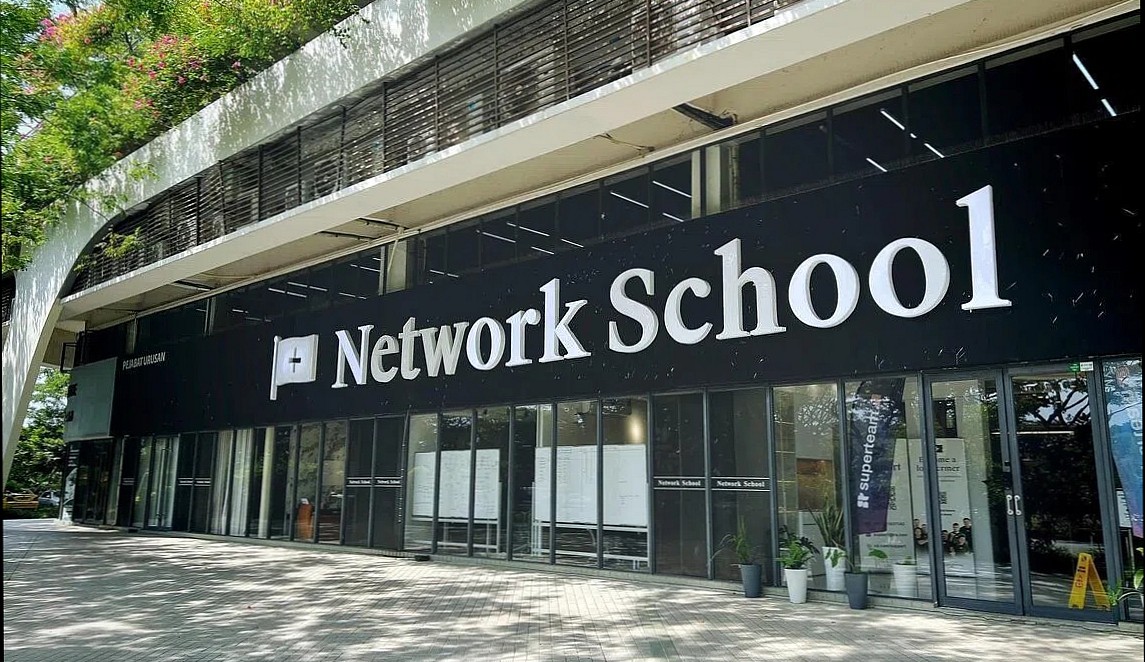
Johor authorities say the organization breached its licensing conditions, but the severity and timing of the action have led to questions about Malaysia’s treatment of foreign investors and digital talent.
In a surprising development, the Network School in Forest City has ceased operations after the Iskandar Puteri City Council revoked the business licence of its operator. The closure took effect in July 2026 following a series of inspections and investigations by local and federal authorities.
The decision is particularly significant because the Network School had become one of the more promising initiatives associated with the attempted revival of Forest City.
Built largely on reclaimed land off the Johor coast, Forest City was conceived as an ambitious new urban development close to Singapore. Although connected to the mainland by a bridge, much of the development sits on an artificial island. It was marketed heavily to Chinese buyers, but changing regulations, restrictions on the movement of money from China, the pandemic, and the financial difficulties of developer Country Garden all contributed to slower-than-expected growth.
The large number of unoccupied apartments subsequently earned Forest City an international reputation as a “ghost city”. In response, the Malaysian government introduced several initiatives intended to attract residents and investment, including its designation as a Special Financial Zone (SFZ), making it a duty-free island and creating a special SFZ MM2H visa for people who purchased property there with more attractive conditions than the national MM2H visa
These initiatives have generated some renewed interest, although progress has remained gradual. Forest City is generally well-maintained, and its hotels, golf courses, restaurants, and retail outlets tend to attract more visitors at weekends. Nevertheless, the many sparsely occupied residential towers remain a visible reminder that the development has not yet achieved its original ambitions.
A DIFFERENT KIND OF SCHOOL
The arrival of the Network School therefore appeared to offer Forest City something it badly needed: an active community of entrepreneurs, technology professionals, investors, and content creators.
Despite its name, the Network School was not a typical academic institution offering recognized qualifications. It described itself as a residential technology community and “startup society,” bringing together entrepreneurs, remote workers and other participants for programmes, workshops, and collaborative projects.
It was founded by Balaji Srinivasan, a prominent American technology investor and former chief technology officer of cryptocurrency platform Coinbase. Srinivasan argued that the project could help turn Forest City into a centre for international technology talent and entrepreneurship.
The situation changed rapidly after allegations appeared on social media claiming that Israeli nationals were participating in the programme, potentially using passports from other countries.
Malaysia does not maintain diplomatic relations with Israel and generally prohibits the entry of Israeli passport holders. The allegations therefore prompted considerable public and political attention, followed by an investigation involving the Immigration Department and other government agencies.
However, an inspection of 266 foreign nationals from 40 countries found that all those examined possessed valid immigration documents based on the records available at the time. Officials said that further checks would continue to ensure compliance with immigration conditions and other relevant laws.
LICENSING BREACHES IDENTIFIED
Attention subsequently shifted to the organization’s business and premises licences.
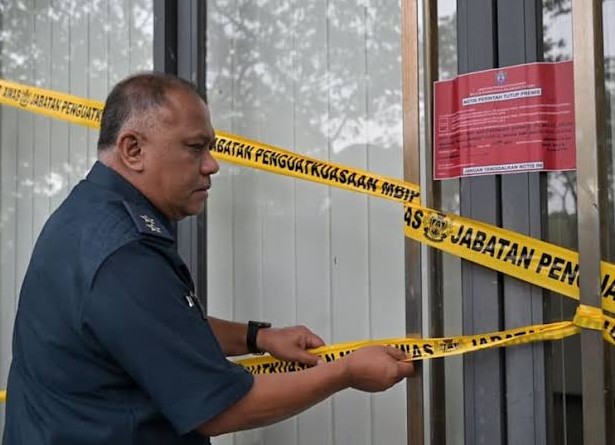
Authorities said the Network School was operating from two premises, one of which did not have a valid business licence. The council also found that activities were allegedly being conducted beyond those permitted under the existing office licence, and that the wording or details displayed on its signboards did not comply with the approved advertising licence.
Srinivasan said he considered these as technical matters that could be corrected. He acknowledged that the co-working space had been created by joining two neighbouring units, but that only one side had been properly licensed. He also said the organization had initially been given time to address both the premises and signboard issues.
Nevertheless, after reviewing inspection reports, enforcement findings and representations submitted by the company, the city council revoked the operator’s business licence and ordered all activities to cease. Johor Menteri Besar, Onn Hafiz Ghazi said the authorities had followed due process and stressed that no investor or organization could be placed above Malaysian law.
A QUESTION OF PROPORTIONALITY
Businesses operating in Malaysia must, of course, comply with local licensing, immigration, and premises regulations. The government is entitled to investigate allegations and take action where genuine breaches are discovered.
What remains unclear is whether the licensing violations were sufficiently serious to justify the complete closure of the operation, rather than resulting in a warning, fine, or defined period in which the problems could be corrected.
The sequence of events has inevitably created the impression that relatively ordinary licensing matters became considerably more serious after the controversy surrounding the rumoured presence of Israeli nationals. The initial immigration inspection did not find any problems or invalid travel documents among the people examined, although authorities said that further investigations were continuing.
This does not prove that the closure was politically motivated or that other concerns did not exist. The authorities may also possess additional information that has not been disclosed publicly. However, in the absence of a fuller explanation, the severity of the action does appear somewhat disproportionate.
Srinivasan has reacted strongly, warning that the episode could damage Malaysia’s efforts to attract international technology companies, entrepreneurs, and investors. Following the closure, he announced that Network School had signed an agreement to establish a new campus in Kazakhstan.
The loss is therefore not limited to one organization. Forest City has spent years trying to overcome its negative image and attract exactly the kind of active, internationally connected community that the Network School appeared capable of creating. Malaysia obviously expects foreign investors to obey its laws, but investors expect those regulations to be applied transparently, consistently, and proportionately.
If more serious violations have occurred, we hope the authorities will explain them. If the stated breaches of the licensing rules were the principal reason for the closure, then questions will remain over whether shutting down the entire operation was really the most constructive response.
At a time when both Forest City and Malaysia are seeking to present themselves as welcoming destinations for global investment and digital talent, greater transparency would help ensure that this episode does not cause lasting reputational damage.