

A beloved bestseller capturing the quirks of Malaysian English is back with a new edition, offering more words, sharper humour, and an affectionately insightful look at the country’s linguistic mash-up.
In a country as linguistically rich as Malaysia, it is perhaps inevitable that language evolves into something that’s… well, uniquely its own, lah. English, widely used as a common thread across communities, has been reshaped by Malay, Chinese dialects, Tamil, and countless local expressions. The result is something instantly recognizable to anyone who has spent time here – a lively, expressive hybrid known simply as Manglish.
The latest edition of Manglish: Malaysian English at Its Wackiest embraces that identity with renewed energy, expanding on a formula that has already earned the book a loyal following. First released to considerable acclaim, the updated version builds on its success with new words, fresh expressions, and an even broader snapshot of how Malaysians actually speak.
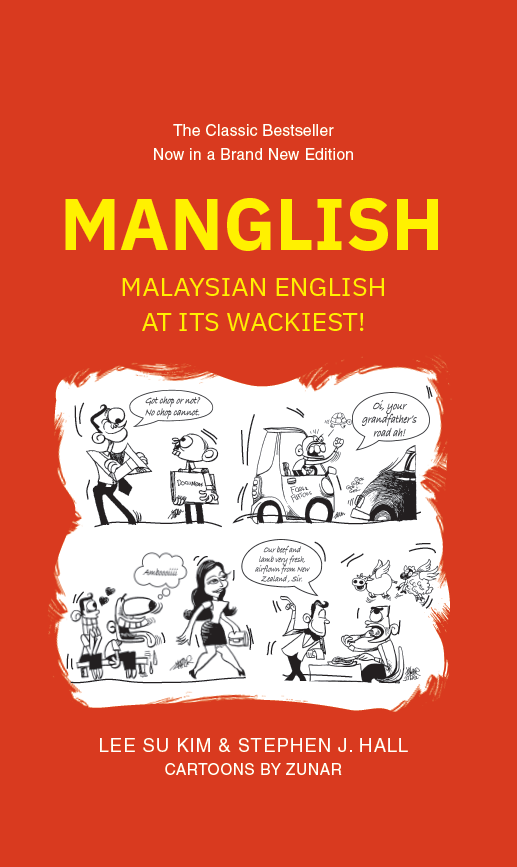
Compiled by Malaysian educator and cultural observer Dr Lee Su Kim, in collaboration with resident expat and former professor Dr Stephen J. Hall, the book continues to draw from real conversations heard in everyday settings – from kopitiams to classrooms, and from office banter to casual street exchanges. These snippets are not merely amusing; they form the backbone of a language that is both functional and, we would argue, deeply cultural.
At its core, the book operates as a kind of informal dictionary, offering explanations of commonly used Manglish terms and phrases, how they are used, and what they reveal about Malaysian communication styles. The entries are concise, often humorous, and occasionally surprising, even for locals, who will spend most of their time with the book smiling and nodding. For newcomers, the pages serve as a practical guide to navigating conversations that may otherwise feel puzzling despite being rooted in English.
What sets this edition apart is its expanded scope. While the earlier version, which we reviewed back in 2019, already captured a wide range of expressions, the latest update reflects how the local lingo continues to evolve. New idioms, updated usages, and additional cultural references ensure that the book remains relevant in an ever-changing linguistic landscape.
Adding to its appeal, certainly for us, are the illustrations by well-known cartoonist Zunar, whose sketches inject an extra layer of humour and local flavour, not to mention a dash of real talent and artistic flair. His visual interpretations complement the text, turning familiar phrases into memorable snapshots of Malaysian life. The result is a book that is as enjoyable to browse and “bounce around” in as it is to read sequentially from cover to cover.
Beyond its humour, the book offers insight into how language functions in a multicultural society, and it’s not hard to recognize the scholarly approach and depth of knowledge that underpins the lighthearted presentation. Manglish often prioritizes clarity and efficiency over strict grammatical rules, relying on shared understanding rather than formal structure. Expressions such as “Where got?” to indicate disbelief, or the emphatic “Best!” to signal approval, may not conform to standard English, but they are widely understood here across cultural lines in Malaysia
The influence of other languages is equally evident. Words like tapau (to take away food) from Cantonese, or belanja (to treat someone) from Malay, are seamlessly integrated into everyday speech. These borrowings are not treated as foreign, but as part of a shared national “linguistic toolkit” that we think reflects Malaysia’s charm and diversity.
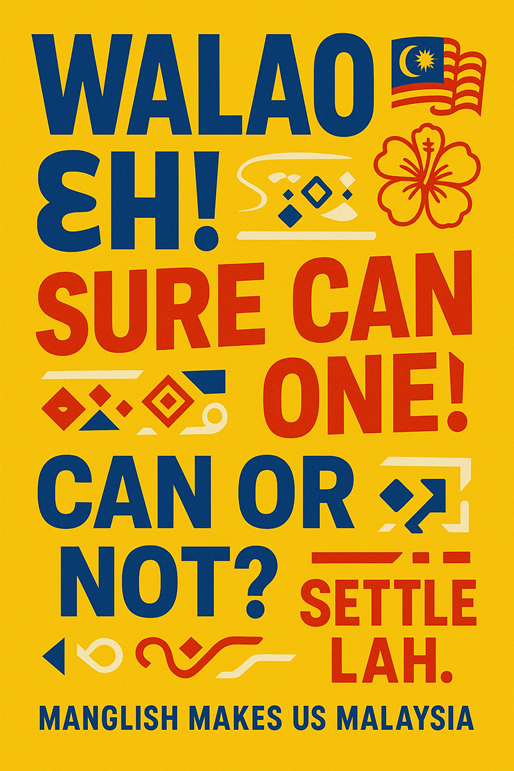
The book also highlights the subtle use of sentence-ending particles – ‘lah’, ‘leh’, and ‘wan’, among others – which add tone, emphasis (or softness), or just a general nuance that might be lacking without their use. These small additions often carry meaning that goes beyond the words themselves, shaping how a sentence is received. For those unfamiliar with them, they can no doubt be perplexing; for those who use them daily, they are second nature.
Importantly, Manglish is not presented as “incorrect” English, which we quite appreciated, but rather as a legitimate, living form of communication. It is the language Malaysians turn to when they want to connect, to joke, or to speak without formality. In that sense, it reflects not just how people speak, but how they relate to one another – and isn’t that the core function of communication?
The new edition underscores this idea quite well, encouraging readers to appreciate the humour and creativity embedded in everyday speech.
For Malaysians, the book offers a sense of familiarity, humour, and maybe even nostalgia, capturing and celebrating phrases that may otherwise go unnoticed. For expats and visitors, it serves as both a guide and an icebreaker, helping to bridge the gap between formal English and the language heard on the ground.
Ultimately, we believe Manglish: Malaysian English at Its Wackiest succeeds as both a guidebook and an entertaining read because it understands its subject well. It recognizes that language is not static, and that in Malaysia, it is constantly being reshaped by culture, context, and community. This latest edition reinforces that point with wit, warmth, and a clear affection for the way Malaysians speak. Whether you’re a local looking for an insightful compendium of the sometimes quirky language that drives daily life in your home country or an expat looking to enrich your time in Malaysia through a deeper understanding of the local cross-cultural lingo, this book is for you.
Manglish: Malaysian English at Its Wackiest is available at good booksellers throughout Malaysia, through Amazon (e-book version also available), and we also found it online through the Popular website HERE. You may also read more about it on Google Books HERE.
To read our own ExpatGo article on the benefits of speaking Manglish, just CLICK HERE!