



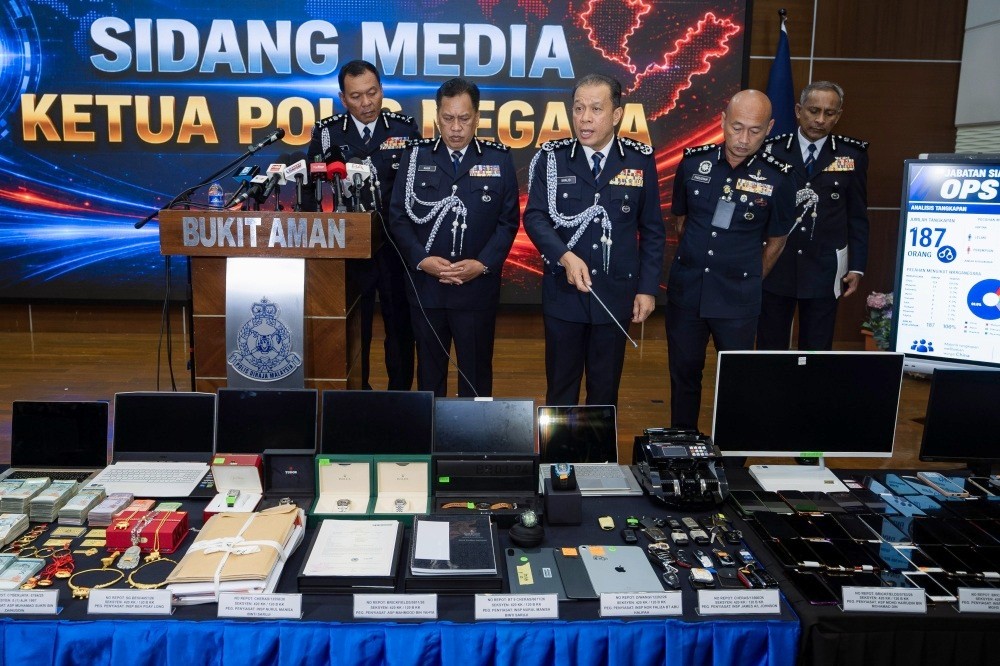
A major police crackdown in the Klang Valley has uncovered just how deeply embedded international scam syndicates have become in Malaysia – but the operation also highlights an increasingly aggressive response from the authorities.
Malaysia’s reputation as one of Southeast Asia’s most connected and business-friendly nations has brought enormous economic benefits over the years. Unfortunately, those same advantages have also made the country increasingly attractive to international scam syndicates.
In a major recent operation, the Royal Malaysia Police, more commonly known as the PDRM, arrested 187 suspects from nine countries during a sweeping crackdown on online scam operations based in the Klang Valley. The operation, dubbed Op Teguh 2.0, involved 46 coordinated raids on residential properties believed to be functioning as scam centres.
According to Inspector-General of Police Datuk Seri Khalid Ismail, the syndicates were far from localized operations. Instead, they appeared to involve cross-border criminal networks working collaboratively while using Malaysia as a regional operating base.
Among those arrested were suspects from China, Japan, Vietnam, Indonesia, Laos, Thailand, the Philippines, Myanmar, and Malaysia itself. In total, police detained 151 men and 36 women, while seizing assets estimated to be worth nearly RM58 million.
The haul was staggering even by modern cybercrime standards. Authorities confiscated luxury properties, high-end vehicles, designer goods, gold bars, cryptocurrency assets, cash, and hundreds of digital devices allegedly linked to the operations.
The syndicates reportedly targeted victims across East Asia using a wide range of tactics, including fake investment schemes, romance scams, illegal online gambling operations, and impersonation scams involving fake Japanese police officers communicating through Telegram.
AN APPEALING OPERATIONAL BASE
Malaysia has unfortunately become an increasingly attractive location for these activities for several reasons. The country enjoys strong internet infrastructure, relatively affordable living costs, extensive regional flight connectivity, and comparatively easy movement within Southeast Asia. Visa-free entry arrangements for certain nationalities, while valuable for tourism and business, can also be exploited by organized criminal groups.
Cybersecurity analysts and regional law enforcement agencies have repeatedly warned that scam operations across Southeast Asia have become more sophisticated, more international in scale and scope, and dramatically more lucrative in recent years. The United Nations Office on Drugs and Crime (UNODC) has previously highlighted how organized scam compounds have proliferated across parts of the region, generating billions of dollars annually through online fraud.
Malaysia, however, differs somewhat from the more notorious scam-centre hotspots elsewhere in the region. Rather than sprawling compounds hidden in remote border towns, many Malaysian operations appear to function from ordinary condominiums and rented residences in urban areas, allowing syndicates to blend quietly into normal city life.
That reality makes successful enforcement operations all the more important.

PRAISE FOR PDRM
To the PDRM’s credit, Op Teguh 2.0 appears to have been both extensive and highly coordinated. Investigations are continuing under multiple laws, including provisions related to fraud, organised crime, computer misuse, and money laundering. Authorities are also working closely with the Immigration Department and other agencies to examine how suspects entered and operated within the country.
Given the scale of online scam activity affecting Malaysians today, the crackdown will likely be welcomed by the public. Scam-related losses in Malaysia have surged sharply in recent years, with police and financial institutions repeatedly warning about increasingly convincing fraud tactics. Fake parcel delivery messages, Macau scams, bogus investment platforms, romance scams, fake bank calls, and impersonation schemes have all become distressingly common.
The uncomfortable reality is that virtually anyone can become a target.
While Malaysia’s openness and connectivity remain important strengths, they also create vulnerabilities that organized criminal groups are clearly eager to exploit. The challenge now is balancing accessibility with stronger enforcement, tighter oversight, and greater public awareness.
Operations like Op Teguh 2.0 suggest the authorities in Malaysia are taking that challenge quite seriously, and that’s something to be applauded.
Sources: Malay Mail; Royal Malaysia Police (PDRM); United Nations Office on Drugs and Crime (UNODC); public cybersecurity advisories and regional scam trend reports.